
We provide real 1Z0-071 exam questions and answers braindumps in two formats. Download PDF & Practice Tests. Pass Oracle 1Z0-071 Exam quickly & easily. The 1Z0-071 PDF type is available for reading and printing. You can print more and practice many times. With the help of our Oracle 1Z0-071 dumps pdf and vce product and material, you can easily pass the 1Z0-071 exam.
Also have 1Z0-071 free dumps questions for you:
NEW QUESTION 1
View the Exhibit and examine the structure of the SALES and PRODUCTS tables. (Choose two.)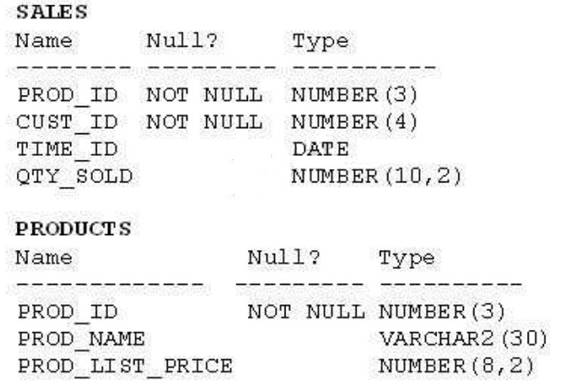
In the SALES table, PROD_ID is the foreign key referencing PROD_ID in the PRODUCTS table. You must list each product ID and the number of times it has been sold.
Examine this query which is missing a JOIN operator: SQL > SELECT p.prod_id, count(s.prod_id)
FROM products p sales s ON p.prod_id = s.prod_id
GROUP BY p.prod_id;
Which two JOIN operations can be used to obtain the required output?
- A. FULL OUTER JOIN
- B. JOIN
- C. LEFT OUETR JOIN
- D. RIGHT OUTER JOIN
Answer: AC
NEW QUESTION 2
Examine the structure of the PROMOTIONS table: (Choose the best answer.)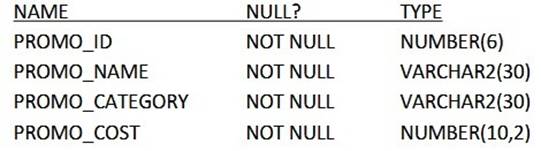
Management requires a report of unique promotion costs in each promotion category. Which query would satisfy this requirement?
- A. SELECT DISTINCT promo_category, promo_cost FROM promotions ORDER BY 1
- B. SELECT promo_category, DISTINCT promo_cost FROM promotions
- C. SELECT DISTINCT promo_cost, promo_category FROM promotions
- D. SELECT DISTINCT promo_cost, DISTINCT promo_category FROM promotions;
Answer: A
NEW QUESTION 3
Using the CUSTOMERS table, you need to generate a report that shows 50% of each credit amount in each income level. The report should NOT show any repeated credit amounts in each income level.
Which query would give the required result?
- A. SELECT cust_income_level || ‘ ’ || cust_credit_limit * 0.50 AS “50% Credit Limit” FROM customers.
- B. SELECT DISTINCT cust_income_level || ‘ ’ || cust_credit_limit * 0.50 AS “50% Credit Limit” FROM customers.
- C. SELECT DISTINCT cust_income_level, DISTINCT cust_credit_limit * 0.50 AS “50% Credit Limit” FROM customers.
- D. SELECT cust_income_level, DISTINCT cust_credit_limit * 0.50 AS “50% Credit Limit” FROM customers
Answer: B
NEW QUESTION 4
Examine the following query:
SQL> SELECT prod_id, amount_sold FROM sales
ORDER BY amount_sold
FETCH FIRST 5 PERCENT ROWS ONLY;
What is the output of this query?
- A. It displays 5 percent of the products with the highest amount sold.
- B. It displays the first 5 percent of the rows from the SALES table.
- C. It displays 5 percent of the products with the lowest amount sold.
- D. It results in an error because the ORDER BY clause should be the last clause.
Answer: C
Explanation:
References:
https://oracle-base.com/articles/12c/row-limiting-clause-for-top-n-queries-12cr1
NEW QUESTION 5
You issued the following command: SQL> DROP TABLE employees; Which three statements are true?
- A. All uncommitted transactions are committed.
- B. All indexes and constraints defined on the table being dropped are also dropped.
- C. Sequences used in the employees table become invalid.
- D. The space used by the employees table is reclaimed immediately.
- E. The employees table can be recovered using the rollback command.
- F. The employees table is moved to the recycle bin
Answer: ABF
NEW QUESTION 6
View the Exhibit and examine the details of PRODUCT_INFORMATION table.
PRODUCT_NAME CATEGORY_ID SUPPLIER_ID
Inkjet C/8/HQ 12
102094
Inkjet C/4 12
102090
LaserPro 600/6/BW 12
102087
LaserPro 1200/8/BW 12
102099
Inkjet B/6 12
102096
Industrial 700/ID 12
102086
Industrial 600/DQ 12
102088
Compact 400/LQ 12
102087
Compact 400/DQ 12
102088
HD 12GB /R 13
102090
HD 10GB /I 13
102071
HD 12GB @7200 /SE 13
102057
HD 18.2GB @10000 /E 13
102078
HD 18.2GB @10000 /I 13
102050
HD 18GB /SE 13
102083
HD 6GB /I 13
102072
HD 8.2GB@5400 13
102093
You have the requirement to display PRODUCT_NAME from the table where the CATEGORY_ID column has values 12 or 13, and the SUPPLIER_ID column has the value 102088. You executed the following SQL statement:
SELECT product_name FROM product_information
WHERE (category_id = 12 AND category_id = 13) AND supplier_id = 102088; Which statement is true regarding the execution of the query?
- A. It would not execute because the same column has been used in both sides of the AND logical operator to form the condition.
- B. It would not execute because the entire WHERE clause condition is not enclosed within the parentheses.
- C. It would execute and the output would display the desired result.
- D. It would execute but the output would return no rows.
Answer: D
NEW QUESTION 7
Examine the commands used to create DEPARTMENT_DETAILS and COURSE_DETAILS: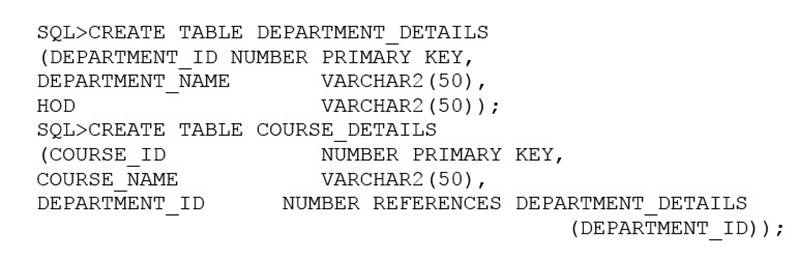
You want to generate a report that shows all course IDs irrespective of whether they have corresponding department IDs or not but no department IDs if they do not have any courses.
Which SQL statement must you use?
- A. SELECT course_id, department_id, FROM department_details d RIGHT OUTER JOIN course_details c USING (department_id)
- B. SELECT c.course_id, d.department_id FROM course_details c RIGHT OUTER JOIN.department_details d ON (c.depatrment_id=d.department_id)
- C. SELECT c.course_id, d.department_id FROM course_details c FULL OUTER JOIN department_details d ON (c.department_id=
- D. department_id)
- E. SELECT c.course_id, d.department_id FROM course_details c FULL OUTER JOIN department_details d ON (c.department_id<>
- F. department_id)
Answer: C
NEW QUESTION 8
You execute the SQL statement: SQL> CREATE TABLE citizens
(citizen_id CHAR (10) PRIMARY KEY, last_name VARCHAR2 (50) NOT NULL, first_name VARCHAR2 (50),
address VARCHAR2 (100),
city VARCHAR2 (30) DEFAULT ‘SEATTLE’ NOT NULL,
CONSTRAINT cnames CHECK (first_name<>last_name) ); What is the outcome?
- A. It fails because the NOT NULL and DEFAULT options cannot be combined for the same column.
- B. It succeeds and CITY can contain only ‘SEATTLE’ or null for all rows.
- C. It fails because the condition for the CANAMES constraint is not valid.
- D. It succeeds and an index is crated for CITIZEN_ID.
Answer: A
NEW QUESTION 9
Evaluate the following statement. INSERT ALL
WHEN order_total < 10000 THEN INTO small_orders
WHEN order_total > 10000 AND order_total < 20000 THEN INTO medium_orders
WHEN order_total > 200000 AND order_total < 20000 THEN INTO large_orders
SELECT order_id, order_total, customer_id FROM orders;
Which statement is true regarding the evaluation of rows returned by the subquery in the INSERT statement?
- A. They are evaluated by all the three WHEN clauses regardless of the results of the evaluation of any other WHEN clause.
- B. They are evaluated by the first WHEN claus
- C. If the condition is true, then the row would be evaluated by the subsequent WHEN clauses.
- D. They are evaluated by the first WHEN claus
- E. If the condition is false, then the row would be evaluated by the subsequent WHEN clauses.
- F. The insert statement would give an error because the ELSE clause is not present for support in case none of WHEN clauses are true.
Answer: A
Explanation:
References:
http://psoug.org/definition/WHEN.htm
NEW QUESTION 10
Which two are the minimal requirements for a self-join? (Choose two.)
- A. Only equijoin conditions may be used in the query.
- B. Outer joins must not be used in the query.
- C. There must be a condition on which the self-join is performed.
- D. No other condition except the self-join may be specified.
- E. The table used for the self-join must have two different alias names in the query.
Answer: CE
NEW QUESTION 11
View the Exhibit and examine the structure of ORDERS and CUSTOMERS tables. (Choose the best answer.)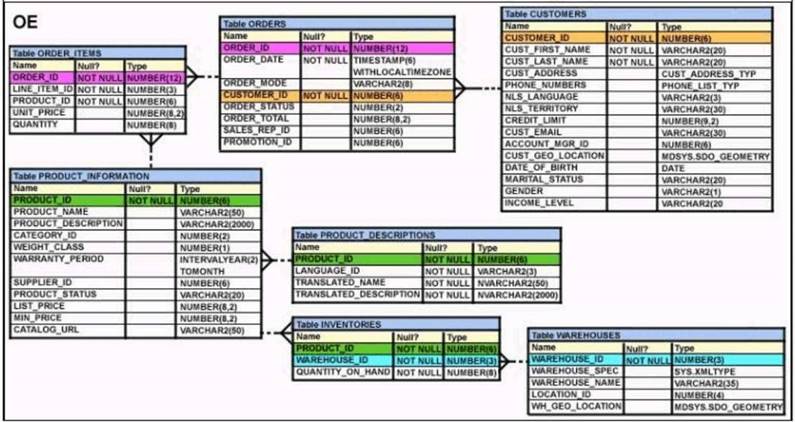
You executed this UPDATE statement: UPDATE
( SELECT order_date, order_total, customer_id FROM orders) Set order_date = '22-mar-2007'
WHERE customer_id IN
(SELECT customer_id FROM customers
WHERE cust_last_name = 'Roberts' AND credit_limit = 600); Which statement is true regarding the execution?
- A. It would not execute because a subquery cannot be used in the WHERE clause of an UPDATE statement.
- B. It would not execute because two tables cannot be referenced in a single UPDATE statement.
- C. It would execute and restrict modifications to the columns specified in the SELECT statement.
- D. It would not execute because a SELECT statement cannot be used in place of a table name.
Answer: C
NEW QUESTION 12
Examine the structure of the BOOKS_TRANSACTIONS table: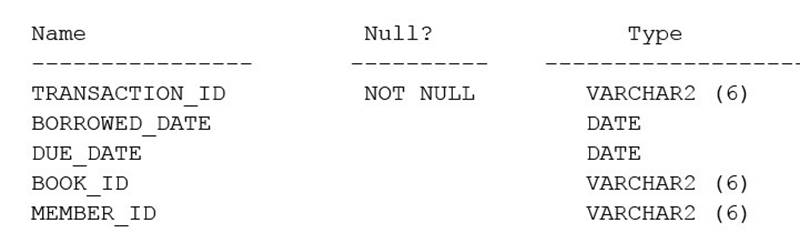
You want to display the member IDs, due date, and late fee as $2 for all transactions. Which SQL statement must you execute?
- A. SELECT member_id AS "MEMBER ID", due_date AS "DUE DATE", $2 AS "LATE FEE" FROM BOOKS_TRANSACTIONS
- B. SELECT member_id AS "MEMBER ID", due_date AS "DUE DATE", '$2' AS "LATE FEE" FROM BOOKS_TRANSACTIONS
- C. SELECT member_id 'MEMBER ID', due_date 'DUE DATE', '$2 AS LATE FEE' FROM BOOKS_TRANSACTIONS;
- D. SELECT member_id AS MEMBER_ID, due_date AS DUE_DATE, $2 AS LATE_FEE FROM BOOKS_TRANSACTIONS
Answer: B
NEW QUESTION 13
Examine the create table statements for the stores and sales tables.
SQL> CREATE TABLE stores(store_id NUMBER(4) CONSTRAINT store_id_pk PRIMARY KEY, store_name VARCHAR2(12), store_address VARCHAR2(20), start_date DATE);
SQL> CREATE TABLE sales(sales_id NUMBER(4) CONSTRAINT sales_id_pk PRIMARY KEY, item_id NUMBER(4), quantity NUMBER(10), sales_date DATE, store_id NUMBER(4), CONSTRAINT store_id_fk FOREIGN KEY(store_id) REFERENCES stores(store_id));
You executed the following statement: SQL> DELETE from stores
WHERE store_id=900;
The statement fails due to the integrity constraint error:
ORA-02292: integrity constraint (HR.STORE_ID_FK) violated
Which three options ensure that the statement will execute successfully?
- A. Disable the primary key in the STORES table.
- B. Use CASCADE keyword with DELETE statement.
- C. DELETE the rows with STORE_ID = 900 from the SALES table and then delete rows from STORES table.
- D. Disable the FOREIGN KEY in SALES table and then delete the rows.
- E. Create the foreign key in the SALES table on SALES_ID column with on DELETE CASCADE option.
Answer: CDE
NEW QUESTION 14
Which statements are true? (Choose all that apply.)
- A. The data dictionary is created and maintained by the database administrator.
- B. The data dictionary views consists of joins of dictionary base tables and user-defined tables.
- C. The usernames of all the users including the database administrators are stored in the data dictionary.
- D. The USER_CONS_COLUMNS view should be queried to find the names of the columns to which a constraint applies.
- E. Both USER_OBJECTS and CAT views provide the same information about all the objects that are owned by the user.
- F. Views with the same name but different prefixes, such as DBA, ALL and USER, use the same base tables from the data dictionary.
Answer: CDF
Explanation:
References:
https://docs.oracle.com/cd/B10501_01/server.920/a96524/c05dicti.htm
NEW QUESTION 15
Evaluate the following CRTEATE TABLE commands:
CREATE_TABLE orders
(ord_no NUMBER (2) CONSTRAINT ord_pk PRIMARY KEY,
ord_date DATE, cust_id NUMBER (4) );
CREATE TABLE ord_items (ord _no NUMBER (2),
item_no NUMBER(3),
qty NUMBER (3) CHECK (qty BETWEEEN 100 AND 200),
expiry_date date CHECK (expiry_date> SYSDATE), CONSTRAINT it_pk PRIMARY KEY (ord_no, item_no),
CONSTARAINT ord_fk FOREIGN KEY (ord_no) REFERENCES orders (ord_no) ); Why would the ORD_ITEMS table not get created?
- A. SYSDATE cannot be used with the CHECK constraint.
- B. The BETWEEN clause cannot be used for the CHECK constraint.
- C. The CHECK constraint cannot be placed on columns having the DATE data type.
- D. ORD_NO and ITEM_NO cannot be used as a composite primary key because ORD_NO is also the FOREIGN KEY.
Answer: A
NEW QUESTION 16
View the Exhibit and examine the structure of the PROMOTION table.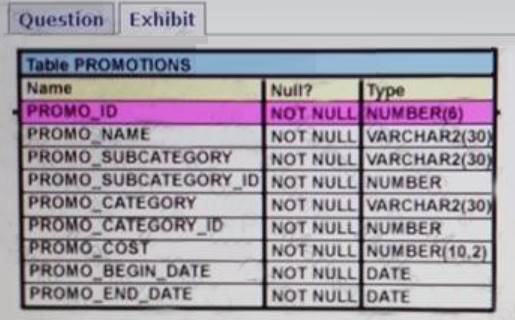
You have to generate a report that displays the promo named start data for all promos that started after that last promo in the ‘INTTERNET’ category.
- A. Select promo_name, promo_being_date FROM promoptions WHERE promo_being_data > ANY (SELCT promo_being-date FROM promotionsWHERE promo_category = ‘INTERNET’
- B. SELECT promo_neme, promo_being_date FROM promotions WHERE promo_being_date > All (SELECT promo_beinjg-date FROM promotionsWHERE promo_category =’INTERNET’ );
- C. SELECT promo-name, promo-being _date FROM promotionsWhere promo_being_data >ALL (SELECT MAX (promo_being-date) FROM promotions ) ANDPromo-category =’INTERNET’;
- D. SELECT promo-name, promo-being_date FROM promotion WHERE promo-being-date IN (SELECT promo_biing_date FROM promotionsWHERE promo_category=’INTYERNET’);
Answer: B
NEW QUESTION 17
Which three statements are true regarding single-row functions? (Choose three.)
- A. The data type returned, can be different from the data type of the argument that is referenced.
- B. They can return multiple values of more than one data type.
- C. They can accept only one argument.
- D. They can be nested up to only two levels.
- E. They can be used in SELECT, WHERE, and ORDER BY clauses.
- F. They can accept column names, expressions, variable names, or a user-supplied constants as arguments.
Answer: AEF
NEW QUESTION 18
In which normal form is a table, if it has no multi-valued attributes and no partial dependencies?
- A. second normal form
- B. first normal form
- C. third normal form
- D. fourth normal form
Answer: A
Explanation:
References:
https://blog.udemy.com/database-normal-forms/
NEW QUESTION 19
......
100% Valid and Newest Version 1Z0-071 Questions & Answers shared by Certshared, Get Full Dumps HERE: https://www.certshared.com/exam/1Z0-071/ (New 399 Q&As)
