
Our pass rate is high to 98.9% and the similarity percentage between our AZ-120 study guide and real exam is 90% based on our seven-year educating experience. Do you want achievements in the Microsoft AZ-120 exam in just one try? I am currently studying for the Microsoft AZ-120 exam. Latest Microsoft AZ-120 Test exam practice questions and answers, Try Microsoft AZ-120 Brain Dumps First.
Free demo questions for Microsoft AZ-120 Exam Dumps Below:
NEW QUESTION 1
You have an on-premises SAP environment hosted on VMware vSphere. You plan to migrate the environment to Azure by using Azure Site Recovery. You need to prepare the environment to support Azure Site Recovery.
What should you deploy first?
- A. an on-premises data gateway to vSphere
- B. Microsoft System Center Virtual Machine Manager (VMM)
- C. an Azure Backup server
- D. a configuration server to vSphere
Answer: D
Explanation:
When you set up disaster recovery for on-premises VMware VMs, Site Recovery needs access to the vCenter Server/vSphere host so that the Site Recovery process server can automatically discover VMs, and fail them over as needed. By default the process server runs on the Site Recovery configuration server. Add an account for the configuration server to connect to the vCenter Server/vSphere host.
References:
https://docs.microsoft.com/en-us/azure/site-recovery/vmware-azure-manage-vcenter
NEW QUESTION 2
You plan to deploy SAP application servers that run Windows Server 2021.
You need to use PowerShell Desired State Configuration (DSC) to configure the SAP application server once the servers are deployed.
Which Azure virtual machine extension should you install on the servers?
- A. the Azure DSC VM Extension
- B. the Azure virtual machine extension
- C. the Azure Chef extension
- D. the Azure Enhanced Monitoring Extension for SAP
Answer: A
Explanation:
The Azure Desired State Configuration (DSC) VM Extension is updated as-needed to support enhancements and new capabilities delivered by Azure, Windows Server, and the Windows Management Framework (WMF) that includes Windows PowerShell.
References:
https://docs.microsoft.com/en-us/powershell/scripting/dsc/getting-started/azuredscexthistory
NEW QUESTION 3
You have an on-premises SAP environment.
Backups are performed by using tape backups. There are SO TB of backups.
A Windows file server has BMP images of checks used by SAP Finance. There are 9 IB of images.
You need to recommend a method to migrate the images and the tape backups to Azure. The solution must maintain continuous replication of the images.
What should you include in the recommendation? To answer, select the appropriate options in the answer area. NOTE: Each correct selection is worth one point.
- A. Mastered
- B. Not Mastered
Answer: A
Explanation: 
NEW QUESTION 4
You have an Azure alert rule and action group as shown in the following exhibit.
Use the drop-down menus to select the answer choice that completes each statement based on the information presented in the graphic.
NOTE: Each correct selection is worth one point.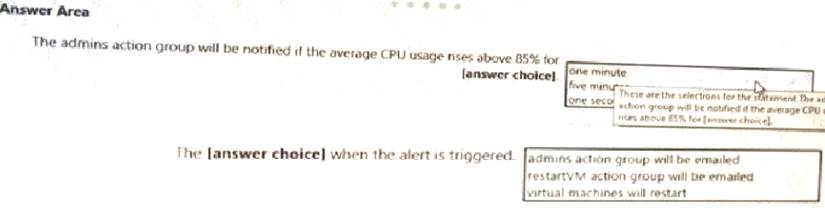
- A. Mastered
- B. Not Mastered
Answer: A
Explanation: 
NEW QUESTION 5
You plan to deploy an SAP environment on Azure.
During a bandwidth assessment, you identify that connectivity between Azure and an on-premises datacenter requires up to 5 Gbps.
You need to identify which connectivity method you must implement to meet the bandwidth requirement. The solution must minimize costs.
Which connectivity method should you identify?
- A. an ExpressRoute connection
- B. an Azure site-to-site VPN that is route-based
- C. an Azure site-to-site VPN that is policy-based
- D. Global VNet peering
Answer: B
Explanation:
Azure site-to-site VPN is cheaper. References:
https://docs.microsoft.com/en-us/azure/architecture/reference-architectures/hybrid-networking/vpn
NEW QUESTION 6
You are deploying an SAP environment on Azure that will use an SAP HANA database server.
You provision an Azure virtual machine for SAP HANA by using the M64s virtual machine SKU.
You need to set the swap space by using the Microsoft Azure Linux Agent (waagent) configuration file. Which two settings should you configure? Each correct answer presents part of the solution.
NOTE: Each correct selection is worth one point.
- A. ResourceDisk.EnableSwapEncryption=n
- B. AutoUpdate.Enabled=n
- C. ResourceDisk.SwapSizeMB=229376
- D. ResourceDisk.EnableSwap=y
Answer: CD
Explanation:
To create a swap file in the directory that's defined by the ResourceDisk.MountPoint parameter, you can update the /etc/waagent.conf file by setting the following three parameters:
ResourceDisk.Format=y ResourceDisk.EnableSwap=y ResourceDisk.SwapSizeMB=xx References:
https://support.microsoft.com/en-us/help/4010058/how-to-add-a-swap-file-in-linux-azure-virtual-machines
NEW QUESTION 7
You have an on-premises SAP environment. Application servers run on SUSE Linux Enterprise Server (SLES) servers. Databases run on SLES servers that have Oracle installed.
You need to recommend a solution to migrate the environment to Azure. The solution must use currently
deployed technologies whenever possible and support high availability.
What should you include in the recommendation? To answer, select the appropriate options in the answer area.
NOTE: Each correct selection is worth one point.
- A. Mastered
- B. Not Mastered
Answer: A
Explanation: 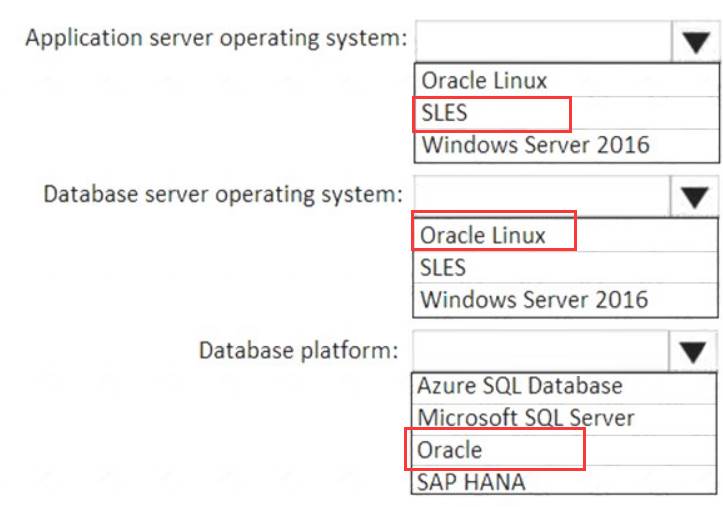
NEW QUESTION 8
You plan to deploy an SAP environment on Azure that will use Azure Availability Zones. Which load balancing solution supports the deployment?
- A. Azure Basic Load Balancer
- B. Azure Standard Load Balancer
- C. Azure Application Gateway v1 SKU
Answer: B
Explanation:
When you deploy Azure VMs across Availability Zones and establish failover solutions within the same Azure region, some restrictions apply: You can't use an Azure Basic Load Balancer to create failover cluster solutions based on Windows Server Failover Clustering or Linux Pacemaker. Instead, you need to use the Azure Standard Load Balancer SKU.
References:
https://docs.microsoft.com/en-us/azure/virtual-machines/workloads/sap/sap-ha-availability-zones
NEW QUESTION 9
You deploy an SAP environment on Azure.
Your company has a Service Level Agreement (SLA) of 99.99% for SAP. You implement Azure Availability Zones that have the following components:
* Redundant SAP application servers
* ASCS/ERS instances that use a failover cluster
* Database high availability that has a primary instance and a secondary instance
You need to validate the load distribution to the application servers. What should you use?
- A. SAP Solution Manager
- B. Azure Monitor
- C. SAPControl
- D. SAP Web Dispatcher
Answer: D
Explanation:
Load balancers. These are used to distribute traffic to virtual machines in the application-tier subnet. For high availability, use the built-in SAP Web Dispatcher, Azure Load Balancer, or network appliances, depending on the traffic type (such as HTTP or SAPGUI) or the required network services, such as Secure Sockets Layer (SSL) termination.
Reference:
https://docs.microsoft.com/en-us/azure/architecture/reference-architectures/sap/sap-netweaver
NEW QUESTION 10
You have an SAP ERP Central Component (SAP ECQ) environment on Azure.
You need to add an additional SAP application server to meet the following requirements:
• Provide the highest availability.
• Provide the fastest speed between the new server and the database. What should you do?
- A. Place the new server in a different Azure Availability Zone than the database.
- B. Place the new server in the same Azure Availability Set a? the database and the other application servers.
- C. Place the new server in the same Azure Availability Zone as the database and the other application servers.
Answer: A
NEW QUESTION 11
A company named Contoso, Ltd. has users across the globe. Contoso is evaluating whether to migrate SAP to Azure.
The SAP environment runs on SUSE Linux Enterprise Server (SLES) servers and SAP HANA databases. The Suite on HANA database is 4 TB.
You need to recommend a migration solution to migrate SAP application servers and the SAP HANA databases. The solution must minimize downtime.
Which migration solutions should you recommend? To answer, select the appropriate options in the answer area.
NOTE: Each correct selection is worth one point.
- A. Mastered
- B. Not Mastered
Answer: A
Explanation:
Box 1: Azure Site Recovery
Microsoft Azure Site Recovery (ASR) now supports SUSE Linux Enterprise Server 11 SP3/SP4 and SUSE Linux Enterprise Server 12 SP1/SP2/SP3. This is great for customers that are planning to migrate systems to Microsoft Azure or customers who need to have a business continuity strategy for their Azure deployments.
Azure Site Recovery enables SUSE customers to migrate their non-Azure virtual machines or physical servers to Microsoft Azure virtual machines.
Box 2: System Copy for SAP Systems
In order to migrate an existing SAP HANA system into Azure, a SAP homogeneous system copy can be performed.
Reference: https://www.suse.com/c/asr_supports_suse/ https://www.netapp.com/us/media/tr-4746.pdf
NEW QUESTION 12
Note: This question is part of a series of questions that present the same scenario. Each question in the series contains a unique solution that might meet the stated goals. Some question sets might have more than one correct solution, while others might not have a correct solution.
After you answer a question in this section, you will NOT be able to return to it. As a result, these
questions will not appear in the review screen.
You have a complex SAP environment that has both ABAP- and Java-based systems. The current on-premises landscapes are based on SAP NetWeaver 7.0 (Unicode and Non-Unicode) running on Windows Server and Microsoft SQL Server.
You need to migrate the SAP environment to a HANA-certified Azure environment.
Solution: You upgrade to SAP NetWeaver 7.4, and then you migrate SAP to Azure by using Azure Site Recovery.
Does this meet the goal?
- A. Yes
- B. No
Answer: A
Explanation:
We need upgrade to SAP NetWeaver 7.4 before the migration. Then Azure Site Recovery is used for the migration to Azure.
Reference:
https://docs.microsoft.com/en-us/azure/site-recovery/vmware-azure-architecture
NEW QUESTION 13
You have an SAP environment on Azure that uses multiple subscriptions.
To meet GDPR requirements, you need to ensure that virtual machines are deployed only to the West Europe and North Europe Azure regions.
Which Azure components should you use?
- A. Azure resource locks and the Compliance admin center
- B. Azure resource groups and role-based access control (RBAC)
- C. Azure management groups and Azure Policy
- D. Azure Security Center and Azure Active Directory (Azure AD) groups
Answer: C
Explanation:
Azure Policy enables you to set policies to conform to the GDPR. Azure Policy is generally available today at no additional cost to Azure customers. You can use Azure Policy to define and enforce policies that help your cloud environment become compliant with internal policies as well as external regulations.
Azure Policy is deeply integrated into Azure Resource Manager and applies across all resources in Azure. Individual policies can be grouped into initiatives to quickly implement multiple rules. You can also use Azure Policy in a wide range of compliance scenarios, such as ensuring that your data is encrypted or remains in a specific region as part of GDPR compliance. Microsoft is the only hyperscale cloud provider to offer this level of policy integration built in to the platform for no additional charge.
References:
https://azure.microsoft.com/de-de/blog/new-capabilities-to-enable-robust-gdpr-compliance/
NEW QUESTION 14
You are deploying an SAP production landscape to Azure.
Your company’s chief information security officer (CISO) requires that the SAP deployment complies with ISO 27001.
You need to generate a compliance report for ISO 27001. What should you use?
- A. Azure Security Center
- B. Azure Log Analytics
- C. Azure Active Directory (Azure AD)
- D. Azure Monitor
Answer: A
NEW QUESTION 15
You are integrating SAP HANA and Azure Active Directory (Azure AD).
For each of the following statements, select Yes if the statement is true. Otherwise, select No.
NOTE: Each correct selection is worth one point.
- A. Mastered
- B. Not Mastered
Answer: A
Explanation:
Box 1: Yes
To configure Azure AD single sign-on with SAP HANA, perform the following steps:
*1. In the Azure portal, on the SAP HANA application integration page, select Single sign-on.
*2. On the Select a Single sign-on method dialog, select SAML/WS-Fed mode to enable single sign-on.
Box 2: No
Box 3: No
Key security considerations for deploying SAP on Azure References:
https://docs.microsoft.com/en-us/azure/active-directory/saas-apps/saphana-tutorial
NEW QUESTION 16
You plan to migrate an SAP ERP Central Component (SAP ECC) production system to Azure. You are reviewing the SAP EarlyWatch Alert report for the system.
You need to recommend sizes for the Azure virtual machines that will host the system.
Which two sections of the report should you review? Each correct answer presents a complete solution.
NOTE: Each correct selection is worth one point.
- A. Hardware Capacity
- B. Patch Levels under SAP Software Configuration
- C. Hardware Configuration under Landscape
- D. Database and ABAP Load Optimization
- E. Data Volume Management
Answer: AD
Explanation:
It is important to note that there are 2 types of data collected for Hardware Capacity. Performance Data - e.g. CPU and Memory utilization data.
Hardware Capacity data shown in the EWA is measuring CPU and Memory utilization data. This is known as Performance Data.
Configuration Data - e.g. OS information, CPU type.
It is also collecting system information about the host such as hardware manufacturer, CPU type etc. This is
known as Configuration Data.
NEW QUESTION 17
You plan to migrate an SAP environment to Azure.
You need to recommend a solution to migrate the SAP application servers to Azure. The solution must minimize downtime and changes to the environments.
What should you include in the recommendation?
- A. Azure Storage Explorer
- B. Azure Import/Export service
- C. AzCopy
- D. Azure Site Recovery
Answer: D
Explanation:
Site Recovery is used to manage and orchestrate disaster recovery of on-premises machines and Azure VMs. However, it can also be used for migration. Migration uses the same steps as disaster recovery with one exception. In a migration, failing machines over from your on-premises site is the final step. Unlike disaster recovery, you can't fail back to on-premises in a migration scenario.
References:
https://docs.microsoft.com/en-us/azure/site-recovery/migrate-tutorial-on-premises-azure
NEW QUESTION 18
You plan to migrate an SAP environment to Azure.
You need to create a design to facilitate end-user access to SAP applications over the Internet, while
restricting user access to the virtual machines of the SAP application servers. What should you include in the design?
- A. Configure a public IP address for each SAP application server
- B. Deploy an internal Azure Standard Load Balancer for incoming connections
- C. Use an SAP Web Dispatcher to route all incoming connections
- D. Configure point-to-site VPN connections for each user
Answer: C
Explanation:  A public internet user can reach the SAP Web-Dispatcher over port 443
 The SAP Web-Dispatcher can reach the SAP Application server over port 443 The App Subnet accepts traffic on port 443 from 10.0.0.0/24 The SAP Application server sends traffic on port 30015 to the SAP DB server The DB subnet accepts traffic on port 30015 from 10.0.1.0/24. Public Internet Access is blocked on both App Subnet and DB Subnet.
References:
https://azure.microsoft.com/en-in/blog/sap-on-azure-architecture-designing-for-security/
NEW QUESTION 19
You have an SAP environment on Azure.
You use Azure Site Recovery to protect an SAP production landscape.
You need to validate whether you can recover the landscape in the event of a failure. The solution must minimize the impact on the landscape.
Which four actions should you perform in sequence? To answer, move the appropriate actions from the list of actions to the answer area and arrange them in the correct order.
- A. Mastered
- B. Not Mastered
Answer: A
Explanation:
Step 1: Create a virtual network...
We recommended that for test failover, you choose a network that's isolated from the production recovery site network specific in the Compute and Network settings for each VM. By default, when you create an Azure virtual network, it is isolated from other networks. The test network should mimic your production network:
The test network should have same number of subnets as your production network. Subnets should have the same names.
The test network should use the same IP address range. Step 2: Add a public IP address...
Because Site Recovery does not replicate the cloud witness, we recommend that you deploy the cloud witness in the disaster recovery region.
Step 3: Shut down production virtual machines
Make sure that the primary VM is shut down when you run the test failover. Otherwise there will be two VMs with the same identity, running in the same network at the same time. This can lead to unexpected consequences.
Step 4: Select Test failover from the Recovery Plans blade References:
https://docs.microsoft.com/en-us/azure/site-recovery/site-recovery-test-failover-to-azure
NEW QUESTION 20
You have a large and complex SAP environment on Azure.
You are designing a training landscape that will be used 10 times a year.
You need to recommend a solution to create the training landscape. The solution must meet the following requirements: Minimize the effort to build the training landscape. Minimize costs.
In which order should you recommend the actions be performed for the first training session? To answer, move all actions from the list of actions to the answer area and arrange them in the correct order.
- A. Mastered
- B. Not Mastered
Answer: A
Explanation:
References:
https://docs.microsoft.com/en-us/azure/virtual-machines/workloads/sap/planning-guide
NEW QUESTION 21
You have an on-premises SAP environment.
Backups are performed by using tape backups. There are 50 TB of backups.
A Windows file server has BMP images of checks used by SAP Finance. There are 9 TB of images.
You need to recommend a method to migrate the images and the tape backups to Azure. The solution must maintain continuous replication of the images.
What should you include in the recommendation? To answer, select the appropriate options in the answer area.
NOTE: Each correct selection is worth one point.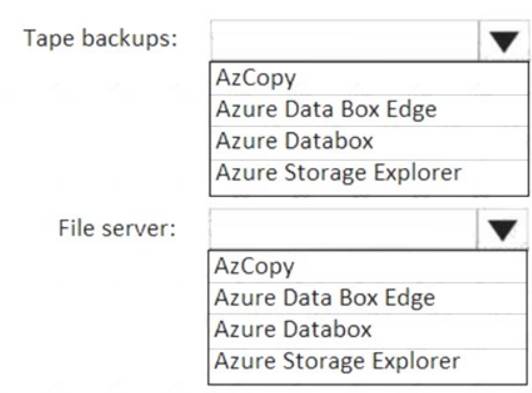
- A. Mastered
- B. Not Mastered
Answer: A
Explanation:
Tape backups: Azure DataBox
The Microsoft Azure Data Box cloud solution lets you send terabytes of data into Azure in a quick, inexpensive, and reliable way. The secure data transfer is accelerated by shipping you a proprietary Data Box storage device. Each storage device has a maximum usable storage capacity of 80 TB and is transported to your datacenter through a regional carrier. The device has a rugged casing to protect and secure data during the transit.
File server: Azure Storage Explorer
Azure Storage Explorer is an application which helps you to easily access the Azure storage account through any device on any platform, be it Windows, MacOS, or Linux. You can easily connect to your subscription and manipulate your tables, blobs, queues, and files.
NEW QUESTION 22
Note: This question is part of a series of questions that present the same scenario. Each question in the series contains a unique solution that might meet the stated goals. Some question sets might have more than one correct solution, while others might not have a correct solution.
After you answer a question in this section, you will NOT be able to return to it. As a result, these questions will not appear in the review screen.
You plan to migrate an SAP HANA instance to Azure.
You need to gather CPU metrics from the last 24 hours from the instance. Solution: You use DBA Cockpit from SAP GUI.
Does this meet the goal?
- A. Yes
- B. No
Answer: A
Explanation:
The SAP HANA cockpit provides a single point of access to a range of SAP HANA administration and monitoring tasks. It is used to monitor and ensure the overall health of the system.
The HANA Monitoring dashboard also visualizes key HANA Metrics of SAP HANA system. References:
https://developers.sap.com/tutorials/dt-monitoring-hana-part1.html
https://help.sap.com/viewer/afa922439b204e9caf22c78b6b69e4f2/2.10.0.0/en-US https://www.hanatutorials.com/p/hana-monitoring-dashboard.html
NEW QUESTION 23
A customer enterprise SAP environment plans to migrate to Azure. The environment uses servers that runs Windows Server 2021 and Microsoft SQL Server.
The environment is critical and requires a comprehensive business continuity and disaster recovery (BCDRJ strategy that minimizes the recovery point objective (RPO) and the recovery time objective (RTO).
The customer wants a resilient environment that has a secondary site that is at least 250 Kilometers away. You need to recommend a solution for the customer.
Which two solutions should you recommend? Each correct answer presents part ot the solution. NOTE; Each correct selection Is worth one point.
- A. an internal load balancer to route Internet traffic
- B. warm standby virtual machines in Azure Availability Zones.
- C. warn standby virtual machines in paired regions
- D. Warm standby virtual machine an Azure Availability Set that uses geo-redundant storage (GRS)
- E. Azure Traffic Manager to route incoming traffic.
Answer: CD
Explanation:
References:
https://docs.microsoft.com/en-us/azure/virtual-machines/workloads/sap/sap-hana-availability-one-region
NEW QUESTION 24
You are designing the backup for an SAP database.
You have an Azure Storage account that is configured as shown in the following exhibit.
Use the drop-down menus to select the answer choice that completes each statement based on the information presented in the graphic.
NOTE: Each correct selection is worth one point.
- A. Mastered
- B. Not Mastered
Answer: A
Explanation:
Box 1: standard solid-state drives (SSDs)
Standard SSD Managed Disks, a low-cost SSD offering, are optimized for test and entry-level production workloads requiring consistent latency.
Box 2: to another Azure region
Geo-redundant storage (GRS) copies your data synchronously three times within a single physical location in the primary region using LRS. It then copies your data asynchronously to a single physical location in a secondary region that is hundreds of miles away from the primary region.
References:
https://azure.microsoft.com/en-us/pricing/details/managed-disks/
https://docs.microsoft.com/en-us/azure/storage/common/storage-redundancy#geo-redundant-storage
NEW QUESTION 25
You have an SAP development landscape on Azure.
For each of the following statements, select Yes if the statement is true. Otherwise, select No. NOTE: Each correct selection is worth one point.
- A. Mastered
- B. Not Mastered
Answer: A
Explanation: 
NEW QUESTION 26
......
P.S. 2passeasy now are offering 100% pass ensure AZ-120 dumps! All AZ-120 exam questions have been updated with correct answers: https://www.2passeasy.com/dumps/AZ-120/ (108 New Questions)
