
Exam Code: AZ-220 (Practice Exam Latest Test Questions VCE PDF)
Exam Name: Microsoft Azure IoT Developer
Certification Provider: Microsoft
Free Today! Guaranteed Training- Pass AZ-220 Exam.
Check AZ-220 free dumps before getting the full version:
NEW QUESTION 1
You need to install the Azure IoT Edge runtime on a new device that runs Windows 10 IoT Enterprise. Which four actions should you perform in sequence? To answer, move the appropriate actions from the list of actions to the answer area and arrange them in the correct order.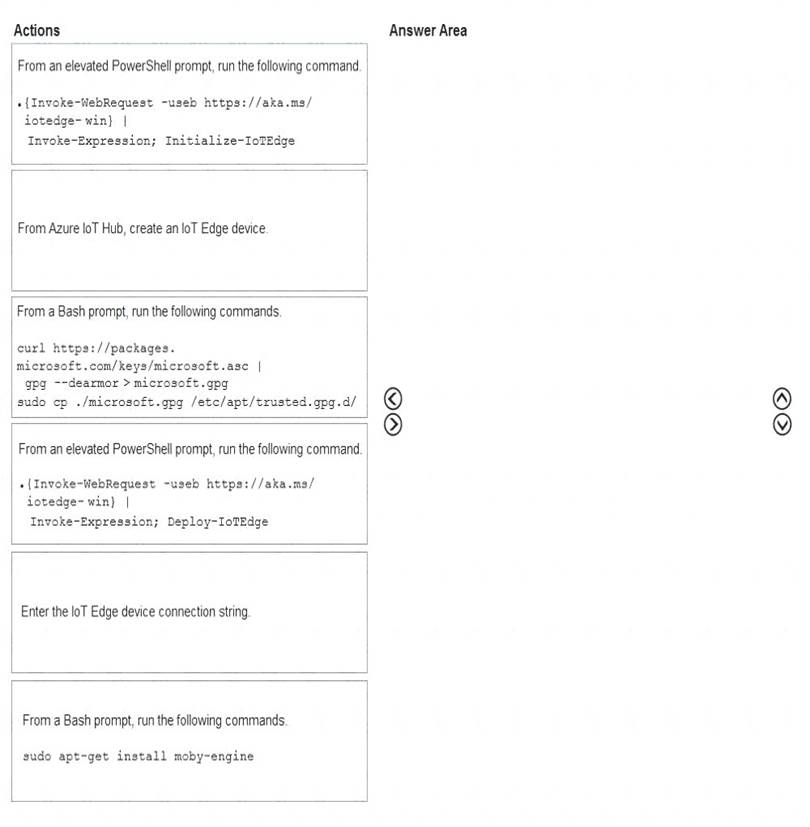
- A. Mastered
- B. Not Mastered
Answer: A
Explanation:
Step 1: From Azure IoT Hub, create an IoT Edge Device
Step 2: Deploy-IoTEdge
The Deploy-IoTEdge command checks that your Windows machine is on a supported version, turns on the containers feature, and then downloads the moby runtime and the IoT Edge runtime. The command defaults to using Windows containers.
{Invoke-WebRequest -useb https://aka.ms/iotedge-win} | Invoke-Expression; ` Deploy-IoTEdge
Step 3: Initialize-IoTEdge
The Initialize-IoTEdge command configures the IoT Edge runtime on your machine. The command defaults to manual provisioning with Windows containers.
{Invoke-WebRequest -useb https://aka.ms/iotedge Step 4: Enter the IoT Edge device connection string.
When prompted, provide the device connection string that you retrieved in step 1. The device connection string associates the physical device with a device ID in IoT Hub.
Reference:
https://docs.microsoft.com/en-us/azure/iot-edge/module-composition
NEW QUESTION 2
You have an Azure IoT Central application that has a custom device template. You need to configure the device template to support the following activities: Return the reported power consumption. Configure the desired fan speed. Run the device reset routine. Read the fan serial number.
Which option should you use for each activity? Each correct answer presents part of the solution.
NOTE: Each correct selection is worth one point.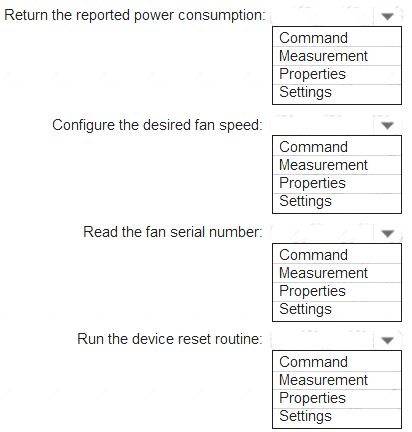
- A. Mastered
- B. Not Mastered
Answer: A
Explanation:
Box 1: Measurement
Telemetry/measurement is a stream of values sent from the device, typically from a sensor. For example, a sensor might report the ambient temperature.
Box 2: Property
The template can provide a writeable fan speed property
Properties represent point-in-time values. For example, a device can use a property to report the target temperature it's trying to reach. You can set writeable properties from IoT Central.
Box 3: Settings
Box 4: Command
You can call device commands from IoT Central. Commands optionally pass parameters to the device and receive a response from the device. For example, you can call a command to reboot a device in 10 seconds.
Reference:
https://docs.microsoft.com/en-us/azure/iot-central/core/howto-set-up-template
NEW QUESTION 3
You plan to deploy a standard tier Azure IoT hub.
You need to perform an over-the-air (OTA) update on devices that will connect to the IoT hub by using scheduled jobs.
What should you use?
- A. a device-to-cloud message
- B. the device twin reported properties
- C. a cloud-to-device message
- D. a direct method
Answer: D
Explanation:
Releases via the REST API.
All of the operations that can be performed from the Console can also be automated using the REST API. You might do this to automate your build and release process, for example.
You can build firmware using the Particle CLI or directly using the compile source code API.
Note: Over-the-air (OTA) firmware updates are a vital component of any IoT system. Over-the-air firmware updates refers to the practice of remotely updating the code on an embedded device.
Reference:
https://docs.particle.io/tutorials/device-cloud/ota-updates/
NEW QUESTION 4
Note: This question is part of a series of questions that present the same scenario. Each question in the series contains a unique solution that might meet the stated goals. Some question sets might have more than one correct solution, while others might not have a correct solution.
After you answer a question in this question, you will NOT be able to return to it. As a result, these questions will not appear in the review screen.
You have devices that connect to an Azure IoT hub. Each device has a fixed GPS location that includes latitude and longitude.
You discover that a device entry in the identity registry of the IoT hub is missing the GPS location.
You need to configure the GPS location for the device entry. The solution must prevent the changes from being propagated to the physical device.
Solution: You add tags to the device twin. Does the solution meet the goal?
- A. Yes
- B. No
Answer: B
Explanation:
Instead add the desired properties to the device twin.
Note: Device Twins are used to synchronize state between an IoT solution's cloud service and its devices. Each device's twin exposes a set of desired properties and reported properties. The cloud service populates the
desired properties with values it wishes to send to the device. When a device connects it requests and/or subscribes for its desired properties and acts on them.
Reference:
https://azure.microsoft.com/sv-se/blog/deep-dive-into-azure-iot-hub-notifications-and-device-twin/
NEW QUESTION 5
Note: This question is part of a series of questions that present the same scenario. Each question in the series contains a unique solution that might meet the stated goals. Some question sets might have more than one correct solution, while others might not have a correct solution.
After you answer a question in this question, you will NOT be able to return to it. As a result, these questions will not appear in the review screen.
You have devices that connect to an Azure IoT hub. Each device has a fixed GPS location that includes latitude and longitude.
You discover that a device entry in the identity registry of the IoT hub is missing the GPS location.
You need to configure the GPS location for the device entry. The solution must prevent the changes from being propagated to the physical device.
Solution: You use an Azure policy to apply tags to a resource group. Does the solution meet the goal?
- A. Yes
- B. No
Answer: B
Explanation:
Instead add the desired properties to the device twin.
Note: Device Twins are used to synchronize state between an IoT solution's cloud service and its devices. Each device's twin exposes a set of desired properties and reported properties. The cloud service populates the desired properties with values it wishes to send to the device. When a device connects it requests and/or subscribes for its desired properties and acts on them.
Reference:
https://azure.microsoft.com/sv-se/blog/deep-dive-into-azure-iot-hub-notifications-and-device-twin/
NEW QUESTION 6
You have 100 devices that connect to an Azure IoT hub.
You plan to use Azure functions to process all the telemetry messages from the devices before storing the messages.
You need to configure the functions binding for the IoT hub.
Which two configuration details should you use to configure the binding? Each Answer presents part of the solution.
NOTE: Each correct selection is worth one point.
- A. the name of the resource group that contains the IoT hub
- B. the IoT hub's connection string shared access key that has Service connect permissions
- C. the connection string of the Azure Event Hub-compatible endpoint from the IoT Hub built-in endpoints
- D. the Azure Event-Hub compatible name
Answer: CD
Explanation:
EventHubName: Functions 2.x and higher. The name of the event hub. When the event hub name is also present in the connection string, that value overrides this property at runtime.
Connection: The name of an app setting that contains the connection string to the event hub's namespace. Copy this connection string by clicking the Connection Information button for the namespace, not the event hub itself. This connection string must have send permissions to send the message to the event stream.
Reference:
https://docs.microsoft.com/en-us/azure/azure-functions/functions-bindings-event-iot-output
NEW QUESTION 7
You use Azure Security Center in an Azure IoT solution.
You need to exclude some security events. The solution must minimize development effort. What should you do?
- A. Create an Azure function to filter security messages.
- B. Add a configuration to the code of the physical IoT device.
- C. Add configuration details to the device twin object.
- D. Create an azureiotsecurity module twin and add configuration details to the module twin object.
Answer: D
Explanation:
Properties related to every Azure Security Center for IoT security agent are located in the agent configuration object, within the desired properties section, of the azureiotsecurity module.
To modify the configuration, create and modify this object inside the azureiotsecurity module twin identity. Note: Azure Security Center for IoT's security agent twin configuration object is a JSON format object. The
configuration object is a set of controllable properties that you can define to control the behavior of the agent. These configurations help you customize the agent for each scenario required. For example, automatically
excluding some events, or keeping power consumption to a minimal level are possible by configuring these
properties.
Reference:
https://docs.microsoft.com/en-us/azure/asc-for-iot/how-to-agent-configuration
NEW QUESTION 8
You need to enable telemetry message tracing through the entire IoT solution. What should you do?
- A. Monitor device lifecycle events.
- B. Upload IoT device logs by using the File upload feature.
- C. Enable the DeviceTelemetry diagnostic log and stream the log data to an Azure event hub.
- D. Implement distributed tracing.
Answer: D
Explanation:
IoT Hub is one of the first Azure services to support distributed tracing. As more Azure services support distributed tracing, you'll be able trace IoT messages throughout the Azure services involved in your solution.
Note:
Enabling distributed tracing for IoT Hub gives you the ability to:
Precisely monitor the flow of each message through IoT Hub using trace context. This trace context includes correlation IDs that allow you to correlate events from one component with events from another component. It can be applied for a subset or all IoT device messages using device twin.
Automatically log the trace context to Azure Monitor diagnostic logs.
Measure and understand message flow and latency from devices to IoT Hub and routing endpoints. Start considering how you want to implement distributed tracing for the non-Azure services in your IoT solution.
Reference:
https://docs.microsoft.com/en-us/azure/iot-hub/iot-hub-distributed-tracing
NEW QUESTION 9
Note: This question is part of a series of questions that present the same scenario. Each question in the series contains a unique solution that might meet the stated goals. Some question sets might have more than one correct solution, while others might not have a correct solution.
After you answer a question in this question, you will NOT be able to return to it. As a result, these questions will not appear in the review screen.
You have an Azure IoT solution that includes an Azure IoT hub, a Device Provisioning Service instance, and 1,000 connected IoT devices.
All the IoT devices are provisioned automatically by using one enrollment group. You need to temporarily disable the IoT devices from the connecting to the IoT hub.
Solution: From the IoT hub, you change the credentials for the shared access policy of the IoT devices. Does the solution meet the goal?
- A. Yes
- B. No
Answer: B
Explanation:
Reference:
https://docs.microsoft.com/bs-latn-ba/azure/iot-dps/how-to-unprovision-devices
NEW QUESTION 10
You are troubleshooting an Azure IoT hub.
You discover that some telemetry messages are dropped before they reach downstream processing. You suspect that IoT Hub throttling is the root cause.
Which log in the Diagnostics settings of the IoT hub should you use to capture the throttling error events?
- A. Routes
- B. DeviceTelemetry
- C. Connections
- D. C2DCommands
Answer: B
Explanation:
The device telemetry category tracks errors that occur at the IoT hub and are related to the telemetry pipeline. This category includes errors that occur when sending telemetry events (such as throttling) and receiving telemetry events (such as unauthorized reader). This category cannot catch errors caused by code running on the device itself.
Note: The metric d2c.telemetry.ingress.sendThrottle is the number of throttling errors due to device throughput throttles.
Reference:
https://docs.microsoft.com/en-us/azure/iot-hub/iot-hub-monitor-resource-health
NEW QUESTION 11
You plan to deploy Azure Time Series Insights.
What should you create on iothub1 before you deploy Time Series Insights?
- A. a new message route
- B. a new consumer group
- C. a new shared access policy
- D. an IP filter rule
Answer: B
Explanation:
Create a dedicated consumer group in the IoT hub for the Time Series Insights environment to consume from. Each Time Series Insights event source must have its own dedicated consumer group that isn't shared with any other consumer. If multiple readers consume events from the same consumer group, all readers are likely to exhibit failures.
Reference:
https://docs.microsoft.com/en-us/azure/time-series-insights/time-series-insights-how-to-add-an-event-source- iothub
NEW QUESTION 12
You have an Azure IoT solution that includes an Azure IoT hub and 100 Azure IoT Edge devices.
You plan to deploy the IoT Edge devices to external networks. The firewalls of the external networks only allow traffic on port 80 and port 443.
You need to ensure that the devices can connect to the IoT hub. The solution must minimize costs. What should you do?
- A. Configure the devices for extended offline operations.
- B. Configure the upstream protocol of the devices to use MQTT over WebSocket.
- C. Connect the external networks to the IoT solution by using ExpressRoute.
- D. Configure the devices to use an HTTPS proxy.
Answer: B
Explanation:
MQTT over WebSockets uses port 443. Reference:
https://docs.microsoft.com/en-us/azure/iot-hub/iot-hub-devguide-protocols
NEW QUESTION 13
You have three Azure IoT hubs named Hub1, Hub2, and Hub3, a Device Provisioning Service instance, and an IoT device named Device1.
Each IoT hub is deployed to a separate Azure region. Device enrollment uses the Lowest latency allocation policy.
The Device Provisioning Service uses the Lowest latency allocation policy. Device1 is auto-provisioned to
Hub1 by using the Device Provisioning Service. Device1 regularly moves between regions.
You need to ensure that Device1 always connects to the IoT hub that has the lowest latency. What should you do?
- A. Configure device attestation that uses X.509 certificates.
- B. Implement device certificate rolling.
- C. Disenroll and reenroll Device1.
- D. Configure the re-provisioning policy.
Answer: D
Explanation:
Automated re-provisioning support.
Microsoft added first-class support for device re-provisioning which allows devices to be reassigned to a different IoT solution sometime after the initial solution assignment. Re-provisioning support is available in two options:
Factory reset, in which the device twin data for the new IoT hub is populated from the enrollment list instead of the old IoT hub. This is common for factory reset scenarios as well as leased device scenarios. Migration, in which device twin data is moved from the old IoT hub to the new IoT hub. This is common for scenarios in which a device is moving between geographies.
Reference:
https://azure.microsoft.com/en-us/blog/new-year-newly-available-iot-hub-device-provisioning-service-features/
NEW QUESTION 14
How should you complete the GROUP BY clause to meet the Streaming Analytics requirements?
- A. GROUP BY HoppingWindow(Second, 60, 30)
- B. GROUP BY TumblingWindow(Second, 30)
- C. GROUP BY SlidingWindow(Second, 30)
- D. GROUP BY SessionWindow(Second, 30, 60)
Answer: B
Explanation:
Scenario: You plan to use a 30-second period to calculate the average temperature reading of the sensors. Tumbling window functions are used to segment a data stream into distinct time segments and perform a
function against them, such as the example below. The key differentiators of a Tumbling window are that they repeat, do not overlap, and an event cannot belong to more than one tumbling window.
InAnswers:
A: Hopping window functions hop forward in time by a fixed period. It may be easy to think of them as Tumbling windows that can overlap, so events can belong to more than one Hopping window result set.
Reference:
https://docs.microsoft.com/en-us/azure/stream-analytics/stream-analytics-window-functions
NEW QUESTION 15
You plan to deploy an Azure IoT hub. The IoT hub must support the following: Three Azure IoT Edge devices 2,500 IoT devices Each IoT device will spend a 6 KB message every five seconds.
You need to size the IoT hub to support the devices. The solution must minimize costs. What should you choose?
- A. one unit of the S1 tier
- B. one unit of the B2 tier
- C. one unit of the B1 tier
- D. one unit of the S3 tier
Answer: D
Explanation:
\ 2500* 6 KB * 12 = 180,000 KB/minute = 180 MB/Minute.
B3, S3 can handle up to 814 MB/minute per unit. Incorrect Answers:
A, C: B1, S1 can only handle up to 1111 KB/minute per unit B: B2, S2 can only handle up to 16 MB/minute per unit.
Reference:
https://docs.microsoft.com/en-us/azure/iot-hub/iot-hub-scaling
NEW QUESTION 16
......
Thanks for reading the newest AZ-220 exam dumps! We recommend you to try the PREMIUM Passcertsure AZ-220 dumps in VCE and PDF here: https://www.passcertsure.com/AZ-220-test/ (0 Q&As Dumps)
