
Approved of DP-203 practice materials and practice exam for Microsoft certification for examinee, Real Success Guaranteed with Updated DP-203 pdf dumps vce Materials. 100% PASS Data Engineering on Microsoft Azure exam Today!
Online DP-203 free questions and answers of New Version:
NEW QUESTION 1
You configure monitoring for a Microsoft Azure SQL Data Warehouse implementation. The implementation uses PolyBase to load data from comma-separated value (CSV) files stored in Azure Data Lake Gen 2 using an external table.
Files with an invalid schema cause errors to occur. You need to monitor for an invalid schema error. For which error should you monitor?
- A. EXTERNAL TABLE access failed due to internal error: 'Java exception raised on call to HdfsBridge_Connect: Error[com.microsoft.polybase.client.KerberosSecureLogin] occurred while accessing external files.'
- B. EXTERNAL TABLE access failed due to internal error: 'Java exception raised on call to HdfsBridge_Connect: Error [No FileSystem for scheme: wasbs] occurred while accessing external file.'
- C. Cannot execute the query "Remote Query" against OLE DB provider "SQLNCLI11": for linked server "(null)", Query aborted- the maximum reject threshold (orows) was reached while regarding from an external source: 1 rows rejected out of total 1 rows processed.
- D. EXTERNAL TABLE access failed due to internal error: 'Java exception raised on call to HdfsBridge_Connect: Error [Unable to instantiate LoginClass] occurredwhile accessing external files.'
Answer: C
Explanation:
Customer Scenario:
SQL Server 2016 or SQL DW connected to Azure blob storage. The CREATE EXTERNAL TABLE DDL points to a directory (and not a specific file) and the directory contains files with different schemas.
SSMS Error:
Select query on the external table gives the following error: Msg 7320, Level 16, State 110, Line 14
Cannot execute the query "Remote Query" against OLE DB provider "SQLNCLI11" for linked server "(null)". Query aborted-- the maximum reject threshold (0 rows) was reached while reading from an external source: 1 rows rejected out of total 1 rows processed.
Possible Reason:
The reason this error happens is because each file has different schema. The PolyBase external table DDL when pointed to a directory recursively reads all the files in that directory. When a column or data type mismatch happens, this error could be seen in SSMS.
Possible Solution:
If the data for each table consists of one file, then use the filename in the LOCATION section prepended by the directory of the external files. If there are multiple files per table, put each set of files into different directories in Azure Blob Storage and then you can point LOCATION to the directory instead of a particular
file. The latter suggestion is the best practices recommended by SQLCAT even if you have one file per table.
NEW QUESTION 2
You have an Azure Storage account and a data warehouse in Azure Synapse Analytics in the UK South region. You need to copy blob data from the storage account to the data warehouse by using Azure Data Factory. The solution must meet the following requirements: Ensure that the data remains in the UK South region at all times. Minimize administrative effort.
Which type of integration runtime should you use?
- A. Azure integration runtime
- B. Azure-SSIS integration runtime
- C. Self-hosted integration runtime
Answer: A
Explanation: 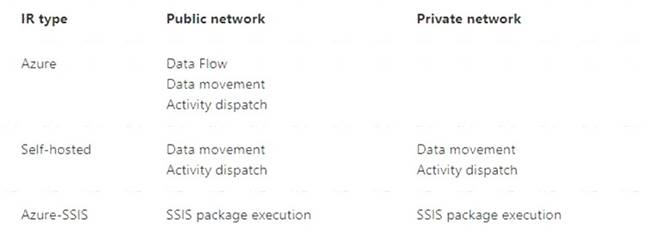
Reference:
https://docs.microsoft.com/en-us/azure/data-factory/concepts-integration-runtime
NEW QUESTION 3
Note: This question is part of a series of questions that present the same scenario. Each question in the series contains a unique solution that might meet the stated goals. Some question sets might have more than one correct solution, while others might not have a correct solution.
After you answer a question in this scenario, you will NOT be able to return to it. As a result, these questions will not appear in the review screen.
You have an Azure Storage account that contains 100 GB of files. The files contain text and numerical values. 75% of the rows contain description data that has an average length of 1.1 MB.
You plan to copy the data from the storage account to an Azure SQL data warehouse. You need to prepare the files to ensure that the data copies quickly.
Solution: You modify the files to ensure that each row is less than 1 MB. Does this meet the goal?
- A. Yes
- B. No
Answer: A
Explanation:
When exporting data into an ORC File Format, you might get Java out-of-memory errors when there are large text columns. To work around this limitation, export only a subset of the columns.
References:
https://docs.microsoft.com/en-us/azure/sql-data-warehouse/guidance-for-loading-data
NEW QUESTION 4
You have files and folders in Azure Data Lake Storage Gen2 for an Azure Synapse workspace as shown in the following exhibit.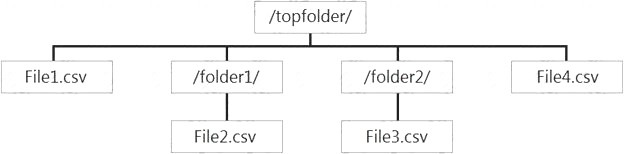
You create an external table named ExtTable that has LOCATION='/topfolder/'.
When you query ExtTable by using an Azure Synapse Analytics serverless SQL pool, which files are returned?
- A. File2.csv and File3.csv only
- B. File1.csv and File4.csv only
- C. File1.csv, File2.csv, File3.csv, and File4.csv
- D. File1.csv only
Answer: C
Explanation:
To run a T-SQL query over a set of files within a folder or set of folders while treating them as a single entity or rowset, provide a path to a folder or a pattern (using wildcards) over a set of files or folders. Reference:
https://docs.microsoft.com/en-us/azure/synapse-analytics/sql/query-data-storage#query-multiple-files-or-folders
NEW QUESTION 5
You have an Azure subscription that contains the following resources:
* An Azure Active Directory (Azure AD) tenant that contains a security group named Group1.
* An Azure Synapse Analytics SQL pool named Pool1.
You need to control the access of Group1 to specific columns and rows in a table in Pool1
Which Transact-SQL commands should you use? To answer, select the appropriate options in the answer area. NOTE: Each appropriate options in the answer area.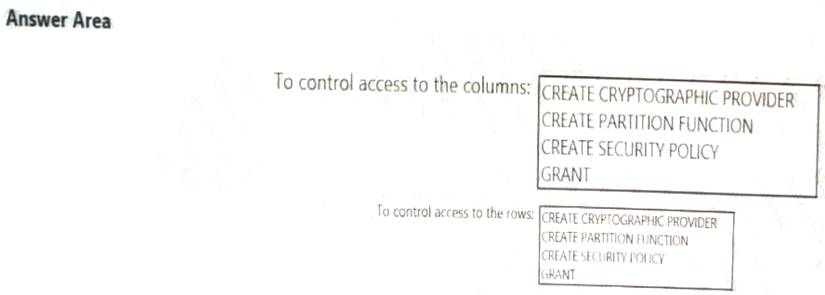
- A. Mastered
- B. Not Mastered
Answer: A
Explanation: 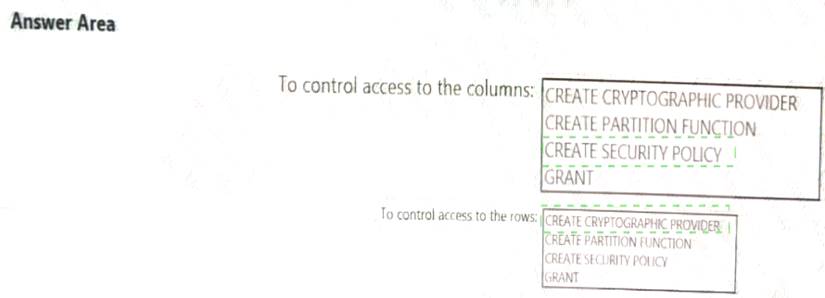
NEW QUESTION 6
You store files in an Azure Data Lake Storage Gen2 container. The container has the storage policy shown in the following exhibit.
Use the drop-down menus to select the answer choice that completes each statement based on the information presented in the graphic.
NOTE: Each correct selection Is worth one point.
- A. Mastered
- B. Not Mastered
Answer: A
Explanation: 
NEW QUESTION 7
You have an Azure Active Directory (Azure AD) tenant that contains a security group named Group1. You have an Azure Synapse Analytics dedicated SQL pool named dw1 that contains a schema named schema1.
You need to grant Group1 read-only permissions to all the tables and views in schema1. The solution must use the principle of least privilege.
Which three actions should you perform in sequence? To answer, move the appropriate actions from the list of actions to the answer area and arrange them in the correct order.
NOTE: More than one order of answer choices is correct. You will receive credit for any of the correct orders you select.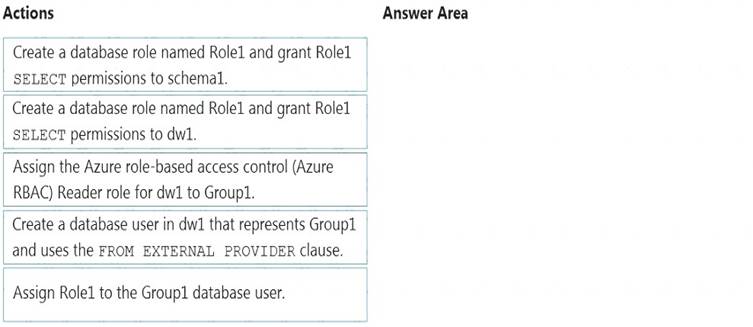
- A. Mastered
- B. Not Mastered
Answer: A
Explanation:
Step 1: Create a database role named Role1 and grant Role1 SELECT permissions to schema You need to grant Group1 read-only permissions to all the tables and views in schema1.
Place one or more database users into a database role and then assign permissions to the database role. Step 2: Assign Rol1 to the Group database user
Step 3: Assign the Azure role-based access control (Azure RBAC) Reader role for dw1 to Group1 Reference:
https://docs.microsoft.com/en-us/azure/data-share/how-to-share-from-sql
NEW QUESTION 8
You are designing a solution that will copy Parquet files stored in an Azure Blob storage account to an Azure Data Lake Storage Gen2 account.
The data will be loaded daily to the data lake and will use a folder structure of {Year}/{Month}/{Day}/.
You need to design a daily Azure Data Factory data load to minimize the data transfer between the two accounts.
Which two configurations should you include in the design? Each correct answer presents part of the solution. NOTE: Each correct selection is worth one point.
- A. Delete the files in the destination before loading new data.
- B. Filter by the last modified date of the source files.
- C. Delete the source files after they are copied.
- D. Specify a file naming pattern for the destination.
Answer: BC
Explanation:
Reference:
https://docs.microsoft.com/en-us/azure/data-factory/connector-azure-data-lake-storage
NEW QUESTION 9
You have the following table named Employees.
You need to calculate the employee _type value based on the hire date value.
How should you complete the Transact-SQL statement? To answer, drag the appropriate values to the correct targets. Each value may be used once, more than once, or not at all. You may need to drag the split bar between panes or scroll to view content
NOTE: Each correct selection is worth one point.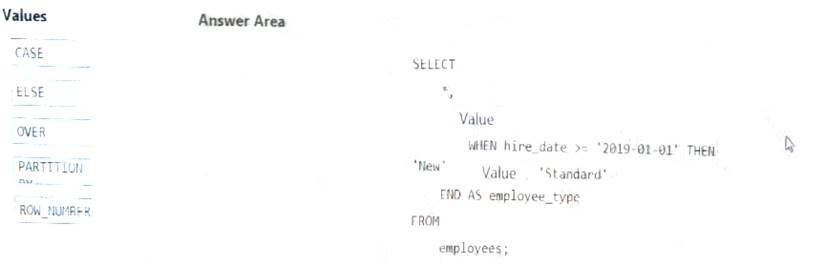
- A. Mastered
- B. Not Mastered
Answer: A
Explanation: 
NEW QUESTION 10
You need to integrate the on-premises data sources and Azure Synapse Analytics. The solution must meet the data integration requirements.
Which type of integration runtime should you use?
- A. Azure-SSIS integration runtime
- B. self-hosted integration runtime
- C. Azure integration runtime
Answer: C
NEW QUESTION 11
You are designing an Azure Stream Analytics solution that receives instant messaging data from an Azure event hub.
You need to ensure that the output from the Stream Analytics job counts the number of messages per time
zone every 15 seconds.
How should you complete the Stream Analytics query? To answer, select the appropriate options in the answer area.
NOTE: Each correct selection is worth one point.
- A. Mastered
- B. Not Mastered
Answer: A
Explanation: 
NEW QUESTION 12
Note: This question is part of a series of questions that present the same scenario. Each question in the series contains a unique solution that might meet the stated goals. Some question sets might have more than one correct solution, while others might not have a correct solution.
After you answer a question in this scenario, you will NOT be able to return to it. As a result, these questions will not appear in the review screen.
You have an Azure Storage account that contains 100 GB of files. The files contain text and numerical values. 75% of the rows contain description data that has an average length of 1.1 MB.
You plan to copy the data from the storage account to an Azure SQL data warehouse. You need to prepare the files to ensure that the data copies quickly.
Solution: You modify the files to ensure that each row is more than 1 MB. Does this meet the goal?
- A. Yes
- B. No
Answer: B
Explanation:
Instead modify the files to ensure that each row is less than 1 MB. References:
https://docs.microsoft.com/en-us/azure/sql-data-warehouse/guidance-for-loading-data
NEW QUESTION 13
You have an Azure Stream Analytics job that receives clickstream data from an Azure event hub.
You need to define a query in the Stream Analytics job. The query must meet the following requirements:  Count the number of clicks within each 10-second window based on the country of a visitor.
 Ensure that each click is NOT counted more than once. How should you define the Query?
- A. SELECT Country, Avg(*) AS AverageFROM ClickStream TIMESTAMP BY CreatedAt GROUP BY Country, SlidingWindow(second, 10)
- B. SELECT Country, Count(*) AS CountFROM ClickStream TIMESTAMP BY CreatedAt GROUP BY Country, TumblingWindow(second, 10)
- C. SELECT Country, Avg(*) AS AverageFROM ClickStream TIMESTAMP BY CreatedAt GROUP BY Country, HoppingWindow(second, 10, 2)
- D. SELECT Country, Count(*) AS CountFROM ClickStream TIMESTAMP BY CreatedAt GROUP BY Country, SessionWindow(second, 5, 10)
Answer: B
Explanation:
Tumbling window functions are used to segment a data stream into distinct time segments and perform a function against them, such as the example below. The key differentiators of a Tumbling window are that they repeat, do not overlap, and an event cannot belong to more than one tumbling window.
Example: Reference:
https://docs.microsoft.com/en-us/azure/stream-analytics/stream-analytics-window-functions
NEW QUESTION 14
You have an Azure Factory instance named DF1 that contains a pipeline named PL1.PL1 includes a tumbling window trigger.
You create five clones of PL1. You configure each clone pipeline to use a different data source.
You need to ensure that the execution schedules of the clone pipeline match the execution schedule of PL1. What should you do?
- A. Add a new trigger to each cloned pipeline
- B. Associate each cloned pipeline to an existing trigger.
- C. Create a tumbling window trigger dependency for the trigger of PL1.
- D. Modify the Concurrency setting of each pipeline.
Answer: B
NEW QUESTION 15
You are designing a dimension table for a data warehouse. The table will track the value of the dimension attributes over time and preserve the history of the data by adding new rows as the data changes.
Which type of slowly changing dimension (SCD) should use?
- A. Type 0
- B. Type 1
- C. Type 2
- D. Type 3
Answer: C
Explanation:
Type 2 - Creating a new additional record. In this methodology all history of dimension changes is kept in the database. You capture attribute change by adding a new row with a new surrogate key to the dimension table. Both the prior and new rows contain as attributes the natural key(or other durable identifier). Also 'effective date' and 'current indicator' columns are used in this method. There could be only one record with current indicator set to 'Y'. For 'effective date' columns, i.e. start_date and end_date, the end_date for current record usually is set to value 9999-12-31. Introducing changes to the dimensional model in type 2 could be very expensive database operation so it is not recommended to use it in dimensions where a new attribute could be added in the future.
https://www.datawarehouse4u.info/SCD-Slowly-Changing-Dimensions.html
NEW QUESTION 16
You are designing an Azure Synapse Analytics dedicated SQL pool.
You need to ensure that you can audit access to Personally Identifiable information (PII). What should you include in the solution?
- A. dynamic data masking
- B. row-level security (RLS)
- C. sensitivity classifications
- D. column-level security
Answer: D
NEW QUESTION 17
You are planning the deployment of Azure Data Lake Storage Gen2. You have the following two reports that will access the data lake: Report1: Reads three columns from a file that contains 50 columns. Report2: Queries a single record based on a timestamp.
You need to recommend in which format to store the data in the data lake to support the reports. The solution must minimize read times.
What should you recommend for each report? To answer, select the appropriate options in the answer area. NOTE: Each correct selection is worth one point.
- A. Mastered
- B. Not Mastered
Answer: A
Explanation:
Report1: CSV
CSV: The destination writes records as delimited data. Report2: AVRO
AVRO supports timestamps.
Not Parquet, TSV: Not options for Azure Data Lake Storage Gen2. Reference:
https://streamsets.com/documentation/datacollector/latest/help/datacollector/UserGuide/Destinations/ADLS-G2
NEW QUESTION 18
You are designing an enterprise data warehouse in Azure Synapse Analytics that will contain a table named Customers. Customers will contain credit card information.
You need to recommend a solution to provide salespeople with the ability to view all the entries in Customers. The solution must prevent all the salespeople from viewing or inferring the credit card information.
What should you include in the recommendation?
- A. data masking
- B. Always Encrypted
- C. column-level security
- D. row-level security
Answer: A
Explanation:
SQL Database dynamic data masking limits sensitive data exposure by masking it to non-privileged users. The Credit card masking method exposes the last four digits of the designated fields and adds a constant string as a prefix in the form of a credit card.
Example: XXXX-XXXX-XXXX-1234
Reference:
https://docs.microsoft.com/en-us/azure/sql-database/sql-database-dynamic-data-masking-get-started
NEW QUESTION 19
......
P.S. Easily pass DP-203 Exam with 61 Q&As Thedumpscentre.com Dumps & pdf Version, Welcome to Download the Newest Thedumpscentre.com DP-203 Dumps: https://www.thedumpscentre.com/DP-203-dumps/ (61 New Questions)
