
Approved of Databricks-Certified-Professional-Data-Engineer exam question materials and vce for Databricks certification for examinee, Real Success Guaranteed with Updated Databricks-Certified-Professional-Data-Engineer pdf dumps vce Materials. 100% PASS Databricks Certified Data Engineer Professional Exam exam Today!
Free demo questions for Databricks Databricks-Certified-Professional-Data-Engineer Exam Dumps Below:
NEW QUESTION 1
Which statement describes Delta Lake optimized writes?
- A. A shuffle occurs prior to writing to try to group data together resulting in fewer files instead of each executor writing multiple files based on directory partitions.
- B. Optimized writes logical partitions instead of directory partitions partition boundaries are only represented in metadata fewer small files are written.
- C. An asynchronous job runs after the write completes to detect if files could be further compacted; yes, an OPTIMIZE job is executed toward a default of 1 GB.
- D. Before a job cluster terminates, OPTIMIZE is executed on all tables modified during the most recent job.
Answer: A
Explanation:
Delta Lake optimized writes involve a shuffle operation before writing out data to the Delta table. The shuffle operation groups data by partition keys, which can lead to a reduction in the number of output files and potentially larger files, instead of multiple smaller files. This approach can significantly reduce the total number of files in the table, improve read performance by reducing the metadata overhead, and optimize the table storage layout, especially for workloads with many small files.
References:
✑ Databricks documentation on Delta Lake performance tuning: https://docs.databricks.com/delta/optimizations/auto-optimize.html
NEW QUESTION 2
A junior data engineer is working to implement logic for a Lakehouse table named silver_device_recordings. The source data contains 100 unique fields in a highly nested JSON structure.
The silver_device_recordings table will be used downstream for highly selective joins on a number of fields, and will also be leveraged by the machine learning team to filter on a handful of relevant fields, in total, 15 fields have been identified that will often be used for filter and join logic.
The data engineer is trying to determine the best approach for dealing with these nested fields before declaring the table schema.
Which of the following accurately presents information about Delta Lake and Databricks that may Impact their decision-making process?
- A. Because Delta Lake uses Parquet for data storage, Dremel encoding information for nesting can be directly referenced by the Delta transaction log.
- B. Tungsten encoding used by Databricks is optimized for storing string data: newly-added native support for querying JSON strings means that string types are always most efficient.
- C. Schema inference and evolution on Databricks ensure that inferred types will always accurately match the data types used by downstream systems.
- D. By default Delta Lake collects statistics on the first 32 columns in a table; these statistics are leveraged for data skipping when executing selective queries.
Answer: D
Explanation:
Delta Lake, built on top of Parquet, enhances query performance through data skipping, which is based on the statistics collected for each file in a table. For tables with a large number of columns, Delta Lake by default collects and stores statistics only for the first 32 columns. These statistics include min/max values and null counts, which are used to optimize query execution by skipping irrelevant data files. When dealing with highly nested JSON structures, understanding this behavior is crucial for schema design, especially when determining which fields should be flattened or prioritized in the table structure to leverage data skipping efficiently for performance optimization.References: Databricks documentation on Delta Lake optimization techniques, including data skipping and statistics collection (https://docs.databricks.com/delta/optimizations/index.html).
NEW QUESTION 3
Each configuration below is identical to the extent that each cluster has 400 GB total of RAM, 160 total cores and only one Executor per VM.
Given a job with at least one wide transformation, which of the following cluster configurations will result in maximum performance?
- A. • Total VMs; 1• 400 GB per Executor• 160 Cores / Executor
- B. • Total VMs: 8• 50 GB per Executor• 20 Cores / Executor
- C. • Total VMs: 4• 100 GB per Executor• 40 Cores/Executor
- D. • Total VMs:2• 200 GB per Executor• 80 Cores / Executor
Answer: B
Explanation:
This is the correct answer because it is the cluster configuration that will result in maximum performance for a job with at least one wide transformation. A wide transformation is a type of transformation that requires shuffling data across partitions, such as join, groupBy, or orderBy. Shuffling can be expensive and time-consuming, especially if there are too many or too few partitions. Therefore, it is important to choose a cluster configuration that can balance the trade-off between parallelism and network overhead. In this case, having 8 VMs with 50 GB per executor and 20 cores per executor will create 8 partitions, each with enough memory and CPU resources to handle the shuffling efficiently. Having fewer VMs with more memory and cores per executor will create fewer partitions, which will reduce parallelism and increase the size of each shuffle block. Having more VMs with less memory and cores per executor will create more partitions, which will increase parallelism but also increase the network overhead and the number of shuffle files. Verified References: [Databricks Certified Data Engineer Professional], under “Performance Tuning” section; Databricks Documentation, under “Cluster configurations” section.
NEW QUESTION 4
A Delta Lake table representing metadata about content from user has the following schema:
Based on the above schema, which column is a good candidate for partitioning the Delta Table?
- A. Date
- B. Post_id
- C. User_id
- D. Post_time
Answer: A
Explanation:
Partitioning a Delta Lake table improves query performance by organizing data into partitions based on the values of a column. In the given schema, the date column is a good candidate for partitioning for several reasons:
✑ Time-Based Queries: If queries frequently filter or group by date, partitioning by the date column can significantly improve performance by limiting the amount of data scanned.
✑ Granularity: The date column likely has a granularity that leads to a reasonable number of partitions (not too many and not too few). This balance is important for optimizing both read and write performance.
✑ Data Skew: Other columns like post_id or user_id might lead to uneven partition sizes (data skew), which can negatively impact performance.
Partitioning by post_time could also be considered, but typically date is preferred due to its more manageable granularity.
References:
✑ Delta Lake Documentation on Table Partitioning: Optimizing Layout with Partitioning
NEW QUESTION 5
Incorporating unit tests into a PySpark application requires upfront attention to the design of your jobs, or a potentially significant refactoring of existing code.
Which statement describes a main benefit that offset this additional effort?
- A. Improves the quality of your data
- B. Validates a complete use case of your application
- C. Troubleshooting is easier since all steps are isolated and tested individually
- D. Yields faster deployment and execution times
- E. Ensures that all steps interact correctly to achieve the desired end result
Answer: A
NEW QUESTION 6
A distributed team of data analysts share computing resources on an interactive cluster with autoscaling configured. In order to better manage costs and query throughput, the workspace administrator is hoping to evaluate whether cluster upscaling is caused by many concurrent users or resource-intensive queries.
In which location can one review the timeline for cluster resizing events?
- A. Workspace audit logs
- B. Driver's log file
- C. Ganglia
- D. Cluster Event Log
- E. Executor's log file
Answer: C
NEW QUESTION 7
A Spark job is taking longer than expected. Using the Spark UI, a data engineer notes that the Min, Median, and Max Durations for tasks in a particular stage show the minimum and median time to complete a task as roughly the same, but the max duration for a task to be roughly 100 times as long as the minimum.
Which situation is causing increased duration of the overall job?
- A. Task queueing resulting from improper thread pool assignment.
- B. Spill resulting from attached volume storage being too small.
- C. Network latency due to some cluster nodes being in different regions from the source data
- D. Skew caused by more data being assigned to a subset of spark-partitions.
- E. Credential validation errors while pulling data from an external system.
Answer: D
Explanation:
This is the correct answer because skew is a common situation that causes increased duration of the overall job. Skew occurs when some partitions have more data than others, resulting in uneven distribution of work among tasks and executors. Skew can be caused by various factors, such as skewed data distribution, improper partitioning strategy, or join operations with skewed keys. Skew can lead to performance issues such as long-running tasks, wasted resources, or even task failures due to memory or disk spills. Verified References: [Databricks Certified Data Engineer Professional], under “Performance Tuning” section; Databricks Documentation, under “Skew” section.
NEW QUESTION 8
A Delta Lake table in the Lakehouse named customer_parsams is used in churn prediction by the machine learning team. The table contains information about customers derived from a number of upstream sources. Currently, the data engineering team populates this table nightly by overwriting the table with the current valid values derived from upstream data sources.
Immediately after each update succeeds, the data engineer team would like to determine the difference between the new version and the previous of the table.
Given the current implementation, which method can be used?
- A. Parse the Delta Lake transaction log to identify all newly written data files.
- B. Execute DESCRIBE HISTORY customer_churn_params to obtain the full operation metrics for the update, including a log of all records that have been added or modified.
- C. Execute a query to calculate the difference between the new version and the previous version using Delta Lake’s built-in versioning and time travel functionality.
- D. Parse the Spark event logs to identify those rows that were updated, inserted, or deleted.
Answer: C
Explanation:
Delta Lake provides built-in versioning and time travel capabilities, allowing users to query previous snapshots of a table. This feature is particularly useful for understanding changes between different versions of the table. In this scenario, where the table is overwritten nightly, you can use Delta Lake's time travel feature to execute a query comparing the latest version of the table (the current state) with its previous version. This approach effectively identifies the differences (such as new, updated, or deleted records) between the two versions. The other options do not provide a straightforward or efficient way to directly compare different versions of a Delta Lake table.
References:
✑ Delta Lake Documentation on Time Travel: Delta Time Travel
✑ Delta Lake Versioning: Delta Lake Versioning Guide
NEW QUESTION 9
The data engineering team is migrating an enterprise system with thousands of tables and views into the Lakehouse. They plan to implement the target architecture using a series of bronze, silver, and gold tables. Bronze tables will almost exclusively be used by production data engineering workloads, while silver tables will be used to support both data engineering and machine learning workloads. Gold tables will largely serve business intelligence and reporting purposes. While personal identifying information (PII) exists in all tiers of data, pseudonymization and anonymization rules are in place for all data at the silver and gold levels.
The organization is interested in reducing security concerns while maximizing the ability to collaborate across diverse teams.
Which statement exemplifies best practices for implementing this system?
- A. Isolating tables in separate databases based on data quality tiers allows for easy permissions management through database ACLs and allows physical separation ofdefault storage locations for managed tables.
- B. Because databases on Databricks are merely a logical construct, choices around database organization do not impact security or discoverability in the Lakehouse.
- C. Storinq all production tables in a single database provides a unified view of all data assets available throughout the Lakehouse, simplifying discoverability by granting all users view privileges on this database.
- D. Working in the default Databricks database provides the greatest security when working with managed tables, as these will be created in the DBFS root.
- E. Because all tables must live in the same storage containers used for the database they're created in, organizations should be prepared to create between dozens and thousands of databases depending on their data isolation requirements.
Answer: A
Explanation:
This is the correct answer because it exemplifies best practices for implementing this system. By isolating tables in separate databases based on data quality tiers, such as bronze, silver, and gold, the data engineering team can achieve several benefits. First, they can easily manage permissions for different users and groups through database ACLs, which allow granting or revoking access to databases, tables, or views. Second, they can physically separate the default storage locations for managed tables in each database, which can improve performance and reduce costs. Third, they can provide a clear and consistent naming convention for the tables in each database, which can improve discoverability and usability. Verified References: [Databricks Certified Data Engineer Professional], under “Lakehouse” section; Databricks Documentation, under “Database object privileges” section.
NEW QUESTION 10
A table named user_ltv is being used to create a view that will be used by data analysts on various teams. Users in the workspace are configured into groups, which are used for setting up data access using ACLs.
The user_ltv table has the following schema:
email STRING, age INT, ltv INT
The following view definition is executed: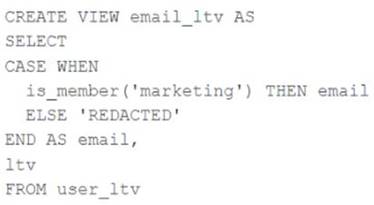
An analyst who is not a member of the marketing group executes the following query: SELECT * FROM email_ltv
Which statement describes the results returned by this query?
- A. Three columns will be returned, but one column will be named "redacted" and contain only null values.
- B. Only the email and itv columns will be returned; the email column will contain all null values.
- C. The email and ltv columns will be returned with the values in user itv.
- D. The email, ag
- E. and ltv columns will be returned with the values in user ltv.
- F. Only the email and ltv columns will be returned; the email column will contain the string "REDACTED" in each row.
Answer: E
Explanation:
The code creates a view called email_ltv that selects the email and ltv columns from a table called user_ltv, which has the following schema: email STRING, age INT, ltv INT. The code also uses the CASE WHEN expression to replace the email values with the string “REDACTED” if the user is not a member of the marketing group. The user who executes the query is not a member of the marketing group, so they will only see the email and ltv columns, and the email column will contain the string “REDACTED” in each row. Verified References: [Databricks Certified Data Engineer Professional], under
“Lakehouse” section; Databricks Documentation, under “CASE expression” section.
NEW QUESTION 11
The data engineer team has been tasked with configured connections to an external database that does not have a supported native connector with Databricks. The external database already has data security configured by group membership. These groups map directly to user group already created in Databricks that represent various teams within the company.
A new login credential has been created for each group in the external database. The Databricks Utilities Secrets module will be used to make these credentials available to Databricks users.
Assuming that all the credentials are configured correctly on the external database and group membership is properly configured on Databricks, which statement describes how teams can be granted the minimum necessary access to using these credentials?
- A. ‘’Read’’ permissions should be set on a secret key mapped to those credentials that will be used by a given team.
- B. No additional configuration is necessary as long as all users are configured as administrators in the workspace where secrets have been added.
- C. “Read” permissions should be set on a secret scope containing only those credentials that will be used by a given team.
- D. “Manage” permission should be set on a secret scope containing only those credentials that will be used by a given team.
Answer: C
Explanation:
In Databricks, using the Secrets module allows for secure management of sensitive information such as database credentials. Granting 'Read' permissions on a secret key that maps to database credentials for a specific team ensures that only members of that team can access these credentials. This approach aligns with the principle of least privilege, granting users the minimum level of access required to perform their jobs, thus enhancing security.
References:
✑ Databricks Documentation on Secret Management: Secrets
NEW QUESTION 12
A Delta Lake table was created with the below query:
Realizing that the original query had a typographical error, the below code was executed: ALTER TABLE prod.sales_by_stor RENAME TO prod.sales_by_store
Which result will occur after running the second command?
- A. The table reference in the metastore is updated and no data is changed.
- B. The table name change is recorded in the Delta transaction log.
- C. All related files and metadata are dropped and recreated in a single ACID transaction.
- D. The table reference in the metastore is updated and all data files are moved.
- E. A new Delta transaction log Is created for the renamed table.
Answer: A
Explanation:
The query uses the CREATE TABLE USING DELTA syntax to create a Delta Lake table from an existing Parquet file stored in DBFS. The query also uses the LOCATION keyword to specify the path to the Parquet file as /mnt/finance_eda_bucket/tx_sales.parquet. By using the LOCATION keyword, the query creates an external table, which is a table that is stored outside of the default warehouse directory and whose metadata is not managed by Databricks. An external table can be created from an existing directory in a cloud storage system, such as DBFS or S3, that contains data files in a supported format, such as Parquet or CSV.
The result that will occur after running the second command is that the table reference in the metastore is updated and no data is changed. The metastore is a service that stores metadata about tables, such as their schema, location, properties, and partitions. The metastore allows users to access tables using SQL commands or Spark APIs without knowing their physical location or format. When renaming an external table using the ALTER TABLE RENAME TO command, only the table reference in the metastore is updated with the new name; no data files or directories are moved or changed in the storage system. The table will still point to the same location and use the same format as before. However, if renaming a managed table, which is a table whose metadata and data are both managed by Databricks, both the table reference in the metastore and the data files in the default warehouse directory are moved and renamed accordingly. Verified References: [Databricks Certified Data Engineer Professional], under “Delta Lake” section; Databricks Documentation, under “ALTER TABLE RENAME TO” section; Databricks Documentation, under “Metastore” section; Databricks Documentation, under “Managed and external tables” section.
NEW QUESTION 13
The DevOps team has configured a production workload as a collection of notebooks scheduled to run daily using the Jobs Ul. A new data engineering hire is onboarding to the team and has requested access to one of these notebooks to review the production logic.
What are the maximum notebook permissions that can be granted to the user without allowing accidental changes to production code or data?
- A. Can manage
- B. Can edit
- C. Can run
- D. Can Read
Answer: D
Explanation:
Granting a user 'Can Read' permissions on a notebook within Databricks allows them to view the notebook's content without the ability to execute or edit it. This level of permission ensures that the new team member can review the production logic for learning or auditing purposes without the risk of altering the notebook's code or affecting production data and workflows. This approach aligns with best practices for maintaining security and integrity in production environments, where strict access controls are essential to prevent unintended modifications.References: Databricks documentation on access control and permissions for notebooks within the workspace (https://docs.databricks.com/security/access-control/workspace-acl.html).
NEW QUESTION 14
Which statement describes integration testing?
- A. Validates interactions between subsystems of your application
- B. Requires an automated testing framework
- C. Requires manual intervention
- D. Validates an application use case
- E. Validates behavior of individual elements of your application
Answer: D
Explanation:
This is the correct answer because it describes integration testing. Integration testing is a type of testing that validates interactions between subsystems of your application, such as modules, components, or services. Integration testing ensures that the subsystems work together as expected and produce the correct outputs or results. Integration testing can be done at different levels of granularity, such as component integration testing, system integration testing, or end-to-end testing. Integration testing can help detect errors or bugs that may not be found by unit testing, which only validates behavior of individual elements of your application. Verified References: [Databricks Certified Data Engineer Professional], under “Testing” section; Databricks Documentation, under “Integration testing” section.
NEW QUESTION 15
When evaluating the Ganglia Metrics for a given cluster with 3 executor nodes, which indicator would signal proper utilization of the VM's resources?
- A. The five Minute Load Average remains consistent/flat
- B. Bytes Received never exceeds 80 million bytes per second
- C. Network I/O never spikes
- D. Total Disk Space remains constant
- E. CPU Utilization is around 75%
Answer: E
Explanation:
In the context of cluster performance and resource utilization, a CPU utilization rate of around 75% is generally considered a good indicator of efficient resource usage. This level of CPU utilization suggests that the cluster is being effectively used without being overburdened or underutilized.
✑ A consistent 75% CPU utilization indicates that the cluster's processing power is being effectively employed while leaving some headroom to handle spikes in workload or additional tasks without maxing out the CPU, which could lead to performance degradation.
✑ A five Minute Load Average that remains consistent/flat (Option A) might indicate underutilization or a bottleneck elsewhere.
✑ Monitoring network I/O (Options B and C) is important, but these metrics alone don't provide a complete picture of resource utilization efficiency.
✑ Total Disk Space (Option D) remaining constant is not necessarily an indicator of proper resource utilization, as it's more related to storage rather than computational efficiency.
References:
✑ Ganglia Monitoring System: Ganglia Documentation
✑ Databricks Documentation on Monitoring: Databricks Cluster Monitoring
NEW QUESTION 16
A production workload incrementally applies updates from an external Change Data Capture feed to a Delta Lake table as an always-on Structured Stream job. When data was initially migrated for this table, OPTIMIZE was executed and most data files were resized to 1 GB. Auto Optimize and Auto Compaction were both turned on for the streaming production job. Recent review of data files shows that most data files are under 64 MB, although each partition in the table contains at least 1 GB of data and the total table size is over 10 TB.
Which of the following likely explains these smaller file sizes?
- A. Databricks has autotuned to a smaller target file size to reduce duration of MERGE operations
- B. Z-order indices calculated on the table are preventing file compactionC Bloom filler indices calculated on the table are preventing file compaction
- C. Databricks has autotuned to a smaller target file size based on the overall size of data in the table
- D. Databricks has autotuned to a smaller target file size based on the amount of data in each partition
Answer: A
Explanation:
This is the correct answer because Databricks has a feature called Auto Optimize, which automatically optimizes the layout of Delta Lake tables by coalescing small files into larger ones and sorting data within each file by a specified column. However, Auto Optimize also considers the trade-off between file size and merge performance, and may choose a smaller target file size to reduce the duration of merge operations, especially for streaming workloads that frequently update existing records. Therefore, it is possible that Auto Optimize has autotuned to a smaller target file size based on the characteristics of the streaming production job. Verified References: [Databricks Certified Data Engineer Professional], under “Delta Lake” section; Databricks Documentation, under “Auto Optimize” section. https://docs.databricks.com/en/delta/tune-file-size.html#autotune-table 'Autotune file size based on workload'
NEW QUESTION 17
The data engineering team has configured a job to process customer requests to be forgotten (have their data deleted). All user data that needs to be deleted is stored in Delta Lake tables using default table settings.
The team has decided to process all deletions from the previous week as a batch job at 1am each Sunday. The total duration of this job is less than one hour. Every Monday at 3am, a batch job executes a series of VACUUM commands on all Delta Lake tables throughout the organization.
The compliance officer has recently learned about Delta Lake's time travel functionality. They are concerned that this might allow continued access to deleted data.
Assuming all delete logic is correctly implemented, which statement correctly addresses this concern?
- A. Because the vacuum command permanently deletes all files containing deleted records, deleted records may be accessible with time travel for around 24 hours.
- B. Because the default data retention threshold is 24 hours, data files containing deleted records will be retained until the vacuum job is run the following day.
- C. Because Delta Lake time travel provides full access to the entire history of a table, deleted records can always be recreated by users with full admin privileges.
- D. Because Delta Lake's delete statements have ACID guarantees, deleted records will be permanently purged from all storage systems as soon as a delete job completes.
- E. Because the default data retention threshold is 7 days, data files containing deleted records will be retained until the vacuum job is run 8 days later.
Answer: E
Explanation:
https://learn.microsoft.com/en-us/azure/databricks/delta/vacuum
NEW QUESTION 18
......
P.S. Dumps-files.com now are offering 100% pass ensure Databricks-Certified-Professional-Data-Engineer dumps! All Databricks-Certified-Professional-Data-Engineer exam questions have been updated with correct answers: https://www.dumps-files.com/files/Databricks-Certified-Professional-Data-Engineer/ (82 New Questions)
