
It is impossible to pass Fortinet FCSS_SOC_AN-7.4 exam without any help in the short term. Come to Examcollection soon and find the most advanced, correct and guaranteed Fortinet FCSS_SOC_AN-7.4 practice questions. You will get a surprising result by our Replace FCSS - Security Operations 7.4 Analyst practice guides.
Online FCSS_SOC_AN-7.4 free questions and answers of New Version:
NEW QUESTION 1
Which two statements about the FortiAnalyzer Fabric topology are true? (Choose two.)
- A. Downstream collectors can forward logs to Fabric members.
- B. Logging devices must be registered to the supervisor.
- C. The supervisor uses an API to store logs, incidents, and events locally.
- D. Fabric members must be in analyzer mode.
Answer: BD
Explanation:
The FortiAnalyzer Fabric topology is designed to centralize logging and analysis across multiple devices in a network.
It involves a hierarchy where the supervisor node manages and coordinates with other Fabric members.
Analyzing the Options:
Option A:Downstream collectors forwarding logs to Fabric members is not a typical configuration. Instead, logs are usually centralized to the supervisor.
Option B:For effective management and log centralization, logging devices must be registered to the supervisor. This ensures proper log collection and coordination.
Option C:The supervisor does not primarily use an API to store logs, incidents, and events locally. Logs are stored directly in the FortiAnalyzer database.
Option D:For the Fabric topology to function correctly, all Fabric members need to be in analyzer mode. This mode allows them to collect, analyze, and forward logs appropriately within the topology.
Conclusion:
The correct statements regarding the FortiAnalyzer Fabric topology are that logging devices must be registered to the supervisor and that Fabric members must be in analyzer mode.
References:
Fortinet Documentation on FortiAnalyzer Fabric Topology.
Best Practices for Configuring FortiAnalyzer in a Fabric Environment.
NEW QUESTION 2
Refer to the exhibits.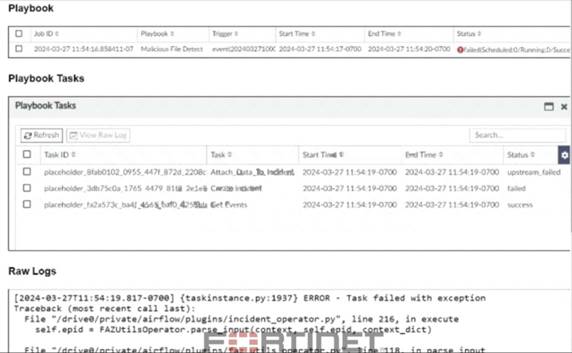
The Malicious File Detect playbook is configured to create an incident when an event handler generates a malicious file detection event.
Why did the Malicious File Detect playbook execution fail?
- A. The Create Incident task was expecting a name or number as input, but received an incorrect data format
- B. The Get Events task did not retrieve any event data.
- C. The Attach_Data_To_lncident incident task wasexpecting an integer, but received an incorrect data format.
- D. The Attach Data To Incident task failed, which stopped the playbook execution.
Answer: A
Explanation:
Understanding the Playbook Configuration:
The "Malicious File Detect" playbook is designed to create an incident when a malicious file detection event is triggered.
The playbook includes tasks such asAttach_Data_To_Incident,Create Incident, andGet Events.
Analyzing the Playbook Execution:
The exhibit shows that theCreate Incidenttask has failed, and theAttach_Data_To_Incidenttask has also failed.
TheGet Eventstask succeeded, indicating that it was able to retrieve event data.
Reviewing Raw Logs:
The raw logs indicate an error related to parsing input in theincident_operator.pyfile.
The error traceback suggests that the task was expecting a specific input format (likely a name or number) but received an incorrect data format.
Identifying the Source of the Failure:
TheCreate Incidenttask failure is the root cause since it did not proceed correctly due to incorrect input format.
TheAttach_Data_To_Incidenttask subsequently failed because it depends on the successful creation of an incident.
Conclusion:
The primary reason for the playbook execution failure is that theCreate Incidenttask received an incorrect data format, which was not a name or number as expected.
References:
Fortinet Documentation on Playbook and Task Configuration.
Error handling and debugging practices in playbook execution.
NEW QUESTION 3
Refer to Exhibit: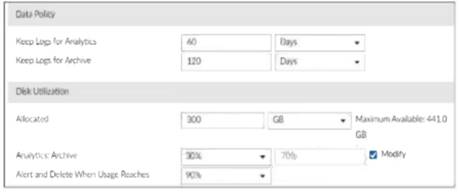
You are tasked with reviewing a new FortiAnalyzer deployment in a network with multiple registered logging devices. There is only one FortiAnalyzer in the topology.
Which potential problem do you observe?
- A. The disk space allocated is insufficient.
- B. The analytics-to-archive ratio is misconfigured.
- C. The analytics retention period is too long.
- D. The archive retention period is too long.
Answer: B
Explanation:
Understanding FortiAnalyzer Data Policy and Disk Utilization:
FortiAnalyzer uses data policies to manage log storage, retention, and disk utilization.
The Data Policy section indicates how long logs are kept for analytics and archive purposes.
The Disk Utilization section specifies the allocated disk space and the proportions used for analytics and archive, as well as when alerts should be triggered based on disk usage.
Analyzing the Provided Exhibit:
Keep Logs for Analytics:60 Days
Keep Logs for Archive:120 Days
Disk Allocation:300 GB (with a maximum of 441 GB available)
Analytics: Archive Ratio:30% : 70%
Alert and Delete When Usage Reaches:90%
Potential Problems Identification:
Disk Space Allocation:The allocated disk space is 300 GB out of a possible 441 GB, which might not be insufficient if the log volume is high, but it is not the primary concern based on the given data.
Analytics-to-Archive Ratio:The ratio of 30% for analytics and 70% for archive is unconventional. Typically, a higher percentage is allocated for analytics since real-time or recent data analysis is often prioritized. A common configuration might be a 70% analytics and 30% archive ratio. The misconfigured ratio can lead to insufficient space for analytics, causing issues with real-time monitoring and analysis.
Retention Periods:While the retention periods could be seen as lengthy, they are not necessarily indicative of a problem without knowing the specific log volume and compliance requirements. The length of these periods can vary based on organizational needs and legal requirements.
Conclusion:
Based on the analysis, the primary issue observed is theanalytics-to-archive ratiobeing misconfigured. This misconfiguration can significantly impact the effectiveness of the FortiAnalyzer in real-time log analysis, potentially leading to delayed threat detection and response.
References:
Fortinet Documentation on FortiAnalyzer Data Policies and Disk Management.
Best Practices for FortiAnalyzer Log Management and Disk Utilization.
NEW QUESTION 4
Which FortiAnalyzer feature uses the SIEM database for advance log analytics and monitoring?
- A. Threat hunting
- B. Asset Identity Center
- C. Event monitor
- D. Outbreak alerts
Answer: A
Explanation:
Understanding FortiAnalyzer Features:
FortiAnalyzer includes several features for log analytics, monitoring, and incident response.
The SIEM (Security Information and Event Management) database is used to store and analyze log data, providing advanced analytics and insights.
Evaluating the Options:
Option A: Threat hunting
Threat hunting involves proactively searching through log data to detect and isolate threats that may not be captured by automated tools.
This feature leverages the SIEM database to perform advanced log analytics, correlate events, and identify potential security incidents.
Option B: Asset Identity Center
This feature focuses on asset and identity management rather than advanced log analytics.
Option C: Event monitor
While the event monitor provides real-time monitoring and alerting based on logs, it does not specifically utilize advanced log analytics in the way the SIEM database does for threat hunting.
Option D: Outbreak alerts
Outbreak alerts provide notifications about widespread security incidents but are not directly related to advanced log analytics using the SIEM database.
Conclusion:
The feature that uses the SIEM database for advanced log analytics and monitoring in
FortiAnalyzer isThreat hunting.
References:
Fortinet Documentation on FortiAnalyzer Features and SIEM Capabilities.
Security Best Practices and Use Cases for Threat Hunting.
NEW QUESTION 5
When does FortiAnalyzer generate an event?
- A. When a log matches a filter in a data selector
- B. When a log matches an action in a connector
- C. When a log matches a rule in an event handler
- D. When a log matches a task in a playbook
Answer: C
Explanation:
Understanding Event Generation in FortiAnalyzer:
FortiAnalyzer generates events based on predefined rules and conditions to help in monitoring and responding to security incidents.
Analyzing the Options:
Option A:Data selectors filter logs based on specific criteria but do not generate events on their own.
Option B:Connectors facilitate integrations with other systems but do not generate events based on log matches.
Option C:Event handlers are configured with rules that define the conditions under which events are generated. When a log matches a rule in an event handler, FortiAnalyzer generates an event.
Option D:Tasks in playbooks execute actions based on predefined workflows but do not directly generate events based on log matches.
Conclusion:
FortiAnalyzer generates an event when a log matches a rule in an event handler.
References:
Fortinet Documentation on Event Handlers and Event Generation in FortiAnalyzer.
Best Practices for Configuring Event Handlers in FortiAnalyzer.
NEW QUESTION 6
Which FortiAnalyzer connector can you use to run automation stitches9
- A. FortiCASB
- B. FortiMail
- C. Local
- D. FortiOS
Answer: D
Explanation:  Overview of Automation Stitches:
 Automation stitches in FortiAnalyzer are predefined sets of automated actions triggered by specific events. These actions help in automating responses to security incidents, improving efficiency, and reducing the response time. FortiAnalyzer Connectors: FortiAnalyzer integrates with various Fortinet products and other third-party solutions through connectors. These connectors facilitate communication and data exchange, enabling centralized management and automation. Available Connectors for Automation Stitches: FortiCASB: FortiCASB is a Cloud Access Security Broker that helps secure SaaS applications.
However, it is not typically used for running automation stitches within FortiAnalyzer.
NEW QUESTION 7
Refer to the exhibits.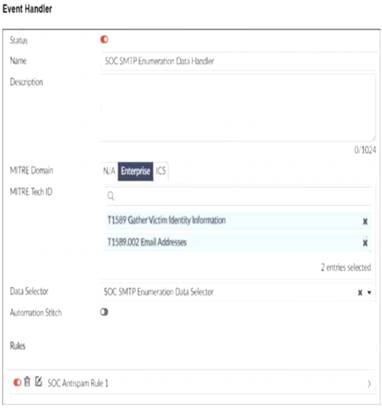
You configured a custom event handler and an associated rule to generate events whenever FortiMail detects spam emails. However, you notice that the event handler is generating events for both spam emails and clean emails.
Which change must you make in the rule so that it detects only spam emails?
- A. In the Log Type field, select Anti-Spam Log (spam)
- B. Disable the rule to use the filter in the data selector to create the event.
- C. In the Trigger an event when field, select Within a group, the log field Spam Name (snane) has 2 or more unique values.
Answer: A
Explanation:
Understanding the Custom Event Handler Configuration:
The event handler is set up to generate events based on specific log data.
The goal is to generate events specifically for spam emails detected by FortiMail.
Analyzing the Issue:
The event handler is currently generating events for both spam emails and clean emails.
This indicates that the rule's filtering criteria are not correctly distinguishing between spam and non-spam emails.
Evaluating the Options:
Option A:Selecting the "Anti-Spam Log (spam)" in the Log Type field will ensure that only logs related to spam emails are considered. This is the most straightforward and accurate way to filter for spam emails.
Option B:Typingtype==spamin the Log filter by Text field might help filter the logs, but it is not as direct and reliable as selecting the correct log type.
Option C:Disabling the rule to use the filter in the data selector to create the event does not address the issue of filtering for spam logs specifically.
Option D:Selecting "Within a group, the log field Spam Name (snane) has 2 or more unique values" is not directly relevant to filtering spam logs and could lead to incorrect filtering criteria.
Conclusion:
The correct change to make in the rule is to select "Anti-Spam Log (spam)" in the Log Type field.
This ensures that the event handler only generates events for spam emails.
References:
Fortinet Documentation on Event Handlers and Log Types.
Best Practices for Configuring FortiMail Anti-Spam Settings.
NEW QUESTION 8
Refer to the exhibit.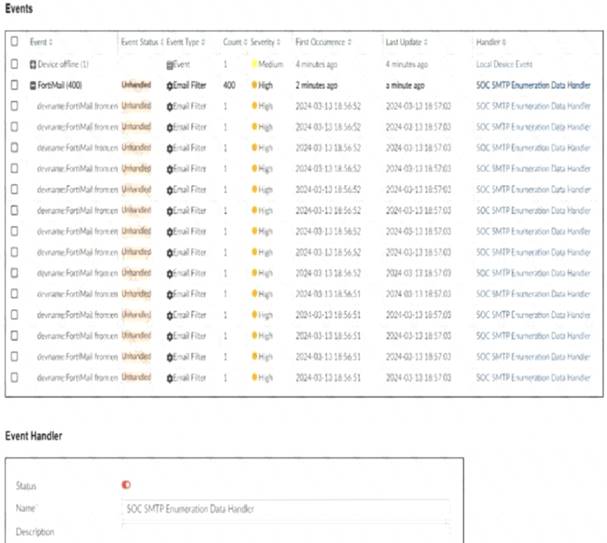
You notice that the custom event handler you configured to detect SMTP reconnaissance activities is creating a large number of events. This is overwhelming your notification system.
How can you fix this?
- A. Increase the trigger count so that it identifies and reduces the count triggered by a particular group.
- B. Disable the custom event handler because it is not working as expected.
- C. Decrease the time range that the custom event handler covers during the attack.
- D. Increase the log field value so that it looks for more unique field values when it creates the event.
Answer: A
Explanation:
Understanding the Issue:
The custom event handler for detecting SMTP reconnaissance activities is generating a large number of events.
This high volume of events is overwhelming the notification system, leading to potential alert fatigue and inefficiency in incident response.
Event Handler Configuration:
Event handlers are configured to trigger alerts based on specific criteria.
The frequency and volume of these alerts can be controlled by adjusting the trigger conditions.
Possible Solutions:
* A. Increase the trigger count so that it identifies and reduces the count triggered by a particular group:
By increasing the trigger count, you ensure that the event handler only generates alerts after a higher threshold of activity is detected.
This reduces the number of events generated and helps prevent overwhelming the notification system.
Selected as it effectively manages the volume of generated events.
* B. Disable the custom event handler because it is not working as expected:
Disabling the event handler is not a practical solution as it would completely stop monitoring for SMTP reconnaissance activities.
Not selected as it does not address the issue of fine-tuning the event generation.
* C. Decrease the time range that the custom event handler covers during the attack:
Reducing the time range might help in some cases, but it could also lead to missing important activities if the attack spans a longer period.
Not selected as it could lead to underreporting of significant events.
* D. Increase the log field value so that it looks for more unique field values when it creates the event:
Adjusting the log field value might refine the event criteria, but it does not directly control the volume of alerts.
Not selected as it is not the most effective way to manage event volume.
Implementation Steps:
Step 1: Access the event handler configuration in FortiAnalyzer.
Step 2: Locate the trigger count setting within the custom event handler for SMTP reconnaissance.
Step 3: Increase the trigger count to a higher value that balances alert sensitivity and volume.
Step 4: Save the configuration and monitor the event generation to ensure it aligns with expected levels.
Conclusion:
By increasing the trigger count, you can effectively reduce the number of events generated by the custom event handler, preventing the notification system from being overwhelmed.
References:
Fortinet Documentation on Event Handlers and Configuration FortiAnalyzer Administration Guide
Best Practices for Event Management Fortinet Knowledge Base
By increasing the trigger count in the custom event handler, you can manage the volume of generated events and prevent the notification system from being overwhelmed.
NEW QUESTION 9
Refer to the Exhibit: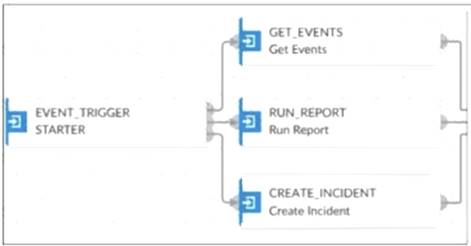
An analyst wants to create an incident and generate a report whenever FortiAnalyzer generates a malicious attachment event based on FortiSandbox analysis. The endpoint hosts are protected by FortiClient EMS integrated with FortiSandbox. All devices are logging to FortiAnalyzer.
Which connector must the analyst use in this playbook?
- A. FortiSandbox connector
- B. FortiClient EMS connector
- C. FortiMail connector
- D. Local connector
Answer: A
Explanation:
Understanding the Requirements:
The objective is to create an incident and generate a report based on malicious attachment events detected by FortiAnalyzer from FortiSandbox analysis.
The endpoint hosts are protected by FortiClient EMS, which is integrated with FortiSandbox. All logs are sent to FortiAnalyzer.
Key Components:
FortiAnalyzer: Centralized logging and analysis for Fortinet devices.
FortiSandbox: Advanced threat protection system that analyzes suspicious files and URLs.
FortiClient EMS: Endpoint management system that integrates with FortiSandbox for endpoint protection.
Playbook Analysis:
The playbook in the exhibit consists of three main actions:GET_EVENTS,RUN_REPORT, andCREATE_INCIDENT.
EVENT_TRIGGER: Starts the playbook when an event occurs.
GET_EVENTS: Fetches relevant events.
RUN_REPORT: Generates a report based on the events.
CREATE_INCIDENT: Creates an incident in the incident management system.
Selecting the Correct Connector:
The correct connector should allow fetching events related to malicious attachments analyzed by FortiSandbox and facilitate integration with FortiAnalyzer.
Connector Options:
FortiSandbox Connector:
Directly integrates with FortiSandbox to fetch analysis results and events related to malicious attachments.
Best suited for getting detailed sandbox analysis results.
Selected as it is directly related to the requirement of handling FortiSandbox analysis events.
FortiClient EMS Connector:
Used for managing endpoint security and integrating with endpoint logs.
Not directly related to fetching sandbox analysis events.
Not selected as it is not directly related to the sandbox analysis events.
FortiMail Connector:
Used for email security and handling email-related logs and events.
Not applicable for sandbox analysis events.
Not selected as it does not relate to the sandbox analysis.
Local Connector:
Handles local events within FortiAnalyzer itself.
Might not be specific enough for fetching detailed sandbox analysis results.
Not selected as it may not provide the required integration with FortiSandbox.
Implementation Steps:
Step 1: Ensure FortiSandbox is configured to send analysis results to FortiAnalyzer.
Step 2: Use the FortiSandbox connector in the playbook to fetch events related to malicious attachments.
Step 3: Configure theGET_EVENTSaction to use the FortiSandbox connector.
Step 4: Set up theRUN_REPORTandCREATE_INCIDENTactions based on the fetched events.
References:
Fortinet Documentation on FortiSandbox Integration FortiSandbox Integration Guide
Fortinet Documentation on FortiAnalyzer Event Handling FortiAnalyzer Administration Guide
By using the FortiSandbox connector, the analyst can ensure that the playbook accurately fetches events based on FortiSandbox analysis and generates the required incident and report.
NEW QUESTION 10
Refer to the exhibit.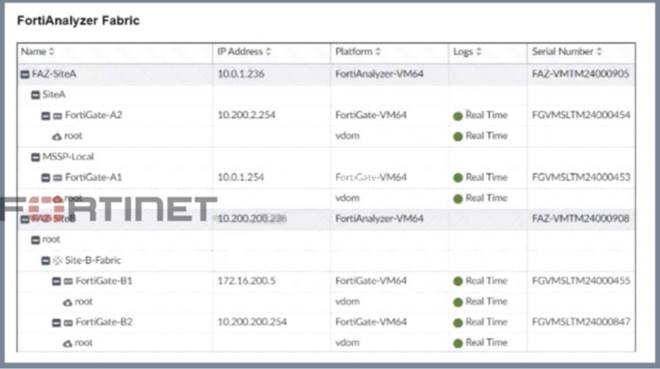
Assume that all devices in the FortiAnalyzer Fabric are shown in the image.
Which two statements about the FortiAnalyzer Fabric deployment are true? (Choose two.)
- A. FortiGate-B1 and FortiGate-B2 are in a Security Fabric.
- B. There is no collector in the topology.
- C. All FortiGate devices are directly registered to the supervisor.
- D. FAZ-SiteA has two ADOMs enabled.
Answer: AD
Explanation:
Understanding the FortiAnalyzer Fabric:
The FortiAnalyzer Fabric provides centralized log collection, analysis, and reporting for connected FortiGate devices.
Devices in a FortiAnalyzer Fabric can be organized into different Administrative Domains (ADOMs) to separate logs and management.
Analyzing the Exhibit:
FAZ-SiteAandFAZ-SiteBare FortiAnalyzer devices in the fabric.
FortiGate-B1andFortiGate-B2are shown under theSite-B-Fabric, indicating they are part of the same Security Fabric.
FAZ-SiteAhas multiple entries under it:SiteAandMSSP-Local, suggesting multiple ADOMs are enabled.
Evaluating the Options:
Option A:FortiGate-B1 and FortiGate-B2 are underSite-B-Fabric, indicating they are indeed part of the same Security Fabric.
Option B:The presence of FAZ-SiteA and FAZ-SiteB as FortiAnalyzers does not preclude the existence of collectors. However, there is no explicit mention of a separate collector role in the exhibit.
Option C:Not all FortiGate devices are directly registered to the supervisor. The exhibit shows hierarchical organization under different sites and ADOMs.
Option D:The multiple entries underFAZ-SiteA(SiteA and MSSP-Local) indicate that FAZ-SiteA has two ADOMs enabled.
Conclusion:
FortiGate-B1 and FortiGate-B2 are in a Security Fabric.
FAZ-SiteA has two ADOMs enabled.
References:
Fortinet Documentation on FortiAnalyzer Fabric Topology and ADOM Configuration.
Best Practices for Security Fabric Deployment with FortiAnalyzer.
NEW QUESTION 11
......
Thanks for reading the newest FCSS_SOC_AN-7.4 exam dumps! We recommend you to try the PREMIUM Dumps-files.com FCSS_SOC_AN-7.4 dumps in VCE and PDF here: https://www.dumps-files.com/files/FCSS_SOC_AN-7.4/ (32 Q&As Dumps)
