
Your success in Juniper JN0-664 is our sole target and we develop all our JN0-664 braindumps in a way that facilitates the attainment of this target. Not only is our JN0-664 study material the best you can find, it is also the most detailed and the most updated. JN0-664 Practice Exams for Juniper JN0-664 are written to the highest standards of technical accuracy.
Free JN0-664 Demo Online For Juniper Certifitcation:
NEW QUESTION 1
When using OSPFv3 for an IPv4 environment, which statement is correct?
- A. OSPFv3 only supports IPv4.
- B. OSPFv3 supports both IPv6 and IPv4, but not in the same routing instance.
- C. OSPFv3 is not backward compatible with IPv4
- D. OSPFv3 supports IPv4 only on interfaces with family inet6 defined
Answer: C
Explanation:
OSPFv3 is an extension of OSPFv2 that supports IPv6 routing and addressing. OSPFv3 is not backward compatible with IPv4 because it uses a different packet format and a different link-state advertisement (LSA) structure than OSPFv2. OSPFv3 also uses IPv6 link-local addresses as router IDs and neighbor addresses, instead of IPv4 addresses. To use OSPFv3 for an IPv4 environment, you need to enable the IPv4 unicast address family under [edit protocols ospf3] hierarchy level and configure IPv4 addresses on the interfaces.
NEW QUESTION 2
Exhibit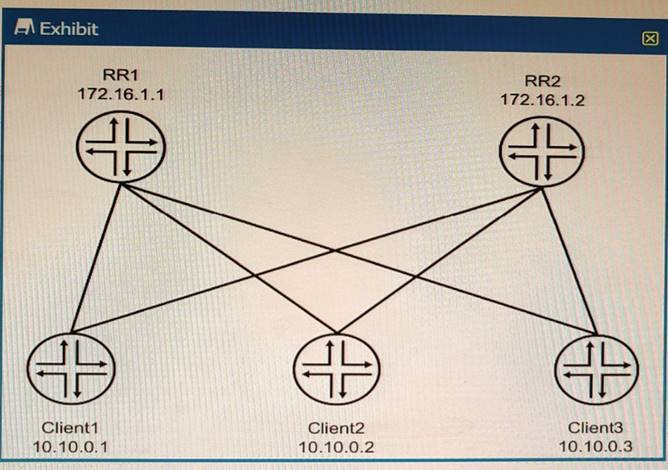
The environment is using BGP All devices are in the same AS with reachability redundancy Referring to the exhibit, which statement is correct?
- A. RR1 is peered to Client2 and RR2
- B. RR2 is in an OpenConfirm State until RR1 becomes unreachable.
- C. Client1 is peered to Client2 and Client3.
- D. Peering is dynamically discovered between all devices.
Answer: A
Explanation:
BGP route reflectors are BGP routers that are allowed to ignore the IBGP loop avoidance rule and advertise IBGP learned routes to other IBGP peers under specific conditions. BGP route reflectors can reduce the number of IBGP sessions and updates in a network by eliminating the need for a full mesh of IBGP peers. BGP route reflectors can have three types of peerings:
✑ EBGP neighbor: A BGP router that belongs to a different autonomous system (AS) than the route reflector.
✑ IBGP client neighbor: An IBGP router that receives reflected routes from the route reflector. A client does not need to peer with other clients or non-clients.
✑ IBGP non-client neighbor: An IBGP router that does not receive reflected routes from the route reflector. A non-client needs to peer with other non-clients and the route reflector.
In the exhibit, we can see that RR1 and RR2 are route reflectors in the same AS with reachability redundancy. They have two types of peerings: EBGP neighbors (R1 and R4) and IBGP client neighbors (Client1, Client2, and Client3). RR1 and RR2 are also peered with each other as IBGP non-client neighbors.
NEW QUESTION 3
By default, which statement is correct about OSPF summary LSAs?
- A. All Type 2 and Type 7 LSAs will be summanzed into a single Type 5 LSA
- B. The area-range command must be installed on all routers.
- C. Type 3 LSAs are advertised for routes in Type 1 LSAs.
- D. The metric associated with a summary route will be equal to the lowest metric associated with an individual contributing route
Answer: C
Explanation:
OSPF uses different types of LSAs to describe different aspects of the network topology. Type 1 LSAs are also known as router LSAs, and they describe the links and interfaces of a router within an area. Type 3 LSAs are also known as summary LSAs, and they describe routes to networks outside an area but within the same autonomous system (AS). By default, OSPF will summarize routes from Type 1 LSAs into Type 3 LSAs when advertising them across area boundaries .
NEW QUESTION 4
Exhibit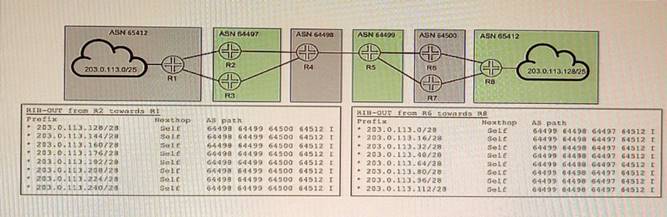
R1 and R8 are not receiving each other's routes
Referring to the exhibit, what are three configuration commands that would solve this problem? (Choose three.)
- A. Configure loops and advertise-peer-as on routers in AS 64497 and AS 64450.
- B. Configure loops on routers in AS 65412 and advertise-peer-as on routers in AS 64498.
- C. Configure as-override on advertisement from AS 64500 toward AS 64512.
- D. Configure remove-private on advertisements from AS 64497 toward AS 64498
- E. Configure remove-private on advertisements from AS 64500 toward AS 64499
Answer: BDE
Explanation:
The problem in this scenario is that R1 and R8 are not receiving each other’s routes because of private AS numbers in the AS path. Private AS numbers are not globally unique and are not advertised to external BGP peers. To solve this problem, you need to do the following:
✑ Configure loops on routers in AS 65412 and advertise-peer-as on routers in AS 64498. This allows R5 and R6 to advertise their own AS number (65412) instead of their peer’s AS number (64498) when sending updates to R7 and R8. This prevents a loop detection issue that would cause R7 and R8 to reject the routes from R5 and R62.
✑ Configure remove-private on advertisements from AS 64497 toward AS 64498 and from AS 64500 toward AS 64499. This removes any private AS numbers from the AS path before sending updates to external BGP peers. This allows R2 and R3 to receive the routes from R1 and R4, respectively3.
NEW QUESTION 5
Which two statements describe PIM-SM? (Choose two)
- A. Routers with receivers send join messages to their upstream neighbors.
- B. Routers without receivers must periodically prune themselves from the SPT.
- C. Traffic is initially flooded to all routers and an S,G is maintained for each group
- D. Traffic is only forwarded to routers that request to join the distribution tree.
Answer: AD
Explanation:
PIM sparse mode (PIM-SM) is a multicast routing protocol that uses a pull model to deliver multicast traffic. In PIM-SM, routers with receivers send join messages to their upstream neighbors toward a rendezvous point (RP) or a source-specific tree (SPT). The RP or SPT acts as the root of a shared distribution tree for a multicast group. Traffic is only forwarded to routers that request to join the distribution tree by sending join messages. PIM-SM does not flood traffic to all routers or prune routers without receivers, as PIM dense mode does.
NEW QUESTION 6
Exhibit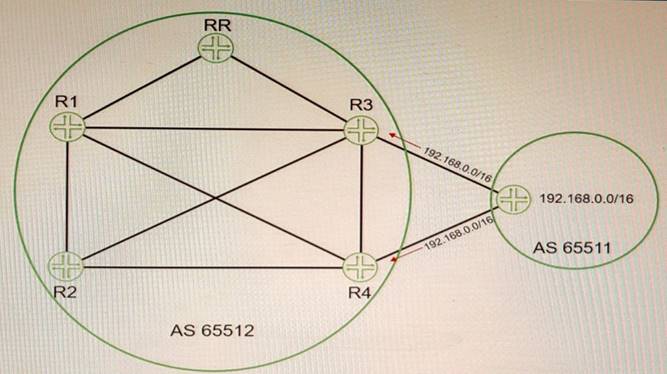
Referring to the exhibit, you are receiving the 192.168 0 0/16 route on both R3 and R4 from your EBGP neighbor You must ensure that R1 and R2 receive both BGP routes from the route reflector
In this scenario, which BGP feature should you configure to accomplish this behavior?
- A. add-path
- B. multihop
- C. multipath
- D. route-target
Answer: A
Explanation:
BGP add-path is a feature that allows the advertisement of multiple paths through the same peering session for the same prefix without the new paths implicitly replacing any previous paths. This behavior promotes path diversity and reduces multi-exit discriminator (MED) oscillations. BGP add-path is implemented by adding a path identifier to each path in the NLRI. The path identifier can be considered as something similar to a route distinguisher in VPNs, except that a path ID can apply to any address family. Path IDs are unique to a peering session and are generated for each network3. In this question, we have a route reflector (RR) that receives two routes for the same prefix (192.168.0.0/16) from an EBGP neighbor. By default, the RR will only advertise its best path to its clients (R1 and R2). However, we want R1 and R2 to receive both routes from the RR. To achieve this, we need to configure BGP add-path on the RR and enable it to send multiple paths for the same prefix to its clients.
Reference: 3: https://www.cisco.com/c/en/us/td/docs/ios-
xml/ios/iproute_bgp/configuration/xe-16/irg-xe-16-book/bgp-additional-paths.html
NEW QUESTION 7
Exhibit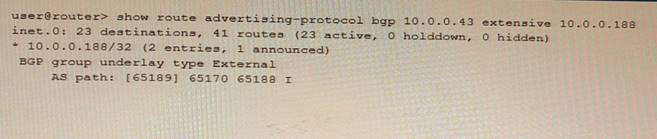
Referring to the exhibit, what do the brackets [ ] in the AS path identify?
- A. They identify the local AS number associated with the AS path if configured on the router, or if AS path prepending is configured
- B. They identify an AS set, which are groups of AS numbers in which the order does not matter
- C. They identify that the autonomous system number is incomplete and awaiting more information from the BGP protocol.
- D. They identify that a BGP confederation is being used to ensure that there are no routing loops.
Answer: B
Explanation:
The brackets [ ] in the AS path identify an AS set, which are groups of AS numbers in which the order does not matter. An AS set is used when BGP aggregates routes from different ASs into a single prefix. For example, if BGP aggregates routes 10.0.0.0/16 and 10.1.0.0/16 from AS 100 and AS 200, respectively, into a single prefix 10.0.0.0/15, then the AS path for this prefix will be [100 200]. An AS set reduces the length of the AS path and prevents routing loops.
NEW QUESTION 8
Exhibit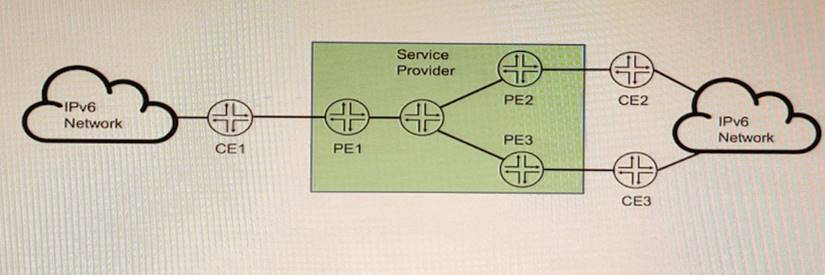
You are running a service provider network and must transport a customer's IPv6 traffic across your IPv4-based MPLS network using BGP You have already configured mpis ipv6- tunneling on your PE routers.
Which two statements are correct about the BGP configuration in this scenario? (Choose two.)
- A. You must configure family inet6 labcled-unicast between PE routers.
- B. You must configure family inet6 unicaat between PE and CE routers.
- C. You must configure family inet6 add-path between PE and CE routers.
- D. You must configure family inet6 unicast between PE routers
Answer: AB
Explanation:
To transport IPv6 traffic over an IPv4-based MPLS network using BGP, you need to configure two address families: family inet6 labeled-unicast and family inet6 unicast. The former is used to exchange IPv6 routes with MPLS labels between PE routers, and the latter is used to exchange IPv6 routes without labels between PE and CE routers. The mpis ipv6-tunneling command enables the PE routers to encapsulate the IPv6 packets with an MPLS label stack and an IPv4 header before sending them over the MPLS network.
NEW QUESTION 9
You are responding to an RFP for a new MPLS VPN implementation. The solution must use LDP for signaling and support Layer 2 connectivity without using BGP The solution must be scalable and support multiple VPN connections over a single MPLS LSP The customer wants to maintain all routing for their Private network
In this scenario, which solution do you propose?
- A. circuit cross-connect
- B. BGP Layer 2 VPN
- C. LDP Layer 2 circuit
- D. translational cross-connect
Answer: C
Explanation:
AToM (Any Transport over MPLS) is a framework that supports various Layer 2 transport types over an MPLS network core. One of the transport types supported by AToM is LDP Layer 2 circuit, which is a point-to-point Layer 2 connection that uses LDP for signaling and MPLS for forwarding. LDP Layer 2 circuit can support Layer 2 connectivity without using BGP and can be scalable and efficient by using a single MPLS LSP for multiple VPN connections. The customer can maintain all routing for their private network by using their own CE switches.
NEW QUESTION 10
After a recent power outage, your manager asks you to investigate ways to automatically reduce the impact caused by suboptimal routing in your OSPF and OSPFv3 network after devices reboot.
Which three configuration statements accomplish this task? (Choose three.)
- A. set protocols ospf overload timeout 900
- B. set protocols ospf3 realm ipv4-unicast overload timeout 900
- C. set protocols ospf overload
- D. set protocols oapf3 overload timeout 900
- E. set protocols ospf3 overload
Answer: AE
Explanation:
To reduce the impact of suboptimal routing in OSPF and OSPFv3 after devices reboot, you can use the overload feature to prevent a router from being used as a transit router for a specified period of time. This allows the router to stabilize its routing table before forwarding traffic for other routers. To enable the overload feature, you need to do the following:
✑ For OSPF, configure the overload statement under [edit protocols ospf] hierarchy level. You can also specify a timeout value in seconds to indicate how long the router should remain in overload state after it boots up. For example, set protocols ospf overload timeout 900 means that the router will be in overload state for 15 minutes after it boots up.
✑ For OSPFv3, configure the overload statement under [edit protocols ospf3] hierarchy level. You can also specify a realm (ipv4-unicast or ipv6-unicast) and a timeout value in seconds to indicate how long the router should remain in overload state after it boots up for each realm. For example, set protocols ospf3 realm ipv4- unicast overload timeout 900 means that the router will be in overload state for 15 minutes after it boots up for IPv4 unicast routing.
NEW QUESTION 11
Which two EVPN route types are used to advertise a multihomed Ethernet segment? (Choose two )
- A. Type 1
- B. Type 3
- C. Type 4
- D. Type 2
Answer: AC
Explanation:
EVPN is a solution that provides Ethernet multipoint services over MPLS networks. EVPN uses BGP to distribute endpoint provisioning information and set up pseudowires between PE devices. EVPN uses different route types to convey different information in the control plane. The following are the main EVPN route types:
✑ Type 1 - Ethernet Auto-Discovery Route: This route type is used for network-wide messaging and discovery of other PE devices that are part of the same EVPN instance. It also carries information about the redundancy mode and load balancing algorithm of the PE devices.
✑ Type 2 - MAC/IP Advertisement Route: This route type is used for MAC and IP address learning and advertisement between PE devices. It also carries information about the Ethernet segment identifier (ESI) and the label for forwarding traffic to the MAC or IP address.
✑ Type 3 - Inclusive Multicast Ethernet Tag Route: This route type is used for broadcast, unknown unicast, and multicast (BUM) traffic forwarding. It also carries information about the multicast group and the label for forwarding BUM traffic.
✑ Type 4 - Ethernet Segment Route: This route type is used for multihoming scenarios, where a CE device is connected to more than one PE device. It also carries information about the ESI and the designated forwarder (DF) election process.
NEW QUESTION 12
Exhibit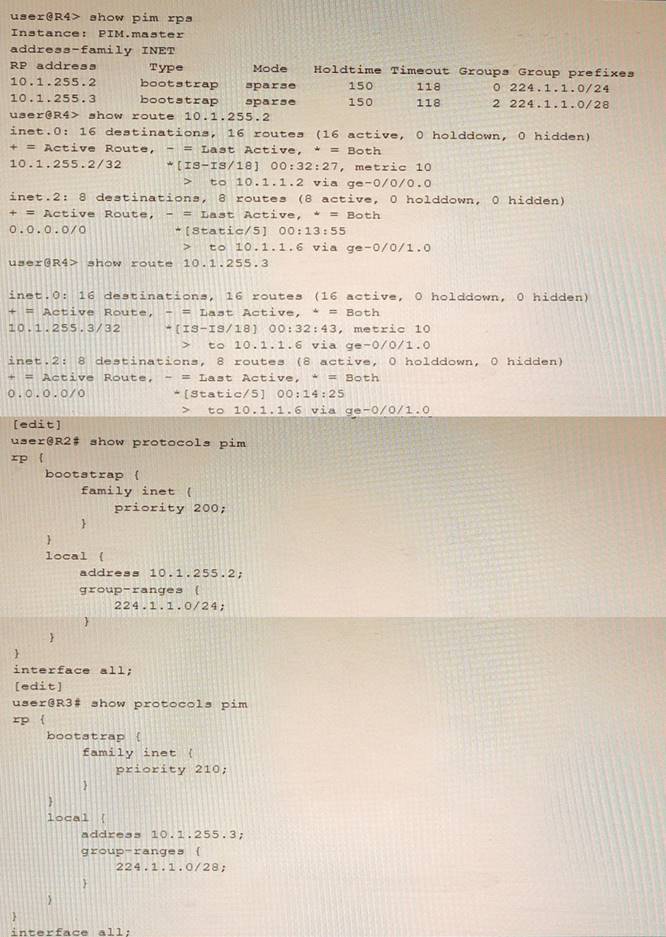
R4 is directly connected to both RPs (R2 and R3) R4 is currently sending all ,o,ns upstream to R3 but you want all joins to go to R2 instead Referring to the exhibit, which configuration change will solve this issue?
- A. Change the bootstrap priority on R2 to be higher than R3
- B. Change the default route in inet.2 on R4 from R3 as the next hop to R2
- C. Change the local address on R2 to be higher than R3.
- D. Change the group-range to be more specific on R2 than R3.
Answer: A
Explanation:
PIM Bootstrap Router (BSR) is a mechanism that allows PIM routers to discover and announce rendezvous point (RP) information for multicast groups. BSR uses two roles: candidate BSR and candidate RP. Candidate BSR is the router that collects information from all available RPs in the network and advertises it throughout the network. Candidate RP is the router that wants to become the RP and registers itself with the BSR. There can be only one active BSR in the network, which is elected based on the highest priority or highest IP address if the priority is the same. The BSR priority can be configured manually or assigned automatically. The default priority is 0 and the highest priority is 2515. In this question, R4 is directly connected to both RPs (R2 and R3) and is currently sending all joins upstream to R3 but we want all joins to go to R2 instead. To achieve this, we need to change the BSR priority on R2 to be higher than R3 so that R2 becomes the active BSR and advertises its RP information to R4.
Reference: 1: https://study-ccnp.com/multicast-rendezvous-points-explained/
NEW QUESTION 13
Exhibit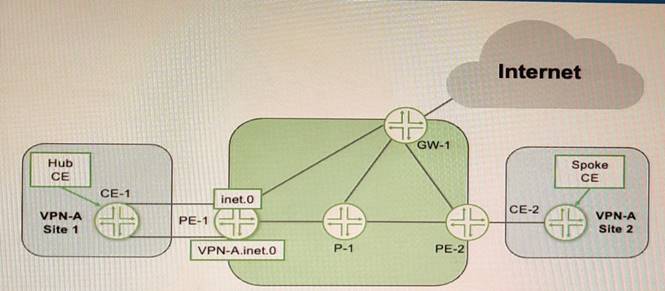
Referring to the exhibit, you must provide Internet access for VPN-A using CE-1 as the hub CE.
Which two statements are correct in this situation? (Choose two.)
- A. You must use RIB groups to leak routes between the ine
- B. o and vpn-
- C. ine
- D. o tables.
- E. RIB groups are not needed to leak routes between the ine
- F. 0 and VPN—
- G. ine
- H. 0 tables,
- I. Internet traffic from Site 2 takes the path of PE-2 -> PE-1 -> GW-1.
- J. Internet traffic from Site 2 takes the path of PE-2 -> PE-1 -> CE-1 -> PE-1 -> GW-1.
Answer: AD
Explanation:
To provide Internet access for VPN-A using CE-1 as the hub CE, you need to do the following:
✑ You must use RIB groups to leak routes between the inet.0 and vpn-a.inet.0 tables on PE-1 and CE-1. RIB groups are routing options that allow you to import routes from one routing table into another routing table based on certain criteria. In this scenario, you need to configure RIB groups on PE-1 and CE-1 to import Internet routes from inet.0 into vpn-a.inet.0 and vice versa.
✑ Internet traffic from Site 2 takes the path of PE-2 -> PE-1 -> CE-1 -> PE-1 -> GW-1. This is because Site 2 does not have direct Internet access and needs to use CE-1 as its default gateway for Internet traffic. Site 2 sends its Internet traffic to PE-2, which forwards it to PE-1 based on VPN-A routes. PE-1 then sends it to CE- 1 based on RIB group import policy. CE-1 then sends it back to PE-1 based on its default route pointing to GW-1. PE-1 then forwards it to GW-1 based on RIB group import policy again.
NEW QUESTION 14
Which statement is correct about IS-IS when it performs the Dijkstra algorithm?
- A. The local router moves its own local tuples into the candidate database
- B. When a new neighbor ID in the tree database matches a router ID in the LSDB, the neighbor ID is moved to the candidate database
- C. Tuples with the lowest cost are moved from the tree database to the LSDB.
- D. The algorithm will stop processing once the tree database is empty.
Answer: A
Explanation:
IS-IS is a link-state routing protocol that uses the Dijkstra algorithm to compute the shortest paths between nodes in a network. The Dijkstra algorithm maintains three data structures: a tree database, a candidate database, and a link-state database (LSDB). The tree database contains the nodes that have been visited and their shortest distances from the source node. The candidate database contains the nodes that have not been visited yet and their tentative distances from the source node. The LSDB contains the topology information of the network, such as the links and their costs.
The Dijkstra algorithm works as follows:
✑ The local router moves its own local tuples into the tree database. A tuple consists of a node ID, a distance, and a parent node ID. The local router’s tuple has a distance of zero and no parent node.
✑ The local router moves its neighbors’ tuples into the candidate database. The neighbors’ tuples have distances equal to the costs of the links to them and parent node IDs equal to the local router’s node ID.
✑ The local router selects the tuple with the lowest distance from the candidate database and moves it to the tree database. This tuple becomes the current node.
✑ The local router updates the distances of the current node’s neighbors in the candidate database by adding the current node’s distance to the link costs. If a shorter distance is found, the parent node ID is also updated.
✑ The algorithm repeats steps 3 and 4 until either the destination node is reached or the candidate database is empty.
NEW QUESTION 15
Exhibit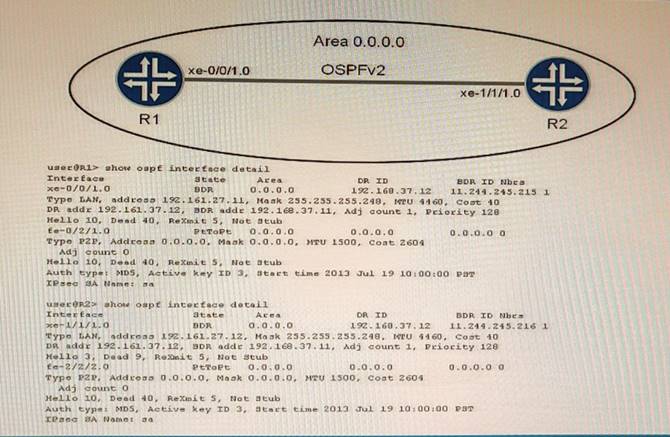
Which two statements are true about the OSPF adjacency displayed in the exhibit? (Choose two.)
- A. There is a mismatch in the hello interval parameter between routers R1 and R2
- B. There is a mismatch in the dead interval parameter between routers R1 and R2.
- C. There is a mismatch in the OSPF hold timer parameter between routers R1 and R2.
- D. There is a mismatch in the poll interval parameter between routers R1 and R2.
Answer: AB
Explanation:
The hello interval is the time interval between two consecutive hello packets sent by an OSPF router on an interface. The dead interval is the time interval after which a neighbor is declared down if no hello packets are received from it. These parameters must match between two OSPF routers for them to form an adjacency. In the exhibit, router R1 has a hello interval of 10 seconds and a dead interval of 40 seconds, while router R2 has a hello interval of 30 seconds and a dead interval of 120 seconds. This causes a mismatch and prevents them from becoming neighbors23.
NEW QUESTION 16
Exhibit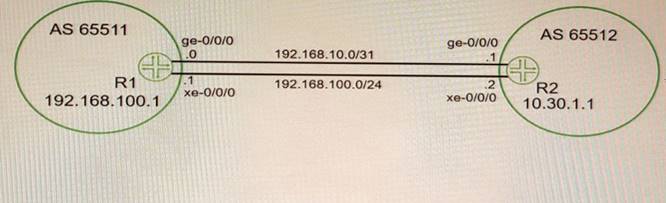
You want to use both links between R1 and R2 Because of the bandwidth difference between the two links, you must ensure that the links are used as much as possible.
Which action will accomplish this goal?
- A. Define a policy to tag routes with the appropriate bandwidth community.
- B. Disable multipath.
- C. Ensure that the metric-out parameter on the Gigabit Ethernet interface is higher than the 10 Gigibit Ethernet interface.
- D. Enable per-prefix load balancing.
Answer: D
Explanation:
VPLS is a Layer 2 VPN technology that allows multiple sites to connect over a shared IP/MPLS network as if they were on the same LAN. VPLS tunnels can be signaled using either Label Distribution Protocol (LDP) or Border Gateway Protocol (BGP). In this question, we have two links between R1 and R2 with different bandwidths (10 Gbps and 1 Gbps). We want to use both links as much as possible for VPLS traffic. To achieve this, we need to enable per-prefix load balancing on both routers. Per-prefix load balancing is a feature that allows a router to distribute traffic across multiple equal-cost or unequal- cost paths based on the destination prefix of each packet. This improves the utilization of multiple links and provides better load sharing than per-flow load balancing, which distributes traffic based on a hash of source and destination addresses4. Per-prefix load balancing can be enabled globally or per interface using the load-balance per-packet command.
Reference: 4: https://www.cisco.com/c/en/us/support/docs/multiprotocol-label-switching-mpls/mpls/137544-technote-mpls-00.html
NEW QUESTION 17
Exhibit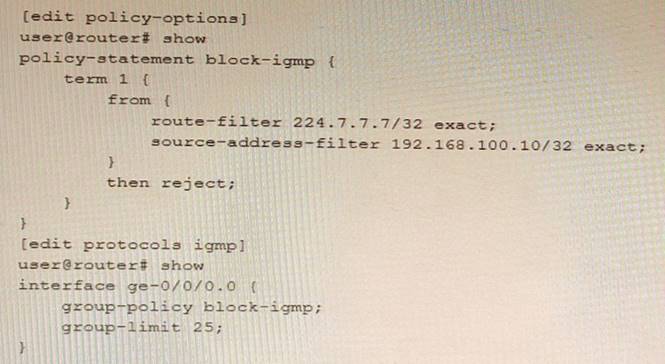
Based on the configuration contents shown in the exhibit, which statement is true?
- A. Joins for group 224.7.7.7 are rejected if the source address is 192.168.100.10
- B. Joins for any group are accepted if the group count value is less than 25.
- C. Joins for group 224.7.7.7 are always rejected, regardless of the group count.
- D. Joins for group 224.7.7.7 are accepted if the group count is less than 25
Answer: D
Explanation:
BGP policy framework is a set of tools that allows you to control the flow of routing information and apply routing policies based on various criteria. BGP policy framework consists of several components, such as route maps, prefix lists, community lists, AS path lists, and route filters. Route maps are used to define routing policies by matching certain conditions and applying certain actions. Prefix lists are used to filter routes based on their prefixes. Community lists are used to filter routes based on their community attributes. AS path lists are used to filter routes based on their AS path attributes. Route filters are used to filter routes based on their prefix length or range3. In this question, we have a route map named ISP-A that has two clauses: clause 10 and clause 20. Clause 10 matches any route with a prefix length between 8 and 24 bits and sets the local preference to 200. Clause 20 matches any route with a prefix of 224.7.7.7/32 and rejects it. The route map is applied inbound on the BGP neighborship with ISP-A. Based on this configuration, the correct statement is that joins for group 224.7.7.7 are always rejected, regardless of the group count. This is because clause 20 explicitly denies any route with a prefix of 224.7.7.7/32, which corresponds to the multicast group 224.7.7.7.
Reference: 3: https://www.cisco.com/c/en/us/td/docs/ios-xml/ios/iproute_bgp/configuration/xe-16/irg-xe-16-book/bgp-policy-framework.html
NEW QUESTION 18
Which two statements are correct about IS-IS interfaces? (Choose two.)
- A. If a broadcast interface is in both L1 and L2, one combined hello message is sent for both levels.
- B. If a point-to-point interface is in both L1 and L2, separate hello messages are sent for each level.
- C. If a point-to-point interface is in both L1 and L2, one combined hello message is sent for both levels.
- D. If a broadcast interface is in both L1 and L2, separate hello messages are sent for each level
Answer: BD
Explanation:
IS-IS supports two levels of routing: Level 1 (intra-area) and Level 2 (interarea). An IS-IS router can be either Level 1 only, Level 2 only, or both Level 1 and Level 2. A router that is both Level 1 and Level 2 is called a Level 1-2 router. A Level 1-2 router sends separate hello messages for each level on both point-to-point and broadcast interfaces1. A point-to-point interface provides a connection between a single source and a single destination. A broadcast interface behaves as if the router is connected to a LAN.
NEW QUESTION 19
Exhibit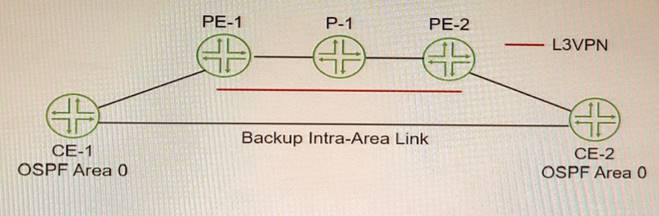
You must ensure that the VPN backbone is preferred over the back door intra-area link as long as the VPN is available. Referring to the exhibit, which action will accomplish this task?
- A. Configure an import routing policy on the CE routers that rejects OSPF routes learned on the backup intra-area link.
- B. Enable OSPF traffic-engineering.
- C. Configure the OSPF metric on the backup intra-area link that is higher than the L3VPN link.
- D. Create an OSPF sham link between the PE routers.
Answer: D
Explanation:
A sham link is a logical link between two PE routers that belong to the same OSPF area but are connected through an L3VPN. A sham link makes the PE routers appear as if they are directly connected, and prevents OSPF from preferring an intra-area back door link over the VPN backbone. To create a sham link, you need to configure the local and remote addresses of the PE routers under the [edit protocols ospf area area-id] hierarchy level1.
NEW QUESTION 20
......
Thanks for reading the newest JN0-664 exam dumps! We recommend you to try the PREMIUM Certleader JN0-664 dumps in VCE and PDF here: https://www.certleader.com/JN0-664-dumps.html (65 Q&As Dumps)
