
It is more faster and easier to pass the MuleSoft MCPA-Level-1 exam by using Exact MuleSoft MuleSoft Certified Platform Architect - Level 1 questuins and answers. Immediate access to the Regenerate MCPA-Level-1 Exam and find the same core area MCPA-Level-1 questions with professionally verified answers, then PASS your exam with a high score now.
MuleSoft MCPA-Level-1 Free Dumps Questions Online, Read and Test Now.
NEW QUESTION 1
What do the API invocation metrics provided by Anypoint Platform provide?
- A. ROI metrics from APIs that can be directly shared with business users
- B. Measurements of the effectiveness of the application network based on the level of reuse
- C. Data on past API invocations to help identify anomalies and usage patterns across various APIs
- D. Proactive identification of likely future policy violations that exceed a given threat threshold
Answer: C
Explanation:
Correct Answer
Data on past API invocations to help identify anomalies and usage patterns across various APIs
*****************************************
API Invocation metrics provided by Anypoint Platform:
>> Does NOT provide any Return Of Investment (ROI) related information. So the option suggesting it is OUT.
>> Does NOT provide any information w.r.t how APIs are reused, whether there is effective usage of APIs or not etc...
>> Does NOT prodive any prediction information as such to help us proactively identify any future policy violations.
So, the kind of data/information we can get from such metrics is on past API invocations to help identify anomalies and usage patterns across various APIs.
NEW QUESTION 2
What API policy would be LEAST LIKELY used when designing an Experience API that is intended to work with a consumer mobile phone or tablet application?
- A. OAuth 2.0 access token enforcement
- B. Client ID enforcement
- C. JSON threat protection
- D. IPwhitellst
Answer: D
Explanation:
Correct Answer
IP whitelist
*****************************************
>> OAuth 2.0 access token and Client ID enforcement policies are VERY common to apply on Experience APIs as API consumers need to register and access the APIs using one of these mechanisms
>> JSON threat protection is also VERY common policy to apply on Experience APIs to prevent bad or suspicious payloads hitting the API implementations.
>> IP whitelisting policy is usually very common in Process and System APIs to only whitelist the IP range inside the local VPC. But also applied occassionally on some experience APIs where the End User/ API Consumers are FIXED.
>> When we know the API consumers upfront who are going to access certain Experience APIs, then we can request for static IPs from such consumers and whitelist them to prevent anyone else hitting the API.
However, the experience API given in the question/ scenario is intended to work with a consumer mobile phone or tablet application. Which means, there is no way we can know all possible IPs that are to be whitelisted as mobile phones and tablets can so many in number and any device in the city/state/country/globe.
So, It is very LEAST LIKELY to apply IP Whitelisting on such Experience APIs whose consumers are typically Mobile Phones or Tablets.
NEW QUESTION 3
An organization has several APIs that accept JSON data over HTTP POST. The APIs are all publicly available and are associated with several mobile applications and web applications.
The organization does NOT want to use any authentication or compliance policies for these APIs, but at the same time, is worried that some bad actor could send payloads that could somehow compromise the applications or servers running the API implementations.
What out-of-the-box Anypoint Platform policy can address exposure to this threat?
- A. Shut out bad actors by using HTTPS mutual authentication for all API invocations
- B. Apply an IP blacklist policy to all APIs; the blacklist will Include all bad actors
- C. Apply a Header injection and removal policy that detects the malicious data before it is used
- D. Apply a JSON threat protection policy to all APIs to detect potential threat vectors
Answer: D
Explanation:
Correct Answer
Apply a JSON threat protection policy to all APIs to detect potential threat vectors
*****************************************
>> Usually, if the APIs are designed and developed for specific consumers (known consumers/customers) then we would IP Whitelist the same to ensure that traffic only comes from them.
>> However, as this scenario states that the APIs are publicly available and being used by so many mobile and web applications, it is NOT possible to identify and blacklist all possible bad actors.
>> So, JSON threat protection policy is the best chance to prevent any bad JSON payloads from such bad actors.
NEW QUESTION 4
What is true about where an API policy is defined in Anypoint Platform and how it is then applied to API instances?
- A. The API policy Is defined In Runtime Manager as part of the API deployment to a Mule runtime, and then ONLY applied to the specific API Instance
- B. The API policy Is defined In API Manager for a specific API Instance, and then ONLY applied to the specific API instance
- C. The API policy Is defined in API Manager and then automatically applied to ALL API instances
- D. The API policy is defined in API Manager, and then applied to ALL API instances in the specified environment
Answer: B
Explanation:
Correct Answer
The API policy is defined in API Manager for a specific API instance, and then ONLY applied to the specific API instance.
*****************************************
>> Once our API specifications are ready and published to Exchange, we need to visit API Manager and register an API instance for each API.
>> API Manager is the place where management of API aspects takes place like addressing NFRs by enforcing policies on them.
>> We can create multiple instances for a same API and manage them differently for different purposes.
>> One instance can have a set of API policies applied and another instance of same API can have different set of policies applied for some other purpose.
>> These APIs and their instances are defined PER environment basis. So, one need to manage them seperately in each environment.
>> We can ensure that same configuration of API instances (SLAs, Policies etc..) gets promoted when promoting to higher environments using platform feature. But this is optional only. Still one can change them per environment basis if they have to.
>> Runtime Manager is the place to manage API Implementations and their Mule Runtimes but NOT APIs itself. Though API policies gets executed in Mule Runtimes, We CANNOT enforce API policies in Runtime Manager. We would need to do that via API Manager only for a cherry picked instance in an environment.
So, based on these facts, right statement in the given choices is - "The API policy is defined in API Manager for a specific API instance, and then ONLY applied to the specific API instance".
NEW QUESTION 5
A set of tests must be performed prior to deploying API implementations to a staging environment. Due to data security and access restrictions, untested APIs cannot be granted access to the backend systems, so instead mocked data must be used for these tests. The amount of available mocked data and its contents is sufficient to entirely test the API implementations with no active connections to the backend systems. What type of tests should be used to incorporate this mocked data?
- A. Integration tests
- B. Performance tests
- C. Functional tests (Blackbox)
- D. Unit tests (Whitebox)
Answer: D
Explanation:
Correct Answer
Unit tests (Whitebox)
*****************************************
NEW QUESTION 6
What are 4 important Platform Capabilities offered by Anypoint Platform?
- A. API Versioning, API Runtime Execution and Hosting, API Invocation, API Consumer Engagement
- B. API Design and Development, API Runtime Execution and Hosting, API Versioning, API Deprecation
- C. API Design and Development, API Runtime Execution and Hosting, API Operations and Management, API Consumer Engagement
- D. API Design and Development, API Deprecation, API Versioning, API Consumer Engagement
Answer: C
Explanation:
Correct Answer
API Design and Development, API Runtime Execution and Hosting, API Operations and Management, API Consumer Engagement
*****************************************
>> API Design and Development - Anypoint Studio, Anypoint Design Center, Anypoint Connectors
>> API Runtime Execution and Hosting - Mule Runtimes, CloudHub, Runtime Services
>> API Operations and Management - Anypoint API Manager, Anypoint Exchange
>> API Consumer Management - API Contracts, Public Portals, Anypoint Exchange, API Notebooks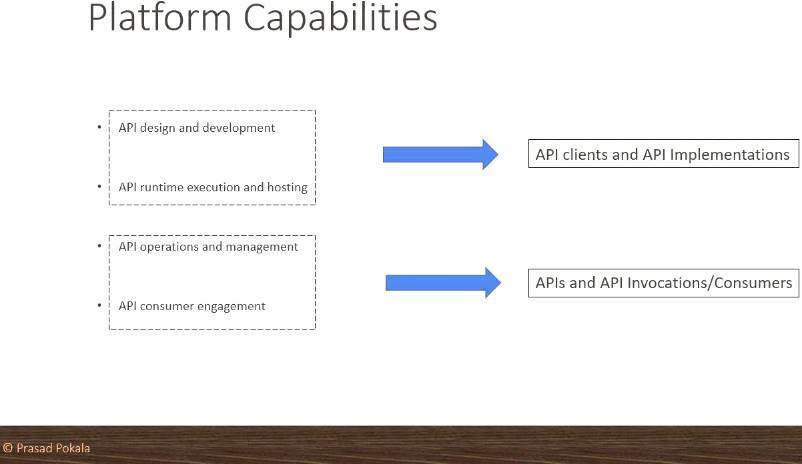
NEW QUESTION 7
What is most likely NOT a characteristic of an integration test for a REST API implementation?
- A. The test needs all source and/or target systems configured and accessible
- B. The test runs immediately after the Mule application has been compiled and packaged
- C. The test is triggered by an external HTTP request
- D. The test prepares a known request payload and validates the response payload
Answer: B
Explanation:
Correct Answer
The test runs immediately after the Mule application has been compiled and packaged
*****************************************
>> Integration tests are the last layer of tests we need to add to be fully covered.
>> These tests actually run against Mule running with your full configuration in place and are tested from external source as they work in PROD.
>> These tests exercise the application as a whole with actual transports enabled. So, external systems are affected when these tests run.
So, these tests do NOT run immediately after the Mule application has been compiled and packaged.
FYI... Unit Tests are the one that run immediately after the Mule application has been compiled and packaged.
NEW QUESTION 8
An organization uses various cloud-based SaaS systems and multiple on-premises systems. The on-premises systems are an important part of the organization's application network and can only be accessed from within the organization's intranet.
What is the best way to configure and use Anypoint Platform to support integrations with both the cloud-based SaaS systems and on-premises systems?
A) Use CloudHub-deployed Mule runtimes in an Anypoint VPC managed by Anypoint Platform Private Cloud Edition control plane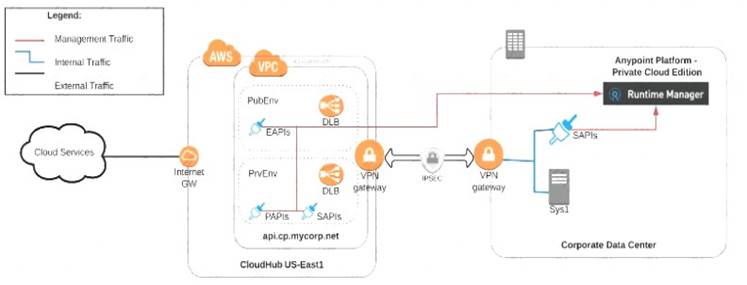
B) Use CloudHub-deployed Mule runtimes in the shared worker cloud managed by the MuleSoft-hosted Anypoint Platform control plane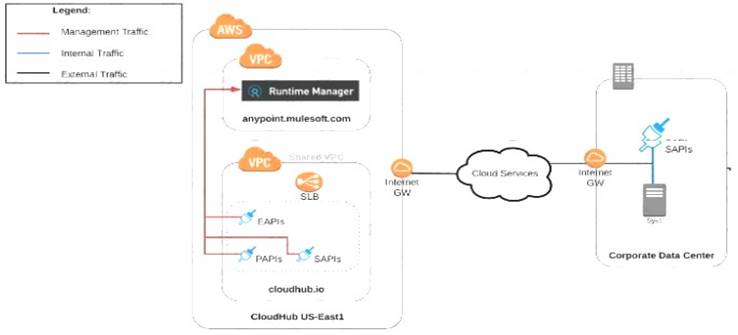
C) Use an on-premises installation of Mule runtimes that are completely isolated with NO external network access, managed by the Anypoint Platform Private Cloud Edition control plane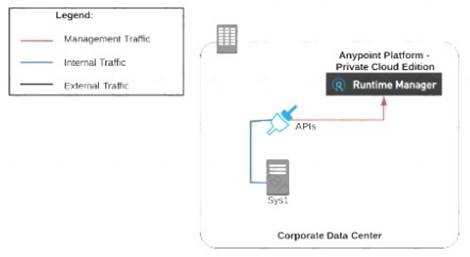
D) Use a combination of Cloud Hub-deployed and manually provisioned on-premises Mule runtimes managed by the MuleSoft-hosted Anypoint Platform control plane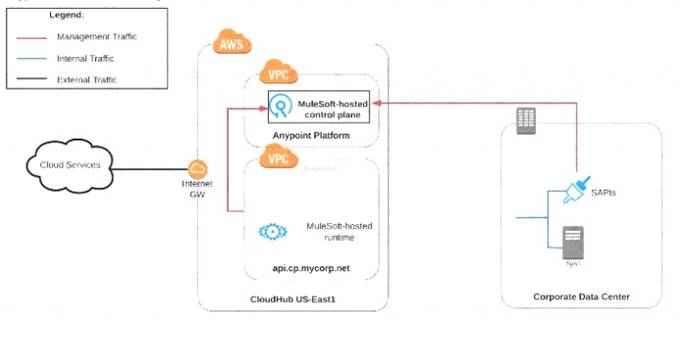
- A. Option A
- B. Option B
- C. Option C
- D. Option D
Answer: B
Explanation:
Correct Answer
Use a combination of CloudHub-deployed and manually provisioned on-premises Mule runtimes managed by the MuleSoft-hosted Platform control plane.
***************************************** Key details to be taken from the given scenario:
>> Organization uses BOTH cloud-based and on-premises systems
>> On-premises systems can only be accessed from within the organization's intranet Let us evaluate the given choices based on above key details:
>> CloudHub-deployed Mule runtimes can ONLY be controlled using MuleSoft-hosted control plane. We CANNOT use Private Cloud Edition's control plane to control CloudHub Mule Runtimes. So, option suggesting this is INVALID
>> Using CloudHub-deployed Mule runtimes in the shared worker cloud managed by the MuleSoft-hosted Anypoint Platform is completely IRRELEVANT to given scenario and silly choice. So, option suggesting this is INVALID
>> Using an on-premises installation of Mule runtimes that are completely isolated with NO external network access, managed by the Anypoint Platform Private Cloud Edition control plane would work for On-premises integrations. However, with NO external access, integrations cannot be done to SaaS-based apps. Moreover CloudHub-hosted apps are best-fit for integrating with SaaS-based applications. So, option suggesting this is BEST WAY.
The best way to configure and use Anypoint Platform to support these mixed/hybrid integrations is to use a combination of CloudHub-deployed and manually provisioned on-premises Mule runtimes managed by the MuleSoft-hosted Platform control plane.
NEW QUESTION 9
An API implementation is deployed to CloudHub.
What conditions can be alerted on using the default Anypoint Platform functionality, where the alert conditions depend on the end-to-end request processing of the API implementation?
- A. When the API is invoked by an unrecognized API client
- B. When a particular API client invokes the API too often within a given time period
- C. When the response time of API invocations exceeds a threshold
- D. When the API receives a very high number of API invocations
Answer: C
Explanation:
Correct Answer
When the response time of API invocations exceeds a threshold
*****************************************
>> Alerts can be setup for all the given options using the default Anypoint Platform functionality
>> However, the question insists on an alert whose conditions depend on the end-to-end request processing of the API implementation.
>> Alert w.r.t "Response Times" is the only one which requires end-to-end request processing of API implementation in order to determine if the threshold is exceeded or not.
NEW QUESTION 10
An organization makes a strategic decision to move towards an IT operating model that emphasizes consumption of reusable IT assets using modern APIs (as defined by MuleSoft).
What best describes each modern API in relation to this new IT operating model?
- A. Each modern API has its own software development lifecycle, which reduces the need for documentation and automation
- B. Each modem API must be treated like a product and designed for a particular target audience (for instance, mobile app developers)
- C. Each modern API must be easy to consume, so should avoid complex authentication mechanisms such as SAML or JWT D
- D. Each modern API must be REST and HTTP based
Answer: B
Explanation:
Correct Answers
* 1. Each modern API must be treated like a product and designed for a particular target audience (for instance mobile app developers)
*****************************************
Bottom of Form Top of Form
NEW QUESTION 11
Refer to the exhibit.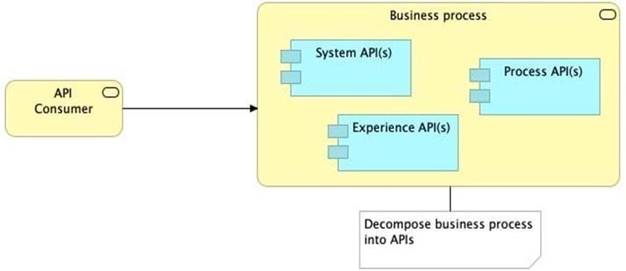
What is the best way to decompose one end-to-end business process into a collaboration of Experience, Process, and System APIs?
A) Handle customizations for the end-user application at the Process API level rather than the Experience API level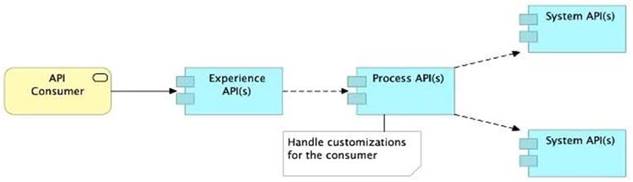
B) Allow System APIs to return data that is NOT currently required by the identified Process or Experience APIs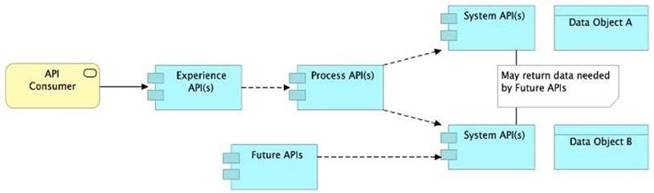
C) Always use a tiered approach by creating exactly one API for each of the 3 layers (Experience, Process and System APIs)
D) Use a Process API to orchestrate calls to multiple System APIs, but NOT to other Process APIs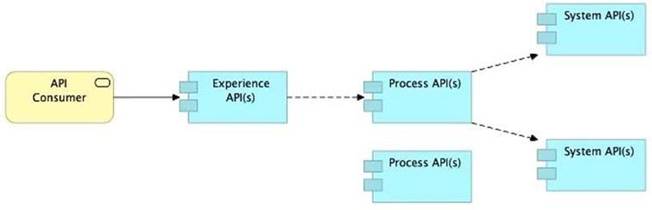
- A. Option A
- B. Option B
- C. Option C
- D. Option D
Answer: B
Explanation:
Correct Answer
Allow System APIs to return data that is NOT currently required by the identified Process or Experience APIs.
*****************************************
>> All customizations for the end-user application should be handled in "Experience API" only. Not in Process API
>> We should use tiered approach but NOT always by creating exactly one API for each of the 3 layers. Experience APIs might be one but Process APIs and System APIs are often more than one. System APIs for sure will be more than one all the time as they are the smallest modular APIs built in front of end systems.
>> Process APIs can call System APIs as well as other Process APIs. There is no such anti-design pattern in API-Led connectivity saying Process APIs should not call other Process APIs.
So, the right answer in the given set of options that makes sense as per API-Led connectivity principles is to allow System APIs to return data that is NOT currently required by the identified Process or Experience APIs. This way, some future Process APIs can make use of that data from System APIs and we need NOT touch the System layer APIs again and again.
NEW QUESTION 12
What are the major benefits of MuleSoft proposed IT Operating Model?
- A. * 1. Decrease the IT delivery gap* 2. Meet various business demands without increasing the IT capacity* 3. Focus on creation of reusable assets firs
- B. Upon finishing creation of all the possible assets then inform the LOBs in the organization to start using them
- C. * 1. Decrease the IT delivery gap* 2. Meet various business demands by increasing the IT capacity and forming various IT departments* 3. Make consumption of assets at the rate of production
- D. * 1. Decrease the IT delivery gap* 2. Meet various business demands without increasing the IT capacity* 3. Make consumption of assets at the rate of production
Answer: C
Explanation:
Correct Answer
* 1. Decrease the IT delivery gap
* 2. Meet various business demands without increasing the IT capacity
* 3. Make consumption of assets at the rate of production.
*****************************************
NEW QUESTION 13
What is the most performant out-of-the-box solution in Anypoint Platform to track transaction state in an asynchronously executing long-running process implemented as a Mule application deployed to multiple CloudHub workers?
- A. Redis distributed cache
- B. java.util.WeakHashMap
- C. Persistent Object Store
- D. File-based storage
Answer: C
Explanation:
Correct Answer
Persistent Object Store
*****************************************
>> Redis distributed cache is performant but NOT out-of-the-box solution in Anypoint Platform
>> File-storage is neither performant nor out-of-the-box solution in Anypoint Platform
>> java.util.WeakHashMap needs a completely custom implementation of cache from scratch using Java code and is limited to the JVM where it is running. Which means the state in the cache is not worker aware when running on multiple workers. This type of cache is local to the worker. So, this is neither out-of-the-box nor worker-aware among multiple workers on cloudhub. https://www.baeldung.com/java-weakhashmap
>> Persistent Object Store is an out-of-the-box solution provided by Anypoint Platform which is performant as well as worker aware among multiple workers running on CloudHub. https://docs.mulesoft.com/object-store/
So, Persistent Object Store is the right answer.
NEW QUESTION 14
What is typically NOT a function of the APIs created within the framework called API-led connectivity?
- A. They provide an additional layer of resilience on top of the underlying backend system, thereby insulating clients from extended failure of these systems.
- B. They allow for innovation at the user Interface level by consuming the underlying assets without being aware of how data Is being extracted from backend systems.
- C. They reduce the dependency on the underlying backend systems by helping unlock data from backend systems In a reusable and consumable way.
- D. They can compose data from various sources and combine them with orchestration logic to create higher level value.
Answer: A
Explanation:
Correct Answer
They provide an additional layer of resilience on top of the underlying backend system, thereby insulating clients from extended failure of these systems.
***************************************** In API-led connectivity,
>> Experience APIs - allow for innovation at the user interface level by consuming the underlying assets without being aware of how data is being extracted from backend systems.
>> Process APIs - compose data from various sources and combine them with orchestration logic to create higher level value
>> System APIs - reduce the dependency on the underlying backend systems by helping unlock data from backend systems in a reusable and consumable way.
However, they NEVER promise that they provide an additional layer of resilience on top of the underlying backend system, thereby insulating clients from extended failure of these systems.
https://dzone.com/articles/api-led-connectivity-with-mule
NEW QUESTION 15
When must an API implementation be deployed to an Anypoint VPC?
- A. When the API Implementation must invoke publicly exposed services that are deployed outside of CloudHub in a customer- managed AWS instance
- B. When the API implementation must be accessible within a subnet of a restricted customer-hosted network that does not allow public access
- C. When the API implementation must be deployed to a production AWS VPC using the Mule Maven plugin
- D. When the API Implementation must write to a persistent Object Store
Answer: A
NEW QUESTION 16
......
P.S. Certshared now are offering 100% pass ensure MCPA-Level-1 dumps! All MCPA-Level-1 exam questions have been updated with correct answers: https://www.certshared.com/exam/MCPA-Level-1/ (95 New Questions)
