
Proper study guides for Down to date Google Google Certified Professional - Cloud Architect (GCP) certified begins with Google Professional-Cloud-Architect preparation products which designed to deliver the Refined Professional-Cloud-Architect questions by making you pass the Professional-Cloud-Architect test at your first time. Try the free Professional-Cloud-Architect demo right now.
Google Professional-Cloud-Architect Free Dumps Questions Online, Read and Test Now.
NEW QUESTION 1
For this question, refer to the TerramEarth case study.
TerramEarth's 20 million vehicles are scattered around the world. Based on the vehicle's location its telemetry data is stored in a Google Cloud Storage (GCS) regional bucket (US. Europe, or Asia). The CTO has asked you to run a report on the raw telemetry data to determine why vehicles are breaking down after 100 K miles. You want to run this job on all the data. What is the most cost-effective way to run this job?
- A. Move all the data into 1 zone, then launch a Cloud Dataproc cluster to run the job.
- B. Move all the data into 1 region, then launch a Google Cloud Dataproc cluster to run the job.
- C. Launch a cluster in each region to preprocess and compress the raw data, then move the data into a multi region bucket and use a Dataproc cluster to finish the job.
- D. Launch a cluster in each region to preprocess and compress the raw data, then move the data into a region bucket and use a Cloud Dataproc cluster to finish the jo
Answer: D
Explanation:
Storageguarantees 2 replicates which are geo diverse (100 miles apart) which can get better remote latency and availability.
More importantly, is that multiregional heavily leverages Edge caching and CDNs to provide the content to the end users.
All this redundancy and caching means that Multiregional comes with overhead to sync and ensure consistency between geo-diverse areas. As such, it’s much better for write-once- read-many scenarios. This means frequently accessed (e.g. “hot” objects) around the world, such as website content, streaming videos, gaming or mobile applications.
References: https://medium.com/google-cloud/google-cloud-storage-what-bucket-class-for-the-best-performance-5c847ac8f9f2
NEW QUESTION 2
Your company sends all Google Cloud logs to Cloud Logging. Your security team wants to monitor the logs. You want to ensure that the security team can react quickly if an anomaly such as an unwanted firewall change or server breach is detected. You want to follow Google-recommended practices. What should you do?
- A. Schedule a cron job with Cloud Schedule
- B. The scheduled job queries the logs every minute for the relevant events.
- C. Export logs to BigQuery, and trigger a query in BigQuery to process the log data for the relevant events.
- D. Export logs to a Pub/Sub topic, and trigger Cloud Function with the relevant log events.
- E. Export logs to a Cloud Storage bucket, and trigger Cloud Run with the relevant log events.
Answer: C
Explanation:
https://cloud.google.com/blog/products/management-tools/automate-your-response-to-a-cloud-logging-event
NEW QUESTION 3
For this question, refer to the Dress4Win case study.
Dress4Win has asked you for advice on how to migrate their on-premises MySQL deployment to the cloud. They want to minimize downtime and performance impact to their on-premises solution during the migration. Which approach should you recommend?
- A. Create a dump of the on-premises MySQL master server, and then shut it down, upload it to the cloud environment, and load into a new MySQL cluster.
- B. Setup a MySQL replica server/slave in the cloud environment, and configure it for asynchronous replication from the MySQL master server on-premises until cutover.
- C. Create a new MySQL cluster in the cloud, configure applications to begin writing to both on-premises and cloud MySQL masters, and destroy the original cluster at cutover.
- D. Create a dump of the MySQL replica server into the cloud environment, load it into: Google Cloud Datastore, and configure applications to read/write to Cloud Datastore at cutover.
Answer: B
NEW QUESTION 4
Your company has a project in Google Cloud with three Virtual Private Clouds (VPCs). There is a Compute Engine instance on each VPC. Network subnets do not overlap and must remain separated. The network configuration is shown below.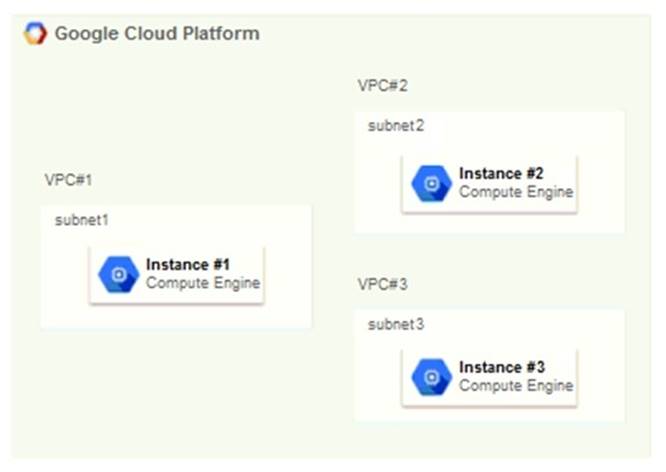
Instance #1 is an exception and must communicate directly with both Instance #2 and Instance #3 via internal IPs. How should you accomplish this?
- A. Create a cloud router to advertise subnet #2 and subnet #3 to subnet #1.
- B. Add two additional NICs to Instance #1 with the following configuration:•NIC1VPC: VPC #2SUBNETWORK: subnet #2•NIC2VPC: VPC #3SUBNETWORK: subnet #3Update firewall rules to enable traffic between instances.
- C. Create two VPN tunnels via CloudVPN:•1 between VPC #1 and VPC #2.•1 between VPC #2 and VPC #3.Update firewall rules to enable traffic between the instances.
- D. Peer all three VPCs:•Peer VPC #1 with VPC #2.•Peer VPC #2 with VPC #3.Update firewall rules to enable traffic between the instances.
Answer: B
Explanation:
As per GCP documentation: "By default, every instance in a VPC network has a single network interface. Use these instructions to create additional network interfaces. Each interface is attached to a different VPC network, giving that instance access to different VPC networks in Google Cloud. You cannot attach multiple network interfaces to the same VPC network." Refer to: https://cloud.google.com/vpc/docs/create-use-multiple-interfaces https://cloud.google.com/vpc/docs/create-use-multiple- interfaces#i_am_not_able_to_connect_to_secondary_interfaces_internal_ip
NEW QUESTION 5
Your company and one of its partners each nave a Google Cloud protect in separate organizations. Your company s protect (prj-a) runs in Virtual Private Cloud (vpc-a). The partner's project (prj-b) runs in vpc-b. There are two instances running on vpc-a and one instance running on vpc-b Subnets denned in both VPCs are not overlapping. You need to ensure that all instances communicate with each other via internal IPs minimizing latency and maximizing throughput. What should you do?
- A. Set up a network peering between vpc-a and vpc-b
- B. Set up a VPN between vpc-a and vpc-b using Cloud VPN
- C. Configure IAP TCP forwarding on the instance in vpc b and then launch the following gcloud command from one of the instance in vpc-gcloud:
 * 1. Create an additional instance in vpc-a* 2. Create an additional instance n vpc-b* 3. Instal OpenVPN in newly created instances* 4. Configure a VPN tunnel between vpc-a and vpc-b with the help of OpenVPN
Answer: C
NEW QUESTION 6
Your company is moving 75 TB of data into Google Cloud. You want to use Cloud Storage and follow Googlerecommended practices. What should you do?
- A. Move your data onto a Transfer Applianc
- B. Use a Transfer Appliance Rehydrator to decrypt the data into Cloud Storage.
- C. Move your data onto a Transfer Applianc
- D. Use Cloud Dataprep to decrypt the data into Cloud Storage.
- E. Install gsutil on each server that contains dat
- F. Use resumable transfers to upload the data into Cloud Storage.
- G. Install gsutil on each server containing dat
- H. Use streaming transfers to upload the data into CloudStorage.
Answer: A
Explanation:
https://cloud.google.com/transfer-appliance/docs/2.0/faq
NEW QUESTION 7
Your company has developed a monolithic, 3-tier application to allow external users to upload and share files. The solution cannot be easily enhanced and lacks reliability. The development team would like to re-architect the application to adopt microservices and a fully managed service approach, but they need to convince their leadership that the effort is worthwhile. Which advantage(s) should they highlight to leadership?
- A. The new approach will be significantly less costly, make it easier to manage the underlying infrastructure, and automatically manage the CI/CD pipelines.
- B. The monolithic solution can be converted to a container with Docke
- C. The generatedcontainer can then be deployed into a Kubernetes cluster.
- D. The new approach will make it easier to decouple infrastructure from application, develop and release new features, manage the underlying infrastructure, manage CI/CD pipelines and perform A/B testing, and scale the solution if necessary.
- E. The process can be automated with Migrate for Compute Engine.
Answer: C
Explanation:
The new approach will make it easier to decouple infrastructure from an application, develop and release new features, manage the underlying infrastructure, manage CI/CD pipelines and perform A/B testing, and scale the solution if necessary.
NEW QUESTION 8
For this question, refer to the EHR Healthcare case study. In the past, configuration errors put public IP addresses on backend servers that should not have been accessible from the Internet. You need to ensure that no one can put external IP addresses on backend Compute Engine instances and that external IP addresses can only be configured on frontend Compute Engine instances. What should you do?
- A. Create an Organizational Policy with a constraint to allow external IP addresses only on the frontend Compute Engine instances.
- B. Revoke the compute.networkAdmin role from all users in the project with front end instances.
- C. Create an Identity and Access Management (IAM) policy that maps the IT staff to the compute.networkAdmin role for the organization.
- D. Create a custom Identity and Access Management (IAM) role named GCE_FRONTEND with the compute.addresses.create permission.
Answer: A
Explanation:
https://cloud.google.com/compute/docs/ip-addresses/reserve-static-external-ip-address#disableexternalip
NEW QUESTION 9
Your application needs to process credit card transactions. You want the smallest scope of
Payment Card Industry (PCI) compliance without compromising the ability to analyze transactional data and trends relating to which payment methods are used. How should you design your architecture?
- A. Create a tokenizer service and store only tokenized data.
- B. Create separate projects that only process credit card data.
- C. Create separate subnetworks and isolate the components that process credit card data.
- D. Streamline the audit discovery phase by labeling all of the virtual machines (VMs) that process PCI data.
- E. Enable Logging export to Google BigQuery and use ACLs and views to scope the data shared with the auditor.
Answer: A
Explanation:
https://cloud.google.com/solutions/pci-dss-compliance-in-gcp
NEW QUESTION 10
Your applications will be writing their logs to BigQuery for analysis. Each application should have its own table.
Any logs older than 45 days should be removed. You want to optimize storage and follow Google recommended practices. What should you do?
- A. Configure the expiration time for your tables at 45 days
- B. Make the tables time-partitioned, and configure the partition expiration at 45 days
- C. Rely on BigQuery’s default behavior to prune application logs older than 45 days
- D. Create a script that uses the BigQuery command line tool (bq) to remove records older than 45 days
Answer: B
Explanation:
https://cloud.google.com/bigquery/docs/managing-partitioned-tables
NEW QUESTION 11
For this question, refer to the Mountkirk Games case study. You need to analyze and define the technical architecture for the compute workloads for your company, Mountkirk Games. Considering the Mountkirk Games business and technical requirements, what should you do?
- A. Create network load balancer
- B. Use preemptible Compute Engine instances.
- C. Create network load balancer
- D. Use non-preemptible Compute Engine instances.
- E. Create a global load balancer with managed instance groups and autoscaling policie
- F. Use preemptible Compute Engine instances.
- G. Create a global load balancer with managed instance groups and autoscaling policie
- H. Use non-preemptible Compute Engine instances.
Answer: D
NEW QUESTION 12
You are helping the QA team to roll out a new load-testing tool to test the scalability of your primary cloud services that run on Google Compute Engine with Cloud Bigtable. Which three requirements should they include? Choose 3 answers
- A. Ensure that the load tests validate the performance of Cloud Bigtable.
- B. Create a separate Google Cloud project to use for the load-testing environment.
- C. Schedule the load-testing tool to regularly run against the production environment.
- D. Ensure all third-party systems your services use are capable of handling high load.
- E. Instrument the production services to record every transaction for replay by the load- testing tool.
- F. Instrument the load-testing tool and the target services with detailed logging and metrics collection.
Answer: ABF
NEW QUESTION 13
A lead engineer wrote a custom tool that deploys virtual machines in the legacy data center. He wants to migrate the custom tool to the new cloud environment You want to advocate for the adoption of Google Cloud Deployment Manager What are two business risks of migrating to Cloud Deployment Manager? Choose 2 answers
- A. Cloud Deployment Manager uses Python.
- B. Cloud Deployment Manager APIs could be deprecated in the future.
- C. Cloud Deployment Manager is unfamiliar to the company's engineers.
- D. Cloud Deployment Manager requires a Google APIs service account to run.
- E. Cloud Deployment Manager can be used to permanently delete cloud resources.
- F. Cloud Deployment Manager only supports automation of Google Cloud resources.
Answer: CF
Explanation:
https://cloud.google.com/deployment-manager/docs/deployments/deleting- deployments
NEW QUESTION 14
For this question, refer to the Mountkirk Games case study. You are in charge of the new Game Backend Platform architecture. The game communicates with the backend over a REST API.
You want to follow Google-recommended practices. How should you design the backend?
- A. Create an instance template for the backen
- B. For every region, deploy it on a multi-zone managed instance grou
- C. Use an L4 load balancer.
- D. Create an instance template for the backen
- E. For every region, deploy it on a single- zone managed instance grou
- F. Use an L4 load balancer.
- G. Create an instance template for the backen
- H. For every region, deploy it on a multi-zone managed instance grou
- I. Use an L7 load balancer.
- J. Create an instance template for the backen
- K. For every region, deploy it on a single- zone managed instance grou
- L. Use an L7 load balancer.
Answer: C
Explanation:
https://cloud.google.com/solutions/gaming/cloud-game-infrastructure#dedicated_game_server
NEW QUESTION 15
For this question, refer to the TerramEarth case study. You are building a microservice- based application for TerramEarth. The application is based on Docker containers. You want to follow Google-recommended practices to build the application continuously and store the build artifacts. What should you do?
A.
* 1. Configure a trigger in Cloud Build for new source changes.
* 2. Invoke Cloud Build to build one container image, and tag the image with the label 'latest.'
* 3. Push the image to the Artifact Registry.
B.
* 1. Configure a trigger in Cloud Build for new source changes.
* 2. Invoke Cloud Build to build container images for each microservice, and tag them using the code commit hash.
* 3. Push the images to the Artifact Registry.
C.
* 1 Create a Scheduler job to check the repo every minute.
* 2. For any new change, invoke Cloud Build to build container images for the microservices.
* 3. Tag the images using the current timestamp, and push them to the Artifact Registry.
D.
* 1. Configure a trigger in Cloud Build for new source changes.
* 2. The trigger invokes build jobs and build container images for the microservices.
* 3. Tag the images with a version number, and push them to Cloud Storage.
- A.
Answer: C
NEW QUESTION 16
Dress4win has end to end tests covering 100% of their endpoints.
They want to ensure that the move of cloud does not introduce any new bugs.
Which additional testing methods should the developers employ to prevent an outage?
- A. They should run the end to end tests in the cloud staging environment to determine if the code is working as intended.
- B. They should enable google stack driver debugger on the application code to show errors in the code
- C. They should add additional unit tests and production scale load tests on their cloud staging environment.
- D. They should add canary tests so developers can measure how much of an impact the new release causes to latency
Answer: B
NEW QUESTION 17
For this question, refer to the Helicopter Racing League (HRL) case study. The HRL development team
releases a new version of their predictive capability application every Tuesday evening at 3
- A. a.
- B. UTC to a repositor
- C. The security team at HRL has developed an in-house penetration test Cloud Function called Airwolf.The security team wants to run Airwolf against the predictive capability application as soon as it is releasedevery Tuesda
- D. You need to set up Airwolf to run at the recurring weekly cadenc
- E. What should you do?
- F. Set up Cloud Tasks and a Cloud Storage bucket that triggers a Cloud Function.
- G. Set up a Cloud Logging sink and a Cloud Storage bucket that triggers a Cloud Function.
- H. Configure the deployment job to notify a Pub/Sub queue that triggers a Cloud Function.
- I. Set up Identity and Access Management (IAM) and Confidential Computing to trigger a Cloud Function.
Answer: A
NEW QUESTION 18
For this question, refer to the Dress4Win case study.
The Dress4Win security team has disabled external SSH access into production virtual machines (VMs) on Google Cloud Platform (GCP). The operations team needs to remotely manage the VMs, build and push Docker containers, and manage Google Cloud Storage objects. What can they do?
- A. Grant the operations engineers access to use Google Cloud Shell.
- B. Configure a VPN connection to GCP to allow SSH access to the cloud VMs.
- C. Develop a new access request process that grants temporary SSH access to cloud VMs when an operations engineer needs to perform a task.
- D. Have the development team build an API service that allows the operations team to execute specific remote procedure calls to accomplish their tasks.
Answer: A
NEW QUESTION 19
For this question, refer to the Dress4Win case study.
At Dress4Win, an operations engineer wants to create a tow-cost solution to remotely archive copies of database backup files. The database files are compressed tar files stored in their current data center. How should he proceed?
- A. Create a cron script using gsutil to copy the files to a Coldline Storage bucket.
- B. Create a cron script using gsutil to copy the files to a Regional Storage bucket.
- C. Create a Cloud Storage Transfer Service Job to copy the files to a Coldline Storage bucket.
- D. Create a Cloud Storage Transfer Service job to copy the files to a Regional Storage bucket.
Answer: A
Explanation:
Follow these rules of thumb when deciding whether to use gsutil or Storage Transfer Service:
✑ When transferring data from an on-premises location, use gsutil.
✑ When transferring data from another cloud storage provider, use Storage Transfer Service.
✑ Otherwise, evaluate both tools with respect to your specific scenario.
Use this guidance as a starting point. The specific details of your transfer scenario will also help you determine which tool is more appropriate
https://cloud.google.com/storage-transfer/docs/overview
NEW QUESTION 20
......
P.S. Easily pass Professional-Cloud-Architect Exam with 267 Q&As Thedumpscentre.com Dumps & pdf Version, Welcome to Download the Newest Thedumpscentre.com Professional-Cloud-Architect Dumps: https://www.thedumpscentre.com/Professional-Cloud-Architect-dumps/ (267 New Questions)
