
Master the Professional-Data-Engineer Google Professional Data Engineer Exam content and be ready for exam day success quickly with this Examcollection Professional-Data-Engineer free question. We guarantee it!We make it a reality and give you real Professional-Data-Engineer questions in our Google Professional-Data-Engineer braindumps.Latest 100% VALID Google Professional-Data-Engineer Exam Questions Dumps at below page. You can use our Google Professional-Data-Engineer braindumps and pass your exam.
Free Professional-Data-Engineer Demo Online For Google Certifitcation:
NEW QUESTION 1
To run a TensorFlow training job on your own computer using Cloud Machine Learning Engine, what would your command start with?
- A. gcloud ml-engine local train
- B. gcloud ml-engine jobs submit training
- C. gcloud ml-engine jobs submit training local
- D. You can't run a TensorFlow program on your own computer using Cloud ML Engine .
Answer: A
Explanation:
gcloud ml-engine local train - run a Cloud ML Engine training job locally
This command runs the specified module in an environment similar to that of a live Cloud ML Engine Training Job.
This is especially useful in the case of testing distributed models, as it allows you to validate that you are properly interacting with the Cloud ML Engine cluster configuration.
Reference: https://cloud.google.com/sdk/gcloud/reference/ml-engine/local/train
NEW QUESTION 2
A TensorFlow machine learning model on Compute Engine virtual machines (n2-standard -32) takes two days to complete framing. The model has custom TensorFlow operations that must run partially on a CPU You want to reduce the training time in a cost-effective manner. What should you do?
- A. Change the VM type to n2-highmem-32
- B. Change the VM type to e2 standard-32
- C. Train the model using a VM with a GPU hardware accelerator
- D. Train the model using a VM with a TPU hardware accelerator
Answer: C
NEW QUESTION 3
You are operating a streaming Cloud Dataflow pipeline. Your engineers have a new version of the pipeline with a different windowing algorithm and triggering strategy. You want to update the running pipeline with the new version. You want to ensure that no data is lost during the update. What should you do?
- A. Update the Cloud Dataflow pipeline inflight by passing the --update option with the --jobName set to the existing job name
- B. Update the Cloud Dataflow pipeline inflight by passing the --update option with the --jobName set to a new unique job name
- C. Stop the Cloud Dataflow pipeline with the Cancel optio
- D. Create a new Cloud Dataflow job with the updated code
- E. Stop the Cloud Dataflow pipeline with the Drain optio
- F. Create a new Cloud Dataflow job with the updated code
Answer: A
NEW QUESTION 4
You are choosing a NoSQL database to handle telemetry data submitted from millions of Internet-of-Things (IoT) devices. The volume of data is growing at 100 TB per year, and each data entry has about 100 attributes. The data processing pipeline does not require atomicity, consistency, isolation, and durability (ACID). However, high availability and low latency are required.
You need to analyze the data by querying against individual fields. Which three databases meet your requirements? (Choose three.)
- A. Redis
- B. HBase
- C. MySQL
- D. MongoDB
- E. Cassandra
- F. HDFS with Hive
Answer: BDF
NEW QUESTION 5
Your company is selecting a system to centralize data ingestion and delivery. You are considering messaging and data integration systems to address the requirements. The key requirements are: The ability to seek to a particular offset in a topic, possibly back to the start of all data ever captured Support for publish/subscribe semantics on hundreds of topics Retain per-key ordering
Which system should you choose?
- A. Apache Kafka
- B. Cloud Storage
- C. Cloud Pub/Sub
- D. Firebase Cloud Messaging
Answer: A
NEW QUESTION 6
Flowlogistic wants to use Google BigQuery as their primary analysis system, but they still have Apache Hadoop and Spark workloads that they cannot move to BigQuery. Flowlogistic does not know how to store the data that is common to both workloads. What should they do?
- A. Store the common data in BigQuery as partitioned tables.
- B. Store the common data in BigQuery and expose authorized views.
- C. Store the common data encoded as Avro in Google Cloud Storage.
- D. Store he common data in the HDFS storage for a Google Cloud Dataproc cluster.
Answer: B
NEW QUESTION 7
Your organization has been collecting and analyzing data in Google BigQuery for 6 months. The majority of the data analyzed is placed in a time-partitioned table named events_partitioned. To reduce the cost of queries, your organization created a view called events, which queries only the last 14 days of data. The view is described in legacy SQL. Next month, existing applications will be connecting to BigQuery to read the events data via an ODBC connection. You need to ensure the applications can connect. Which two actions should you take? (Choose two.)
- A. Create a new view over events using standard SQL
- B. Create a new partitioned table using a standard SQL query
- C. Create a new view over events_partitioned using standard SQL
- D. Create a service account for the ODBC connection to use for authentication
- E. Create a Google Cloud Identity and Access Management (Cloud IAM) role for the ODBC connection and shared “events”
Answer: AE
NEW QUESTION 8
You decided to use Cloud Datastore to ingest vehicle telemetry data in real time. You want to build a storage system that will account for the long-term data growth, while keeping the costs low. You also want to create snapshots of the data periodically, so that you can make a point-in-time (PIT) recovery, or clone a copy of the data for Cloud Datastore in a different environment. You want to archive these snapshots for a long time. Which two methods can accomplish this? Choose 2 answers.
- A. Use managed export, and store the data in a Cloud Storage bucket using Nearline or Coldline class.
- B. Use managed exportm, and then import to Cloud Datastore in a separate project under a unique namespace reserved for that export.
- C. Use managed export, and then import the data into a BigQuery table created just for that export, and delete temporary export files.
- D. Write an application that uses Cloud Datastore client libraries to read all the entitie
- E. Treat each entity as a BigQuery table row via BigQuery streaming inser
- F. Assign an export timestamp for each export, and attach it as an extra column for each ro
- G. Make sure that the BigQuery table is partitioned using the export timestamp column.
- H. Write an application that uses Cloud Datastore client libraries to read all the entitie
- I. Format the exported data into a JSON fil
- J. Apply compression before storing the data in Cloud Source Repositories.
Answer: CE
NEW QUESTION 9
You create an important report for your large team in Google Data Studio 360. The report uses Google BigQuery as its data source. You notice that visualizations are not showing data that is less than 1 hour old. What should you do?
- A. Disable caching by editing the report settings.
- B. Disable caching in BigQuery by editing table details.
- C. Refresh your browser tab showing the visualizations.
- D. Clear your browser history for the past hour then reload the tab showing the virtualizations.
Answer: A
Explanation:
Reference https://support.google.com/datastudio/answer/7020039?hl=en
NEW QUESTION 10
You are building a teal-lime prediction engine that streams files, which may contain Pll (personal identifiable information) data, into Cloud Storage and eventually into BigQuery You want to ensure that the sensitive data is masked but still maintains referential Integrity, because names and emails are often used as join keys How should you use the Cloud Data Loss Prevention API (DLP API) to ensure that the Pll data is not accessible by unauthorized individuals?
- A. Create a pseudonym by replacing the Pll data with cryptogenic tokens, and store the non-tokenized data in a locked-down button.
- B. Redact all Pll data, and store a version of the unredacted data in a locked-down bucket
- C. Scan every table in BigQuery, and mask the data it finds that has Pll
- D. Create a pseudonym by replacing Pll data with a cryptographic format-preserving token
Answer: A
NEW QUESTION 11
You receive data files in CSV format monthly from a third party. You need to cleanse this data, but every third month the schema of the files changes. Your requirements for implementing these transformations include: Executing the transformations on a schedule Enabling non-developer analysts to modify transformations Providing a graphical tool for designing transformations
What should you do?
- A. Use Cloud Dataprep to build and maintain the transformation recipes, and execute them on a scheduled basis
- B. Load each month’s CSV data into BigQuery, and write a SQL query to transform the data to a standard schem
- C. Merge the transformed tables together with a SQL query
- D. Help the analysts write a Cloud Dataflow pipeline in Python to perform the transformatio
- E. The Python code should be stored in a revision control system and modified as the incoming data’s schema changes
- F. Use Apache Spark on Cloud Dataproc to infer the schema of the CSV file before creating a Dataframe.Then implement the transformations in Spark SQL before writing the data out to Cloud Storage and loading into BigQuery
Answer: A
Explanation:
you can use dataprep for continuously changing target schema
In general, a target consists of the set of information required to define the expected data in a dataset. Often referred to as a "schema," this target schema information can include:
Names of columns
Order of columns Column data types Data type format Example rows of data
A dataset associated with a target is expected to conform to the requirements of the schema. Where there are differences between target schema and dataset schema, a validation indicator (or schema tag) is displayed.
https://cloud.google.com/dataprep/docs/html/Overview-of-RapidTarget_136155049
NEW QUESTION 12
You need to copy millions of sensitive patient records from a relational database to BigQuery. The total size of the database is 10 TB. You need to design a solution that is secure and time-efficient. What should you do?
- A. Export the records from the database as an Avro fil
- B. Upload the file to GCS using gsutil, and then load the Avro file into BigQuery using the BigQuery web UI in the GCP Console.
- C. Export the records from the database as an Avro fil
- D. Copy the file onto a Transfer Appliance and send it to Google, and then load the Avro file into BigQuery using the BigQuery web UI in the GCP Console.
- E. Export the records from the database into a CSV fil
- F. Create a public URL for the CSV file, and then use Storage Transfer Service to move the file to Cloud Storag
- G. Load the CSV file into BigQuery using the BigQuery web UI in the GCP Console.
- H. Export the records from the database as an Avro fil
- I. Create a public URL for the Avro file, and thenuse Storage Transfer Service to move the file to Cloud Storag
- J. Load the Avro file into BigQuery using the BigQuery web UI in the GCP Console.
Answer: A
NEW QUESTION 13
The marketing team at your organization provides regular updates of a segment of your customer dataset. The marketing team has given you a CSV with 1 million records that must be updated in BigQuery. When you use the UPDATE statement in BigQuery, you receive a quotaExceeded error. What should you do?
- A. Reduce the number of records updated each day to stay within the BigQuery UPDATE DML statement limit.
- B. Increase the BigQuery UPDATE DML statement limit in the Quota management section of the Google Cloud Platform Console.
- C. Split the source CSV file into smaller CSV files in Cloud Storage to reduce the number of BigQuery UPDATE DML statements per BigQuery job.
- D. Import the new records from the CSV file into a new BigQuery tabl
- E. Create a BigQuery job that merges the new records with the existing records and writes the results to a new BigQuery table.
Answer: D
NEW QUESTION 14
You need ads data to serve Al models and historical data tor analytics longtail and outlier data points need to be identified You want to cleanse the data n near-reel time before running it through Al models What should you do?
- A. Use BigQuery to ingest prepare and then analyze the data and then run queries to create views
- B. Use Cloud Storage as a data warehouse shell scripts tor processing, and BigQuery to create views tor desired datasets
- C. Use Dataflow to identity longtail and outber data points programmatically with BigQuery as a sink
- D. Use Cloud Composer to identify longtail and outlier data points, and then output a usable dataset to BigQuery
Answer: A
NEW QUESTION 15
You’re training a model to predict housing prices based on an available dataset with real estate properties. Your plan is to train a fully connected neural net, and you’ve discovered that the dataset contains latitude and longtitude of the property. Real estate professionals have told you that the location of the property is highly influential on price, so you’d like to engineer a feature that incorporates this physical dependency.
What should you do?
- A. Provide latitude and longtitude as input vectors to your neural net.
- B. Create a numeric column from a feature cross of latitude and longtitude.
- C. Create a feature cross of latitude and longtitude, bucketize at the minute level and use L1 regularizationduring optimization.
- D. Create a feature cross of latitude and longtitude, bucketize it at the minute level and use L2 regularization during optimization.
Answer: C
Explanation:
Reference https://cloud.google.com/bigquery/docs/gis-dataa
NEW QUESTION 16
The Development and External teams nave the project viewer Identity and Access Management (1AM) role m a folder named Visualization. You want the Development Team to be able to read data from both Cloud Storage and BigQuery, but the External Team should only be able to read data from BigQuery. What should you do?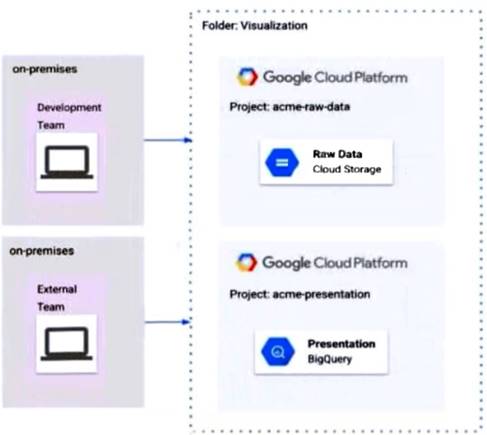
- A. Remove Cloud Storage IAM permissions to the External Team on the acme-raw-data project
- B. Create Virtual Private Cloud (VPC) firewall rules on the acme-raw-data protect that deny all Ingress traffic from the External Team CIDR range
- C. Create a VPC Service Controls perimeter containing both protects and BigQuery as a restricted API Add the External Team users to the perimeter s Access Level
- D. Create a VPC Service Controls perimeter containing both protects and Cloud Storage as a restricted AP
- E. Add the Development Team users to the perimeter's Access Level
Answer: C
NEW QUESTION 17
Which Cloud Dataflow / Beam feature should you use to aggregate data in an unbounded data source every hour based on the time when the data entered the pipeline?
- A. An hourly watermark
- B. An event time trigger
- C. The with Allowed Lateness method
- D. A processing time trigger
Answer: D
Explanation:
When collecting and grouping data into windows, Beam uses triggers to determine when to emit the aggregated results of each window.
Processing time triggers. These triggers operate on the processing time – the time when the data element is processed at any given stage in the pipeline.
Event time triggers. These triggers operate on the event time, as indicated by the timestamp on each data element. Beam’s default trigger is event time-based.
Reference: https://beam.apache.org/documentation/programming-guide/#triggers
NEW QUESTION 18
Your company is implementing a data warehouse using BigQuery, and you have been tasked with designing the data model You move your on-premises sales data warehouse with a star data schema to BigQuery but notice performance issues when querying the data of the past 30 days Based on Google's recommended practices, what should you do to speed up the query without increasing storage costs?
- A. Denormalize the data
- B. Shard the data by customer ID
- C. Materialize the dimensional data in views
- D. Partition the data by transaction date
Answer: C
NEW QUESTION 19
Your neural network model is taking days to train. You want to increase the training speed. What can you do?
- A. Subsample your test dataset.
- B. Subsample your training dataset.
- C. Increase the number of input features to your model.
- D. Increase the number of layers in your neural network.
Answer: D
Explanation:
Reference: https://towardsdatascience.com/how-to-increase-the-accuracy-of-a-neural-network-9f5d1c6f407d
NEW QUESTION 20
You set up a streaming data insert into a Redis cluster via a Kafka cluster. Both clusters are running on Compute Engine instances. You need to encrypt data at rest with encryption keys that you can create, rotate, and destroy as needed. What should you do?
- A. Create a dedicated service account, and use encryption at rest to reference your data stored in your Compute Engine cluster instances as part of your API service calls.
- B. Create encryption keys in Cloud Key Management Servic
- C. Use those keys to encrypt your data in all of the Compute Engine cluster instances.
- D. Create encryption keys locall
- E. Upload your encryption keys to Cloud Key Management Servic
- F. Use those keys to encrypt your data in all of the Compute Engine cluster instances.
- G. Create encryption keys in Cloud Key Management Servic
- H. Reference those keys in your API service calls when accessing the data in your Compute Engine cluster instances.
Answer: C
NEW QUESTION 21
......
Recommend!! Get the Full Professional-Data-Engineer dumps in VCE and PDF From Dumps-files.com, Welcome to Download: https://www.dumps-files.com/files/Professional-Data-Engineer/ (New 268 Q&As Version)
