
Our pass rate is high to 98.9% and the similarity percentage between our 1z0-1085-20 study guide and real exam is 90% based on our seven-year educating experience. Do you want achievements in the Oracle 1z0-1085-20 exam in just one try? I am currently studying for the Oracle 1z0-1085-20 exam. Latest Oracle 1z0-1085-20 Test exam practice questions and answers, Try Oracle 1z0-1085-20 Brain Dumps First.
Also have 1z0-1085-20 free dumps questions for you:
NEW QUESTION 1
Which of the following is an example of an edge service in OCI?
- A. DNS Zone Management
- B. Virtual Machines
- C. OCI compute instances
- D. Oracle Data Guard
Answer: A
Explanation:
The Oracle Cloud Infrastructure Domain Name System (DNS) service lets you create and manage your DNS zones. You can create zones, add records to zones, and allow Oracle Cloud Infrastructure's edge network to handle your domain's DNS queries.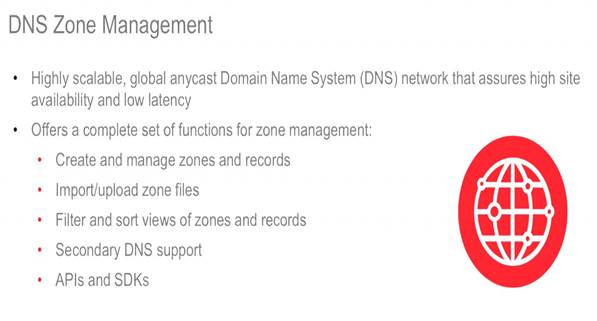
NEW QUESTION 2
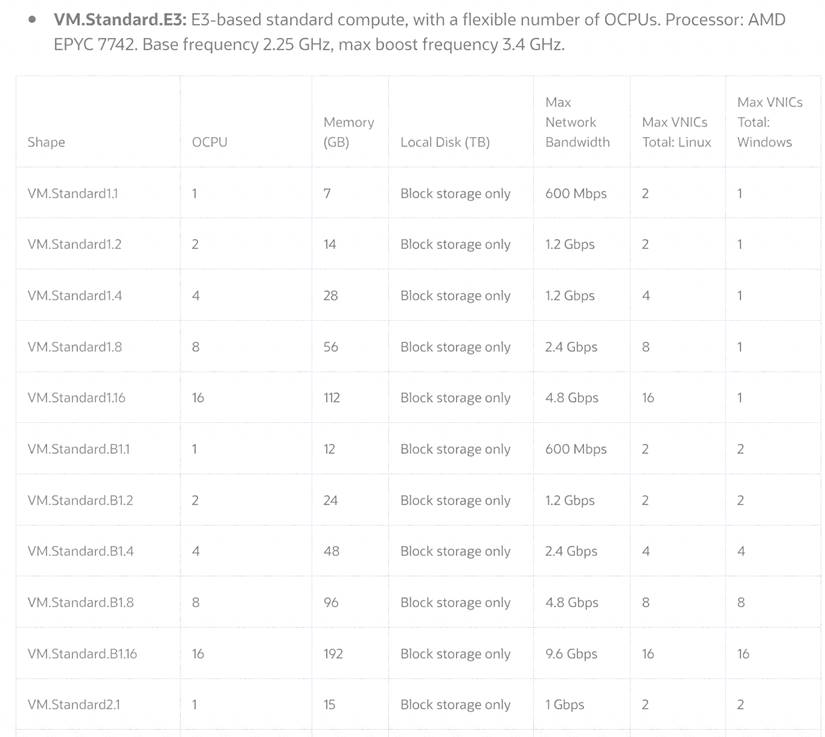
How is total network throughput allocated to a Virtual Machine (VM) Instance?
- A. Network bandwidth is variable
- B. Network bandwidth is proportional to the number of OCPUs in the Instance shape
- C. When launching a compute instance, customers may select the desired maximum network bandwidth
- D. Each VM is allocated 10 Gbps of network bandwidth regardless of the selected shape
Answer: B
Explanation:
A shape is a template that determines the number of CPUs, amount of memory, and other resources that are
allocated to an instance.
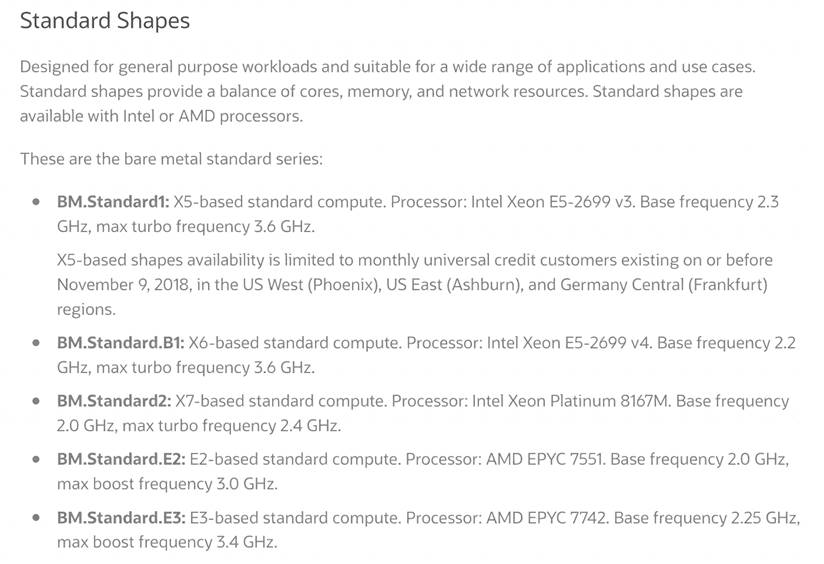
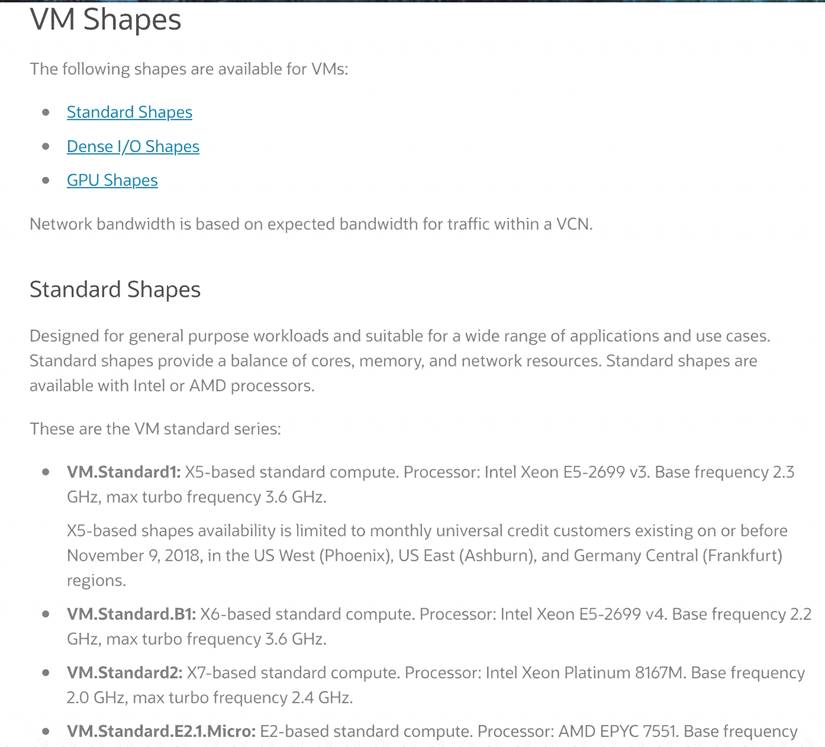
The network bandwidth is directly proportional to the number of OCPUs in the instance shape!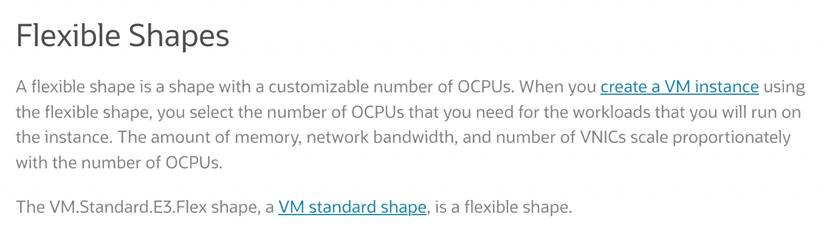
NEW QUESTION 3
What purpose does an Oracle Cloud Infrastructure (OCI) Dynamic Routing Gateway Serve?
- A. Enables OCI Compute Instance to privately connect to OCI Object Storage
- B. Enables OCI Compute instance to connect to on-promises environments
- C. Enable OCI Compute instances to connect to the internal
- D. Enables OCI Compute instances to be reached from internet
Answer: B
Explanation:
You can think of a Dynamic Routing Gateway (DRG) as a virtual router that provides a path for private traff (that is, traffic that uses private IPv4 addresses) between your VCN and networks outside the VCN's region.
For example, if you use an IPSec VPN or Oracle Cloud Infrastructure FastConnect (or both) to connect y on-premises network to your VCN, that private IPv4 address traffic goes through a DRG that you create and attach to your VCN. For scenarios for using a DRG to connect a VCN to your on-premises network,
see Networking Scenarios. For important details about routing to your on-premises network, see Routing Details for Connections to Your On-Premises Network.
Also, if you decide to peer your VCN with a VCN in another region, your VCN's DRG routes traffic to the other VCN over a private backbone that connects the regions (without traffic traversing the internet). For information about connecting VCNs in different regions, see Remote VCN Peering (Across Regions).
NEW QUESTION 4
What does Oracle's Payment Card Industry Data Security Standard (PCI DSS) attestation of compliance provide to customers?
- A. Customers can use these services for workloads that provides validation of card holder transaction but only as 3rd party
- B. Customers can use these services for workloads that process, or transmit cardholder data but not store it.
- C. Customers can use these services for workloads to process applications for credit card approval securely.
- D. Customers can use these services for workloads that store, process, or transmit cardholder data.
Answer: D
Explanation:
The Payment Card Industry Data Security Standard (PCI DSS) is a global set of security standard designed to encourage and enhance cardholder data security and promote the adoption of consistent data security measures around the technical and operational components related to cardholder data.
Oracle has successfully completed a Payment Card Industry Data Security Standard (PCI DSS) audit and received an Attestation of Compliance (AoC) covering several Oracle Cloud Infrastructure services and the Oracle RightNow Service Cloud Service. As a PCI Level 1 Service Provider, customers can now use these services for workloads that store, process or transmit cardholder data.
NEW QUESTION 5
you are analyzing your Oracle Cloud Infrastructure (OCI) usage with Cost Analysis tool in OCI Console. Which is not a default feature of the tool?
- A. Filter costs by applications
- B. Filter costs by compartments
- C. Filter costs by tags
- D. Filter costs by date
Answer: A
Explanation:
You can filter Costs Analysis Tools by following three ways To filter costs by dates
To filter costs by tags
To filter costs by compartments
NEW QUESTION 6
Which two Oracle Cloud Infrastructure resources can be used to group/categorize expenses?
- A. Policies
- B. Tags
- C. Users
- D. Compartments
- E. Groups
Answer: BD
Explanation:
You can do Costs Analysis in OCI and you can group and filter the cost by Tags or compartments To filter costs by dates
To filter costs by tags
To filter costs by compartments
To remove a compartment or tag filter
NEW QUESTION 7
What is Oracle's responsibility according to the Oracle Cloud Infrastructure (OCI) shared-security model?
- A. Configuring OCI services securely
- B. Data classification and compliance
- C. Securing application workloads
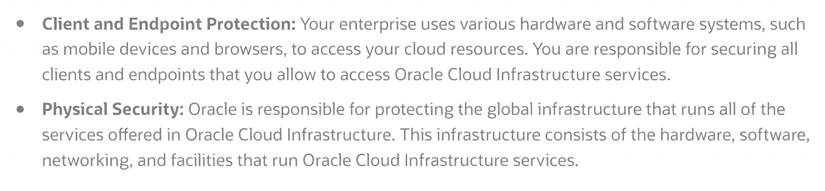
- D. Security of data center facilities
Answer: D
Explanation:
Oracle’s mission is to build cloud infrastructure and platform services for your business to have effective and manageable security to run your mission-critical workloads and store your data with confidence.
Oracle Cloud Infrastructure offers best-in-class security technology and operational processes to secure its enterprise cloud services. However, for you to securely run your workloads in Oracle Cloud Infrastructure, you must be aware of your security and compliance responsibilities. By design, Oracle provides security of cloud infrastructure and operations (cloud operator access controls, infrastructure security patching, and so on), and you are responsible for securely configuring your cloud resources. Security in the cloud is a shared responsibility between you and Oracle.
In a shared, multi-tenant compute environment, Oracle is responsible for the security of the underlying cloud infrastructure (such as data-center facilities, and hardware and software systems) and you are responsible for securing your workloads and configuring your services (such as compute, network, storage, and database) securely.
In a fully isolated, single-tenant, bare metal server with no Oracle software on it, your responsibility increases as you bring the entire software stack (operating systems and above) on which you deploy your applications.
In this environment, you are responsible for securing your workloads, and configuring your services (compute, network, storage, database) securely, and ensuring that the software components that you run on the bare metal servers are configured, deployed, and managed securely.
More specifically, your and Oracle's responsibilities can be divided into the following areas: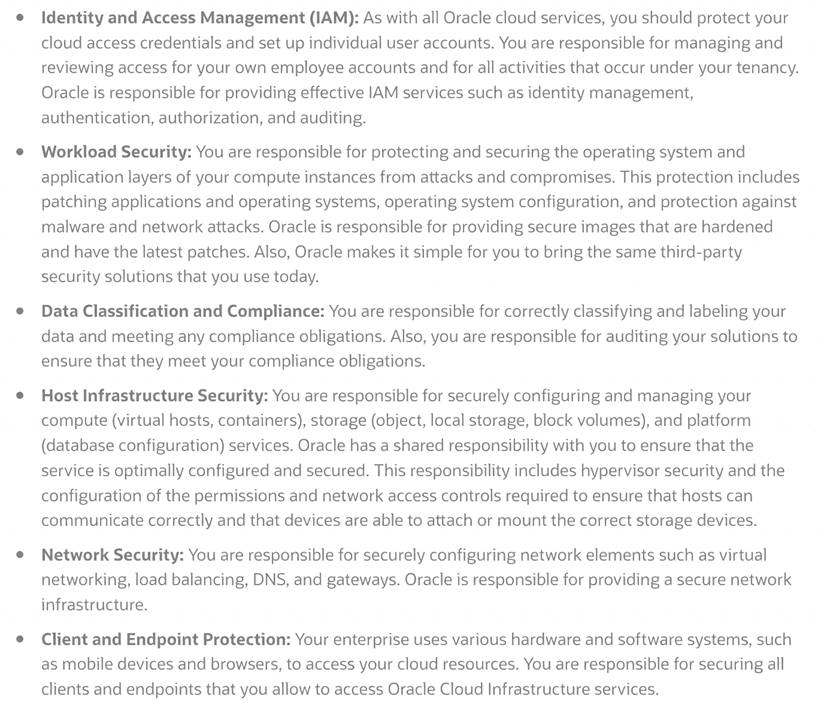
NEW QUESTION 8
Which is NOT available to you whenever Oracle Cloud Infrastructure creates or resolves an incident?
- A. Twitter notifications
- B. Text Message notifications
- C. Email notifications
- D. Webhook notifications
Answer: A
Explanation:
The Oracle Cloud Infrastructure Notifications service broadcasts messages to distributed components through a publish-subscribe pattern, delivering secure, highly reliable, low latency and durable messages for applications hosted on Oracle Cloud Infrastructure and externally. Use Notifications to get notified when event rules are triggered or alarms are breached, or to directly publish a message.
Messages sent out as email by the Oracle Cloud Infrastructure Notifications service are processed and delivered through Oracle resources
NEW QUESTION 9
Which option provides the best performance for running OTLP workloads in Oracle Cloud Infrastructure (OCI)?
- A. OCI Autonomous Data Warehouse
- B. OCI Virtual Machine Instance
- C. OCI Dedicated Virtual Host
- D. OCI Autonomous Transaction Processing
Answer: D
Explanation:
https://docs.oracle.com/en/cloud/paas/atp-cloud/index.html
NEW QUESTION 10
Which statement is correct regarding the oracle cloud infrastructure Compute services?
- A. When you stop a compute instance, all data on the boot volume is lost
- B. You can attach a maximum of one public to each compute instance
- C. You can launch either virtual machines or bare metal instances
- D. You cannot attach a block volume to a compute instance
Answer: C
Explanation:
Oracle Cloud Infrastructure Compute lets you provision and manage compute hosts, known as instances You can launch instances as needed to meet your compute and application requirements. After you launch an instance, you can access it securely from your computer, restart it, attach and detach volumes, and terminate it when you're done with it. Any changes made to the instance's local drives are lost when you terminate it. Any saved changes to volumes attached to the instance are retained.
Oracle Cloud Infrastructure offers both bare metal and virtual machine instances:
1) Bare Metal: A bare metal compute instance gives you dedicated physical server access for highest performance and strong isolation.
2) Virtual Machine: A virtual machine (VM) is an independent computing environment that runs on top of physical bare metal hardware. The virtualization makes it possible to run multiple VMs that are isolated from each other. VMs are ideal for running applications that do not require the performance and resources (CPU, memory, network bandwidth, storage) of an entire physical machine.
An Oracle Cloud Infrastructure VM compute instance runs on the same hardware as a bare metal instance, leveraging the same cloud-optimized hardware, firmware, software stack, and networking infrastructure.
NEW QUESTION 11
A new customer has logged into Oracle Cloud Infrastructure (OCI) as an administrator for the first time. The admin would like to deploy infrastructure. What is the first step they must take in order to accomplish this task?
- A. File a service request for access to each additional region.
- B. Use API endpoints to create resources in the desired region.
- C. Subscribe to the desired region.
- D. Navigate to the desired region and begin creating resources.
Answer: C
Explanation:
When you sign up for Oracle Cloud Infrastructure, Oracle creates a tenancy for you in one region. This is
your home region. Your home region is where your IAM resources are defined. When you subscribe to another region, your IAM resources are available in the new region, however, the master definitions reside in your home region and can only be changed there.
When you subscribe your tenancy to a new region, all the policies from your home region are enforced in the new region. If you want to limit access for groups of users to specific regions, you can write policies to grant access to specific regions only.
NEW QUESTION 12
Which resource do you manage in an Infrastructure-as-a-services (IAAS) offering?
- A. Operating system
- B. Network
- C. Storage
- D. Servers
Answer: A
Explanation:
Infrastructure as a service (IaaS) is a type of cloud service model in which computing resources are hosted in the cloud. Businesses can use the IaaS model to shift some or all of their use of on-premises or colocated data center infrastructure to the cloud, where it is owned and managed by a cloud provider. These infrastructure elements can include compute, network, and storage hardware as well as other components and software.
How Does IaaS Work?
In a typical IaaS model, a business—which can be of any size—consumes services like compute, storage, and databases from a cloud provider. The cloud provider offers those services by hosting hardware and software in the cloud. The business will no longer need to purchase and manage its own equipment, or space to host the equipment, and the cost will shift to a pay-as-you-go model. When the business needs less, it pays for less. And when it grows, it can provision additional computing resources and other technologies in minutes.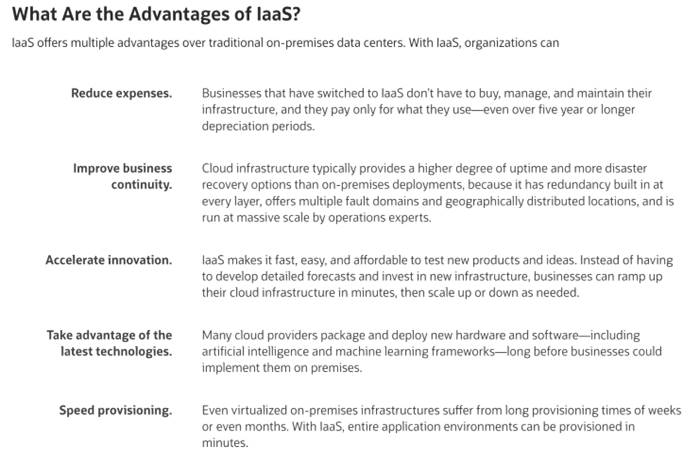
NEW QUESTION 13
Which is a key benefit of using oracle cloud infrastructure autonomous data warehouse?
- A. No username and password required
- B. Scale both CPU and Storage without downtime
- C. Apply database patches as they become available
- D. Maintain root level acress to the underlying operating system
Answer: B
Explanation:
Oracle Autonomous Data Warehouse is a cloud data warehouse service that eliminates virtually all the complexities of operating a data warehouse and securing data. It automates provisioning, configuring, securing, tuning, scaling, patching, backing up, and repairing of the data warehouse. Unlike other “fully managed” cloud data warehouse solutions that only patch and update the service, it also features elastic, automated scaling, performance tuning, security, and a broad set of built-in capabilities that enable machine learning analysis, simple data loading, and data visualizations.
Data Warehouse uses continuous query optimization, table indexing, data summaries, and auto-tuning to ensure consistent high performance even as data volume and number of users grows. Autonomous scaling can temporarily increase compute and I/O by a factor of three to maintain performance. Unlike other cloud services which require downtime to scale, Autonomous Data Warehouse scales while the service continues to run.
NEW QUESTION 14
Which Oracle Cloud Infrastructure service can you use to assess user security of your Oracle databases?
- A. Oracle Data Safe
- B. Oracle Data Guard
- C. Audit Vault and Database Firewall option for Oracle Database Enterprise Edition
- D. Audit Service
Answer: A
Explanation:
Oracle Data Safe is a unified control center for your Oracle databases which helps you understand the sensitivity of your data, evaluate risks to data, mask sensitive data, implement and monitor security controls, assess user security, monitor user activity, and address data security compliance requirements.
Whether you’re using an Autonomous Database or an Oracle DB system, Oracle Data Safe delivers essential
data security capabilities as a service on Oracle Cloud Infrastructure.
NEW QUESTION 15
You were recently assigned to manage a project to deploy Oracle E-Business Suite on Oracle Cloud Infrastructure (OCI). The application will require a database, several servers, and a shared file system.
Which three OCI services are best suited for this project?
- A. OCI virtual or Bare Metal DB Systems
- B. OCI Streaming Service
- C. Object Storage Service
- D. Virtual Machine (VM) or Bare Metal (BM) compute Instances
- E. File Storage Service
- F. Oracle Container Engine for Kubernetes
Answer: ADE
Explanation:
https://docs.oracle.com/en/solutions/deploy-ebusiness-suite-oci/index.html#GUID-0CA881FD-D96F-4885-BC7
NEW QUESTION 16
Which offers the lowest pricing for storage (per GB)?
- A. Oracle Cloud Infrastructure Object Storage (standard tier)
- B. Oracle Cloud Infrastructure Block Volume
- C. Oracle Cloud Infrastructure Archive Storage
- D. Oracle Cloud Infrastructure File Storage
Answer: C
Explanation:
Oracle Cloud Infrastructure Archive Storage is the lowest pricing for storage (per GB)
NEW QUESTION 17
Which two security capabilities are offered by Oracle Cloud Infrastructure?
- A. Always on data encryption for data-at-rest.
- B. Certificate Management service
- C. Captcha
- D. Key Management service
- E. Managed Active Directory service
Answer: AD
Explanation:
Oracle Cloud Infrastructure’s security approach is based on seven core pillars. Each pillar has multiple solutions designed to maximize the security and compliance of the platform and to help customers to improve their security posture.
High Availability: Offer fault-independent data centers that enable high-availability scale-out architectures and are resilient against network attacks, ensuring constant uptime in the face of disaster and security attack.
Customer Isolation: Allow customers to deploy their application and data assets in an environment that commits full isolation from other tenants and Oracle’s staff.
Data Encryption: Protect customer data at-rest and in-transit in a way that allows customers to meet the security and compliance requirements with respect to cryptographic algorithms and key management.
Security Controls: Offer customers effective and easy-to-use application, platform, and network security solutions that allow them to protect their workloads, have a secure application delivery using a global edge network, constrain access to their services, and segregate operational responsibilities to reduce the risk associated with malicious and accidental user actions.
Visibility: Offer customers comprehensive log data and security analytics that they can use to audit and monitor actions on their resources, allowing them to meet their audit requirements and reduce security and operational risk.
Secure Hybrid Cloud: Enable customers to use their existing security assets, such as user accounts and policies, as well as third-party security solutions, when accessing their cloud resources and securing their data and application assets in the cloud.
Verifiably Secure Infrastructure: Follow rigorous processes and use effective security controls in all phases of cloud service development and operation. Demonstrate adherence to Oracle’s strict security standards through third-party audits, certifications, and attestations. Help customers demonstrate compliance readiness to internal security and compliance teams, their customers, auditors, and regulators.
NEW QUESTION 18
You run 5 Oracle Cloud Infrastructure (OCI) Virtual Machine instances on an OCI dedicated virtual host. Ho will this deployment be billed?
- A. Only the dedicated virtual machine host will be billed
- B. The dedicated virtual machine host and the boot volumes of each instance will be billed
- C. The dedicated virtual machine host all 5 instances, and the boot volume of each instance will be billed
- D. All 5 instances will be billed on the basis of the number of OCPUs
Answer: B
Explanation:
You must create a dedicated virtual machine host before you can place any instances on it. When creating th dedicated virtual machine host, you select an availability domain and fault domain to launch it in. All the VM instances that you place on the host will subsequently be created in this availability domain and fault domain. You also select a compartment when you create the dedicated virtual machine host, but you can move the host to a new compartment later without impacting any of the instances placed on it. You can also create the instances in a different compartment than the dedicated virtual machine host, or move them to difference compartments after they have been launched.
You are billed for the dedicated virtual machine host as soon as you create it, but you are not billed for any of the individual VM instances you place on it. You will still be billed for image licensing costs if they apply to the image you are using for the VM instances.
Read more: https://docs.cloud.oracle.com/en-us/iaas/Content/Compute/Concepts/dedicatedvmhosts.htm
NEW QUESTION 19
Which two should be considered when designing a fault tolerant solution in Oracle Cloud Infrastructure (OCI)?
- A. ensuring your solution components are distributed across OCI Fault Domains
- B. performing data integrity check when using OCI File Storage Service
- C. writing custom scripts that will monitor your solution
- D. using multiple OCI Availability Domains (AD), where available, to deploy your solution
- E. creating a manual cluster of compute instances
Answer: AD
Explanation:
Creating a manual cluster of compute instances, and Writing custom scripts that will monitor your solution are not valid ways to ensure fault tolerance at all. Also, Performing Data Integrity check when using OCI File Storage Service is not valid since OCI takes care of it.
Therefore, we are left with:
1) Using multiple OCI Availibility Domains (AD), where available, to deploy your solution - Which is excellent because we have multiple AD's so that if one fails, we have a backup AD!
2) Ensuring your solution components are distributed across OCI Fault Domains - So that we can protect our deployment against unexpected power failures, AD failure etc.
NEW QUESTION 20
______ is a fully-managed, scalable, and highly available service that you can use to deploy your containerized applications to the cloud.
- A. Oracle Cloud Infrastructure Container Engine for Kubernetes
- B. Oracle Cloud Infrastructure Container Engine for Containerization
- C. Oracle Cloud Infrastructure Container Engine for Deployment
- D. Oracle Cloud Infrastructure Container Engine for Docker
Answer: A
Explanation:
Oracle Cloud Infrastructure Container Engine for Kubernetes is a fully-managed, scalable, and highly available service that you can use to deploy your containerized applications to the cloud. Use Container Engine for Kubernetes (sometimes abbreviated to just OKE) when your development team wants to reliably build, deploy, and manage cloud-native applications. You specify the compute resources that your applications require, and Container Engine for Kubernetes provisions them on Oracle Cloud Infrastructure in an existing OCI tenancy.
You can access Container Engine for Kubernetes to define and create Kubernetes clusters using the Console and the REST API. You can access the clusters you create using the Kubernetes command line (kubectl), the Kubernetes Dashboard, and the Kubernetes API.
Container Engine for Kubernetes is integrated with Oracle Cloud Infrastructure Identity and Access Management (IAM), which provides easy authentication with native Oracle Cloud Infrastructure identity functionality.
NEW QUESTION 21
Which two are enabled by Oracle Cloud Infrastructure Fault Domains?
- A. Protect against unexpected hardware or power supply failures
- B. To meet requirements for legal jurisdictions
- C. To mitigate the risk of large scale events such as earthquakes
- D. Build replicated systems for disaster recovery
- E. Protect against planned hardware maintenance
Answer: AE
Explanation:
A fault domain is a grouping of hardware and infrastructure within an availability domain. Each availability domain contains three fault domains. Fault domains provide anti-affinity: they let you distribute your instances so that the instances are not on the same physical hardware within a single availability domain. A hardware failure or Compute hardware maintenance event that affects one fault domain does not affect instances in other fault domains. In addition, the physical hardware in a fault domain has independent and redundant power supplies, which prevents a failure in the power supply hardware within one fault domain from affecting other fault domains.
To control the placement of your compute instances, bare metal DB system instances, or virtual machine DB system instances, you can optionally specify the fault domain for a new instance or instance pool at launch time. If you don't specify the fault domain, the system selects one for you. Oracle Cloud Infrastructure makes a best-effort anti-affinity placement across different fault domains, while optimizing for available capacity in the availability domain. To change the fault domain for an instance, terminate it and launch a new instance in the preferred fault domain.
Use fault domains to do the following things:
Protect against unexpected hardware failures or power supply failures. Protect against planned outages because of Compute hardware maintenance.
We can use fault domains to do the following things:
1) Protect against unexpected hardware failures or power supply failures.
2) Protect against planned outages because of Compute hardware maintenance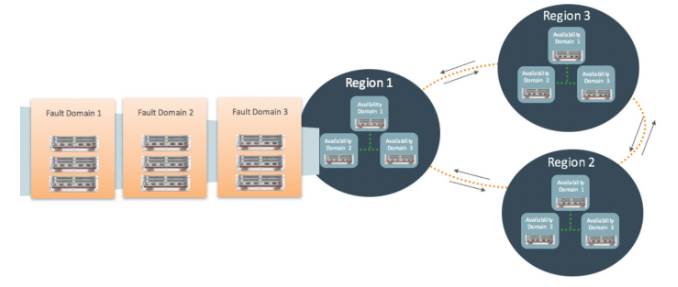
NEW QUESTION 22
You have an application that requires a shared file system. Which of the following services would you use?
- A. File Storage
- B. Archive Storage
- C. Object Storage
- D. Block Volume
Answer: A
Explanation:
Oracle Cloud Infrastructure File Storage service provides a durable, scalable, secure, enterprise-grade network file system. You can connect to a File Storage service file system from any bare metal, virtual machine, or container instance in your Virtual Cloud Network (VCN). You can also access a file system from outside the VCN using Oracle Cloud Infrastructure FastConnect and Internet Protocol security (IPSec) virtual private network (VPN).
Large Compute clusters of thousands of instances can use the File Storage service for high-performance shar storage. Storage provisioning is fully managed and automatic as your use scales from a single byte to exabytes without upfront provisioning.
The File Storage service supports the Network File System version 3.0 (NFSv3) protocol. The service suppo the Network Lock Manager (NLM) protocol for file locking functionality.
Oracle Cloud Infrastructure File Storage employs 5-way replicated storage, located in different fault domain to provide redundancy for resilient data protection. Data is protected with erasure encoding.
The File Storage service uses the "eventual overwrite" method of data eradication. Files are created in the fil system with a unique encryption key. When you delete a single file, its associated encryption key is eradicated, making the file inaccessible. When you delete an entire file system, the file system is marked as inaccessible. The service systematically traverses deleted files and file systems, frees all the used space, and eradicates all residual files.
Use the File Storage service when your application or workload includes big data and analytics, media processing, or content management, and you require Portable Operating System Interface (POSIX)-compliant file system access semantics and concurrently accessible storage. The File Storage service is designed to meet the needs of applications and users that need an enterprise file system across a wide range of use cases, including the following: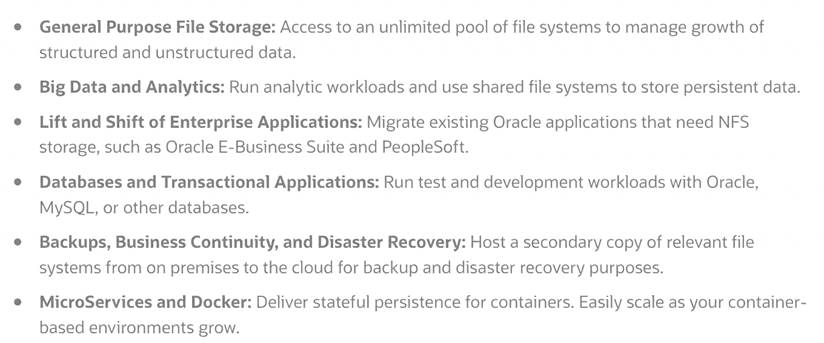
NEW QUESTION 23
Which is NOT considered a security resource within Oracle Cloud Infrastructure?
- A. Network Security Group
- B. Web Application Firewall
- C. File Storage Service
- D. Security Lists
Answer: C
Explanation:
Oracle Cloud Infrastructure File Storage service provides a durable, scalable, secure, enterprise-grade netwo file system. You can connect to a File Storage service file system from any bare metal, virtual machine, or container instance in your Virtual Cloud Network (VCN).
You can control the access of the file system from FSS by applying some security rules and others but the services it self not related to security but it related to shared storage
NEW QUESTION 24
What does compute instance vertical scaling mean?
- A. Providing Fault tolerance
- B. Adding additional compute instances
- C. Enabling Disaster recovery
- D. Changing to a large or smaller shape
Answer: D
Explanation:
Changing the Shape of an Instance (Horizontal Scaling)
You can change the shape of a virtual machine (VM) instance without having to rebuild your instances or redeploy your applications. This lets you scale up your Compute resources for increased performance, or s down to reduce cost.
Autoscaling (vertical scaling)
Autoscaling lets you automatically adjust the number of Compute instances in an instance pool based on performance metrics such as CPU utilization. This helps you provide consistent performance for your end users during periods of high demand, and helps you reduce your costs during periods of low demand.
As load increases, instances are automatically provisioned: the instance pool scales out. As load decreases, instances are automatically removed: the instance pool scales in.
https://docs.cloud.oracle.com/en-us/iaas/Content/Compute/Tasks/resizinginstances.htm
NEW QUESTION 25
......
P.S. Easily pass 1z0-1085-20 Exam with 83 Q&As DumpSolutions.com Dumps & pdf Version, Welcome to Download the Newest DumpSolutions.com 1z0-1085-20 Dumps: https://www.dumpsolutions.com/1z0-1085-20-dumps/ (83 New Questions)
