
Act now and download your Microsoft AZ-204 test today! Do not waste time for the worthless Microsoft AZ-204 tutorials. Download Down to date Microsoft Developing Solutions for Microsoft Azure exam with real questions and answers and begin to learn Microsoft AZ-204 with a classic professional.
Online Microsoft AZ-204 free dumps demo Below:
NEW QUESTION 1
You need to correct the corporate website error.
Which four actions should you recommend be performed in sequence? To answer, move the appropriate actions from the list of actions to the answer area and arrange them in the correct order.
Solution:
Scenario: Corporate website
While testing the site, the following error message displays: CryptographicException: The system cannot find the file specified. Step 1: Generate a certificate
Step 2: Upload the certificate to Azure Key Vault
Scenario: All SSL certificates and credentials must be stored in Azure Key Vault. Step 3: Import the certificate to Azure App Service
Step 4: Update line SCO5 of Security.cs to include error handling and then redeploy the code Reference:
https://docs.microsoft.com/en-us/azure/app-service/configure-ssl-certificate
Does this meet the goal?
- A. Yes
- B. Not Mastered
Answer: A
NEW QUESTION 2
You need to deploy a new version of the LabelMaker application to ACR.
Which three actions should you perform in sequence? To answer, move the appropriate actions from the list of actions to the answer area and arrange them in the correct order.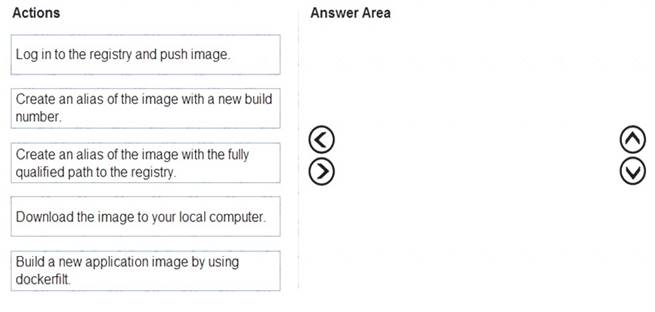
Solution:
A picture containing timeline Description automatically generated
Step 1: Build a new application image by using dockerfile
Step 2: Create an alias if the image with the fully qualified path to the registry
Before you can push the image to a private registry, you’ve to ensure a proper image name. This can be achieved using the docker tag command. For demonstration purpose, we’ll use Docker’s hello world image, rename it and push it to ACR.
# pulls hello-world from the public docker hub
$ docker pull hello-world
# tag the image in order to be able to push it to a private registry
$ docker tag hello-word <REGISTRY_NAME>/hello-world
# push the image
$ docker push <REGISTRY_NAME>/hello-world Step 3: Log in to the registry and push image
In order to push images to the newly created ACR instance, you need to login to ACR form the Docker CLI. Once logged in, you can push any existing docker image to your ACR instance.
Scenario:
Coho Winery plans to move the application to Azure and continue to support label creation. LabelMaker app
Azure Monitor Container Health must be used to monitor the performance of workloads that are deployed to Kubernetes environments and hosted on Azure Kubernetes Service (AKS).
You must use Azure Container Registry to publish images that support the AKS deployment. Reference:
https://thorsten-hans.com/how-to-use-a-private-azure-container-registry-with-kubernetes-9b86e67b93b6
https://docs.microsoft.com/en-us/azure/container-registry/container-registry-tutorial-quick-task
Does this meet the goal?
- A. Yes
- B. Not Mastered
Answer: A
NEW QUESTION 3
You plan to create a Docker image that runs as ASP.NET Core application named ContosoApp. You have a setup script named setupScript.ps1 and a series of application files including ContosoApp.dll.
You need to create a Dockerfile document that meets the following requirements:
•Call setupScript.ps1 when the container is built.
•Run ContosoApp.dll when the container starts.
The Docker document must be created in the same folder where ContosoApp.dll and setupScript.ps1 are stored.
Which four commands should you use to develop the solution? To answer, move the appropriate commands from the list of commands to the answer area and arrange them in the correct order.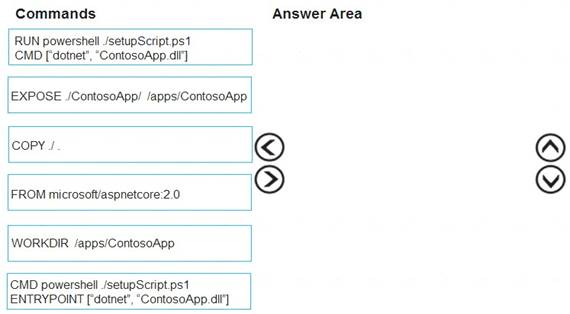
Solution:
Step 1: WORKDIR /apps/ContosoApp Step 2: COPY ./The Docker document must be created in the same folder where ContosoApp.dll and setupScript.ps1 are stored.
Step 3: EXPOSE ./ContosApp/ /app/ContosoApp Step 4: CMD powershell ./setupScript.ps1 ENTRYPOINT ["dotnet", "ContosoApp.dll"]
You need to create a Dockerfile document that meets the following requirements:
 Call setupScript.ps1 when the container is built.
 Run ContosoApp.dll when the container starts. References:
https://docs.microsoft.com/en-us/azure/app-service/containers/tutorial-custom-docker-image
Does this meet the goal?
- A. Yes
- B. Not Mastered
Answer: A
NEW QUESTION 4
You are developing a web service that will run on Azure virtual machines that use Azure Storage. You configure all virtual machines to use managed identities.
You have the following requirements: Must use only Azure Instance Metadata Service endpoints.
You need to write code to retrieve an access token to access Azure Storage. To answer, drag the appropriate code segments to the correct locations. Each code segment may be used once or not at all. You may need to drag the split bar between panes or scroll to view content.
NOTE: Each correct selection is worth one point.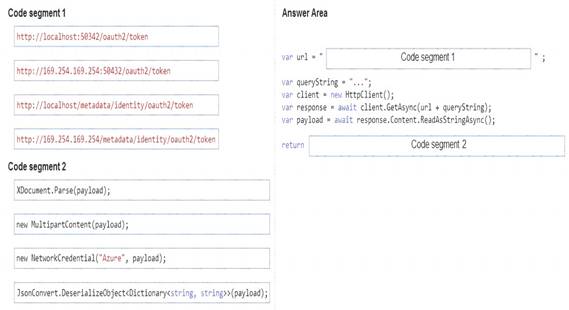
Solution:
Azure Instance Metadata Service endpoints "/oauth2/token"
Box 1: http://169.254.169.254/metadata/identity/oauth2/token
Sample request using the Azure Instance Metadata Service (IMDS) endpoint (recommended): GET 'http://169.254.169.254/metadata/identity/oauth2/token?api-version=2018-02-01
&resource=https://management.azure.com/' HTTP/1.1 Metadata: true
Box 2: JsonConvert.DeserializeObject<Dictionary<string,string>>(payload); Deserialized token response; returning access code.
Reference:
https://docs.microsoft.com/en-us/azure/active-directory/managed-identities-azure-resources/how-to-use-vm-toke https://docs.microsoft.com/en-us/azure/service-fabric/how-to-managed-identity-service-fabric-app-code
Does this meet the goal?
- A. Yes
- B. Not Mastered
Answer: A
NEW QUESTION 5
You are developing a medical records document management website. The website is used to store scanned copies of patient intake forms. If the stored intake forms are downloaded from storage by a third party, the content of the forms must not be compromised.
You need to store the intake forms according to the requirements.
Solution: Create an Azure Cosmos DB database with Storage Service Encryption enabled. Store the intake forms in the Azure Cosmos DB database. Does the solution meet the goal?
- A. Yes
- B. No
Answer: B
Explanation:
Instead use an Azure Key vault and public key encryption. Store the encrypted from in Azure Storage Blob storage.
NEW QUESTION 6
You are developing an Azure solution.
You need to develop code to access a secret stored in Azure Key Vault.
How should you complete the code segment? To answer, drag the appropriate code segments to the correct locations. Each code segment may be used once, more than once, or not at all. You may need to drag the split bar between panes or scroll to view content.
NOTE: Each correct selection is worth one point.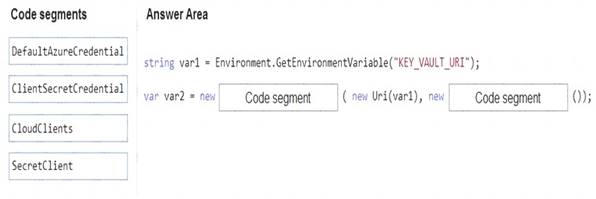
Solution:
Graphical user interface, text, application Description automatically generated with medium confidence
Box 1: SecretClient
Box 2: DefaultAzureCredential
In below example, the name of your key vault is expanded to the key vault URI, in the format
"https://<your-key-vault-name>.vault.azure.net". This example is using 'DefaultAzureCredential()' class from Azure Identity Library, which allows to use the same code across different environments with different options to provide identity.
string keyVaultName = Environment.GetEnvironmentVariable("KEY_VAULT_NAME"); var kvUri = "https://" + keyVaultName + ".vault.azure.net";
var client = new SecretClient(new Uri(kvUri), new DefaultAzureCredential()); Reference:
https://docs.microsoft.com/en-us/azure/key-vault/secrets/quick-create-net
Does this meet the goal?
- A. Yes
- B. Not Mastered
Answer: A
NEW QUESTION 7
You need to configure Azure App Service to support the REST API requirements.
Which values should you use? To answer, select the appropriate options in the answer area.
NOTE: Each correct selection is worth one point.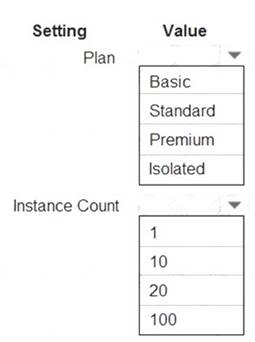
Solution:
Plan: Standard
Standard support auto-scaling Instance Count: 10
Max instances for standard is 10. Scenario:
The REST API’s that support the solution must meet the following requirements:
 Allow deployment to a testing location within Azure while not incurring additional costs. Automatically scale to double capacity during peak shipping times while not causing application downtime. Minimize costs when selecting an Azure payment model. References:
https://azure.microsoft.com/en-us/pricing/details/app-service/plans/
Does this meet the goal?
- A. Yes
- B. Not Mastered
Answer: A
NEW QUESTION 8
You manage several existing Logic Apps.
You need to change definitions, add new logic, and optimize these apps on a regular basis.
What should you use? To answer, drag the appropriate tools to the correct functionalities. Each tool may be used once, more than once, or not at all. You may need to drag the split bar between panes or scroll to view content.
NOTE: Each correct selection is worth one point.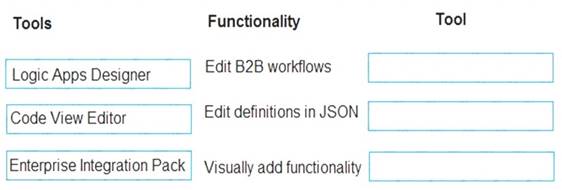
Solution:
Box 1: Enterprise Integration Pack
After you create an integration account that has partners and agreements, you are ready to create a business to business (B2B) workflow for your logic app with the Enterprise Integration Pack.
Box 2: Code View Editor
To work with logic app definitions in JSON, open the Code View editor when working in the Azure portal or in Visual Studio, or copy the definition into any editor that you want.
Box 3: Logical Apps Designer
You can build your logic apps visually with the Logic Apps Designer, which is available in the Azure portal through your browser and in Visual Studio.
References:
https://docs.microsoft.com/en-us/azure/logic-apps/logic-apps-enterprise-integration-b2b https://docs.microsoft.com/en-us/azure/logic-apps/logic-apps-author-definitions
https://docs.microsoft.com/en-us/azure/logic-apps/logic-apps-overview
Does this meet the goal?
- A. Yes
- B. Not Mastered
Answer: A
NEW QUESTION 9
You are developing a solution that uses the Azure Storage Client library for .NET. You have the following code: (Line numbers are included for reference only.)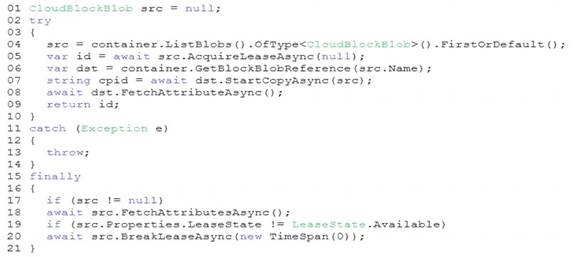
For each of the following statements, select Yes if the statement is true. Otherwise, select No.
NOTE: Each correct selection is worth one point.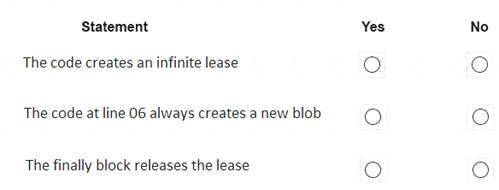
Solution:
Box 1: Yes
AcquireLeaseAsync does not specify leaseTime.
leaseTime is a TimeSpan representing the span of time for which to acquire the lease, which will be rounded down to seconds. If null, an infinite lease will be acquired. If not null, this must be 15 to 60 seconds.
Box 2: No
The GetBlockBlobReference method just gets a reference to a block blob in this container. Box 3: Yes
The BreakLeaseAsync method initiates an asynchronous operation that breaks the current lease on this container.
Reference:
https://docs.microsoft.com/en-us/dotnet/api/microsoft.azure.storage.blob.cloudblobcontainer.acquireleaseasync https://docs.microsoft.com/en-us/dotnet/api/microsoft.azure.storage.blob.cloudblobcontainer.getblockblobrefere https://docs.microsoft.com/en-us/dotnet/api/microsoft.azure.storage.blob.cloudblobcontainer.breakleaseasync
Does this meet the goal?
- A. Yes
- B. Not Mastered
Answer: A
NEW QUESTION 10
You are maintaining an existing application that uses an Azure Blob GPv1 Premium storage account. Data older than three months is rarely used.
Data newer than three months must be available immediately. Data older than a year must be saved but does not need to be available immediately.
You need to configure the account to support a lifecycle management rule that moves blob data to archive storage for data not modified in the last year.
Which three actions should you perform in sequence? To answer, move the appropriate actions from the list of actions to the answer area and arrange them in the correct order.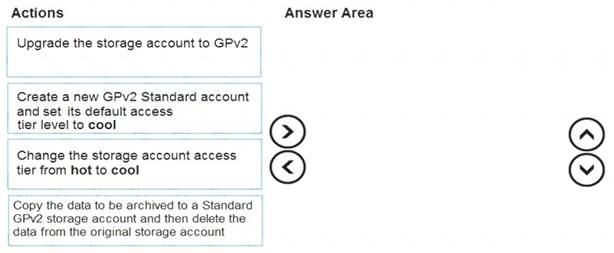
Solution:
Step 1: Upgrade the storage account to GPv2
Object storage data tiering between hot, cool, and archive is supported in Blob Storage and General Purpose v2 (GPv2) accounts. General Purpose v1 (GPv1) accounts don't support tiering.
You can easily convert your existing GPv1 or Blob Storage accounts to GPv2 accounts through the Azure portal.
Step 2: Copy the data to be archived to a Standard GPv2 storage account and then delete the data from the original storage account
Step 3: Change the storage account access tier from hot to cool Note: Hot - Optimized for storing data that is accessed frequently.
Cool - Optimized for storing data that is infrequently accessed and stored for at least 30 days.
Archive - Optimized for storing data that is rarely accessed and stored for at least 180 days with flexible latency requirements, on the order of hours.
Only the hot and cool access tiers can be set at the account level. The archive access tier can only be set at the blob level.
Reference:
https://docs.microsoft.com/en-us/azure/storage/blobs/storage-blob-storage-tiers
Does this meet the goal?
- A. Yes
- B. Not Mastered
Answer: A
NEW QUESTION 11
You are developing a project management service by using ASP.NET. The service hosts conversations, files, to-do lists, and a calendar that users can interact with at any time.
The application uses Azure Search for allowing users to search for keywords in the project data.
You need to implement code that creates the object which is used to create indexes in the Azure Search service.
Which two objects should you use? Each correct answer presents part of the solution. NOTE: Each correct selection is worth one point.
- A. SearchService
- B. SearchlndexCIient
- C. SearchServiceClient
- D. SearchCredentials
Answer: BC
Explanation:
The various client libraries define classes like Index, Field, and Document, as well as operations like Indexes.Create and Documents.Search on the SearchServiceClient and SearchIndexClient classes.
Example:
The sample application we'll be exploring creates a new index named "hotels", populates it with a few documents, then executes some search queries. Here is the main program, showing the overall flow:
/ This sample shows how to delete, create, upload documents and query an index static void Main(string[] args)
{
IConfigurationBuilder builder = new ConfigurationBuilder().AddJsonFile("appsettings.json"); IConfigurationRoot configuration = builder.Build();
SearchServiceClient serviceClient = CreateSearchServiceClient(configuration); Console.WriteLine("{0}", "Deleting index...\n"); DeleteHotelsIndexIfExists(serviceClient);
Console.WriteLine("{0}", "Creating index...\n"); CreateHotelsIndex(serviceClient);
ISearchIndexClient indexClient = serviceClient.Indexes.GetClient("hotels"); References:
https://docs.microsoft.com/en-us/azure/search/search-howto-dotnet-sdk
NEW QUESTION 12
You need to authenticate the user to the corporate website as indicated by the architectural diagram. Which two values should you use? Each correct answer presents part of the solution.
NOTE: Each correct selection is worth one point.
- A. ID token signature
- B. ID token claims
- C. HTTP response code
- D. Azure AD endpoint URI
- E. Azure AD tenant ID
Answer: BE
Explanation:
Claims in access tokens
JWTs (JSON Web Tokens) are split into three pieces: Header - Provides information about how to validate the token including information about the type of token and how it was signed.
 Signature - Is the raw material used to validate the token.
Your client can get an access token from either the v1.0 endpoint or the v2.0 endpoint using a variety of protocols.
Scenario: User authentication (see step 5 below)
The following steps detail the user authentication process:  The user selects Sign in in the website. The browser redirects the user to the Azure Active Directory (Azure AD) sign in page. The user signs in. Azure AD redirects the user’s session back to the web application. The URL includes an access token. The web application calls an API and includes the access token in the authentication header. The application ID is sent as the audience (‘aud’) claim in the access token. The back-end API validates the access token.
Reference:
https://docs.microsoft.com/en-us/azure/api-management/api-management-access-restriction-policies
NEW QUESTION 13
Note: This question is part of a series of questions that present the same scenario. Each question in the series contains a unique solution that might meet the stated goals. Some question sets might have more than one correct solution, while others might not have a correct solution.
After you answer a question in this section, you will NOT be able to return to it. As a result, these questions will not appear in the review screen.
You develop an HTTP triggered Azure Function app to process Azure Storage blob data. The app is triggered using an output binding on the blob.
The app continues to time out after four minutes. The app must process the blob data. You need to ensure the app does not time out and processes the blob data.
Solution: Use the Durable Function async pattern to process the blob data. Does the solution meet the goal?
- A. Yes
- B. No
Answer: B
Explanation:
Instead pass the HTTP trigger payload into an Azure Service Bus queue to be processed by a queue trigger function and return an immediate HTTP success response.
Note: Large, long-running functions can cause unexpected timeout issues. General best practices include: Whenever possible, refactor large functions into smaller function sets that work together and return responses fast. For example, a webhook or HTTP trigger function might require an acknowledgment response within a certain time limit; it's common for webhooks to require an immediate response. You can pass the HTTP trigger payload into a queue to be processed by a queue trigger function. This approach lets you defer the actual work and return an immediate response.
Reference:
https://docs.microsoft.com/en-us/azure/azure-functions/functions-best-practices
NEW QUESTION 14
You need to resolve a notification latency issue.
Which two actions should you perform? Each correct answer presents part of the solution.
NOTE: Each correct selection is worth one point.
- A. Set Always On to true.
- B. Ensure that the Azure Function is using an App Service plan.
- C. Set Always On to false.
- D. Ensure that the Azure Function is set to use a consumption plan.
Answer: AB
Explanation:
Azure Functions can run on either a Consumption Plan or a dedicated App Service Plan. If you run in a dedicated mode, you need to turn on the Always On setting for your Function App to run properly. The Function runtime will go idle after a few minutes of inactivity, so only HTTP triggers will actually "wake up" your functions. This is similar to how WebJobs must have Always On enabled.
Scenario: Notification latency: Users report that anomaly detection emails can sometimes arrive several minutes after an anomaly is detected.
Anomaly detection service: You have an anomaly detection service that analyzes log information for anomalies. It is implemented as an Azure Machine Learning model. The model is deployed as a web service. If an anomaly is detected, an Azure Function that emails administrators is called by using an HTTP WebHook.
Reference:
https://github.com/Azure/Azure-Functions/wiki/Enable-Always-On-when-running-on-dedicated-App-Service-Pl
NEW QUESTION 15
Note: This question is part of a series of questions that present the same scenario. Each question in the series contains a unique solution that might meet the stated goals. Some question sets might have more than one correct solution, while others might not have a correct solution.
After you answer a question in this question, you will NOT be able to return to it. As a result, these questions will not appear in the review screen.
You are developing a solution that will be deployed to an Azure Kubernetes Service (AKS) cluster. The solution will include a custom VNet, Azure Container Registry images, and an Azure Storage account.
The solution must allow dynamic creation and management of all Azure resources within the AKS cluster. You need to configure an AKS cluster for use with the Azure APIs.
Solution: Create an AKS cluster that supports network policy. Create and apply a network to allow traffic only from within a defined namespace.
Does the solution meet the goal?
- A. Yes
- B. No
Answer: A
Explanation:
When you run modern, microservices-based applications in Kubernetes, you often want to control which components can communicate with each other. The principle of least privilege should be applied to how traffic can flow between pods in an Azure Kubernetes Service (AKS) cluster. Let's say you likely want to block traffic directly to back-end applications. The Network Policy feature in Kubernetes lets you define rules for ingress and egress traffic between pods in a cluster.
References:
https://docs.microsoft.com/en-us/azure/aks/use-network-policies
NEW QUESTION 16
You need to configure Azure CDN for the Shipping web site.
Which configuration options should you use? To answer, select the appropriate options in the answer area. NOTE: Each correct selection is worth one point.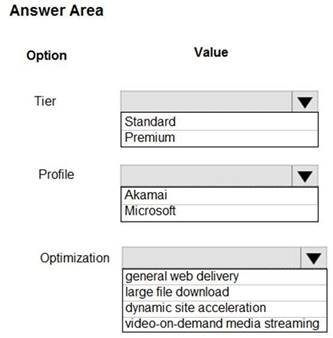
Solution:
Scenario: Shipping website
Use Azure Content Delivery Network (CDN) and ensure maximum performance for dynamic content while minimizing latency and costs.
Tier: Standard Profile: Akamai
Optimization: Dynamic site acceleration
Dynamic site acceleration (DSA) is available for Azure CDN Standard from Akamai, Azure CDN Standard from Verizon, and Azure CDN Premium from Verizon profiles.
DSA includes various techniques that benefit the latency and performance of dynamic content. Techniques include route and network optimization, TCP optimization, and more.
You can use this optimization to accelerate a web app that includes numerous responses that aren't cacheable. Examples are search results, checkout transactions, or real-time data. You can continue to use core Azure CDN caching capabilities for static data.
Reference:
https://docs.microsoft.com/en-us/azure/cdn/cdn-optimization-overview
Does this meet the goal?
- A. Yes
- B. Not Mastered
Answer: A
NEW QUESTION 17
......
P.S. Dumpscollection.com now are offering 100% pass ensure AZ-204 dumps! All AZ-204 exam questions have been updated with correct answers: https://www.dumpscollection.net/dumps/AZ-204/ (254 New Questions)
