
It is impossible to pass Microsoft AZ-305 exam without any help in the short term. Come to Passleader soon and find the most advanced, correct and guaranteed Microsoft AZ-305 practice questions. You will get a surprising result by our Improved Designing Microsoft Azure Infrastructure Solutions practice guides.
Online AZ-305 free questions and answers of New Version:
NEW QUESTION 1
You are designing a microservices architecture that will support a web application.
The solution must meet the following requirements: Allow independent upgrades to each microservice Deploy the solution on-premises and to Azure Set policies for performing automatic repairs to the microservices Support low-latency and hyper-scale operations
You need to recommend a technology. What should you recommend?
- A. Azure Service Fabric
- B. Azure Container Service
- C. Azure Container Instance
- D. Azure Virtual Machine Scale Set
Answer: A
Explanation:
https://docs.microsoft.com/en-us/azure/service-fabric/service-fabric-overview
NEW QUESTION 2
What should you recommend lo meet the monitoring requirements for App2?
- A. Azure Application Insights
- B. Container insights
- C. Microsoft Sentinel
- D. VM insights
Answer: A
NEW QUESTION 3
Note: This question is part of a series of questions that present the same scenario. Each question in the
series contains a unique solution that might meet the stated goals. Some question sets might have more than one correct solution, while others might not have a correct solution.
After you answer a question in this section, you will NOT be able to return to it. As a result, these questions will not appear in the review screen.
You have an Azure Storage account that contains two 1-GB data files named File1 and File2. The data files are set to use the archive access tier.
You need to ensure that File1 is accessible immediately when a retrieval request is initiated. Solution: For File1, you set Access tier to Cool.
Does this meet the goal?
- A. Yes
- B. No
Answer: A
Explanation:
The data in the cool tier is "considered / intended to be stored for 30 days". But this is not a must. You can store data indefinitely in the cool tier. The mentioned reference (see below) even gives an example of large scientific or otherwise large data which is stored for long duration in the cool tier.
https://docs.microsoft.com/en-us/azure/storage/blobs/storage-blob-storage-tiers?tabs=azure-portal
NEW QUESTION 4
You need to implement the Azure RBAC role assignments for the Network Contributor role. The solution must meet the authentication and authorization requirements.
What is the minimum number of assignments that you must use?
- A. 1
- B. 2
- C. 5
- D. 10
- E. 15
Answer: A
Explanation:
Scenario: The Network Contributor built-in RBAC role must be used to grant permissions to the network administrators for all the virtual networks in all the Azure subscriptions.
RBAC roles must be applied at the highest level possible.
NEW QUESTION 5
You have an Azure subscription.
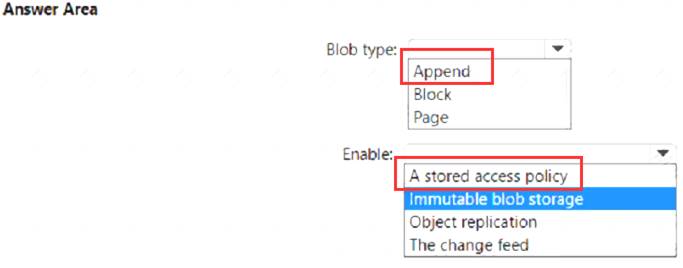
You need to deploy a solution that will provide point-in-time restore for blobs in storage accounts that have blob versioning and blob soft delete enabled.
Which type of blob should you create, and what should you enable for the accounts? To answer, select the appropriate options in the answer area.
NOTE; Each correct selection is worth one point.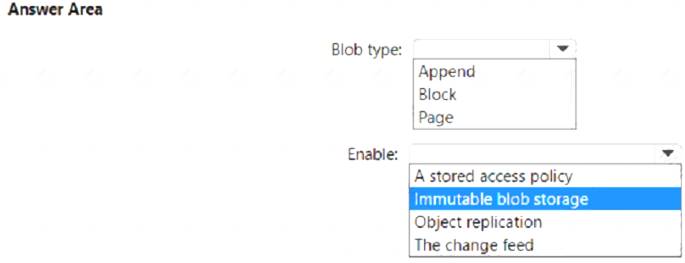
Solution:
Does this meet the goal?
- A. Yes
- B. Not Mastered
Answer: A
NEW QUESTION 6
You configure OAuth2 authorization in API Management as shown in the following exhibit.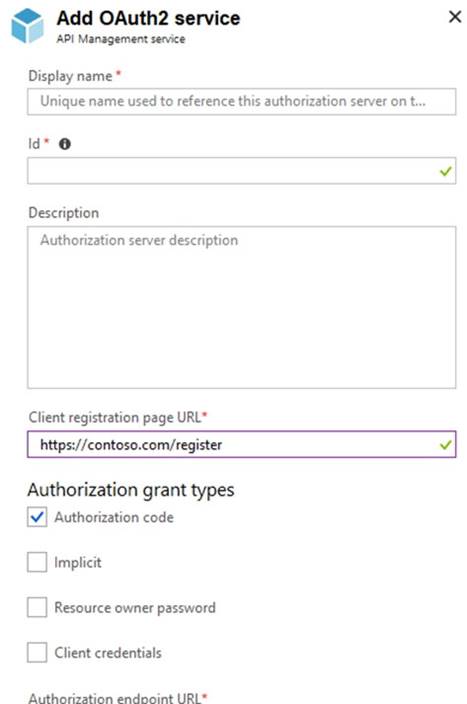
Use the drop-down menus to select the answer choice that completes each statement based on the information presented in the graphic.
NOTE: Each correct selection is worth one point.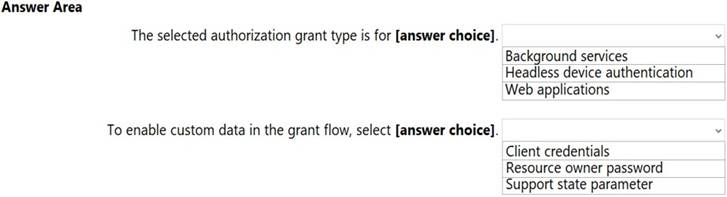
Solution:
Graphical user interface, text, application, email Description automatically generated
Box 1: Web applications
The Authorization Code Grant Type is used by both web apps and native apps to get an access token after a user authorizes an app.
Note: The Authorization Code grant type is used by confidential and public clients to exchange an authorization code for an access token.
After the user returns to the client via the redirect URL, the application will get the authorization code from the URL and use it to request an access token.
Reference:
https://developer.okta.com/blog/2018/04/10/oauth-authorization-code-grant-type https://connect2id.com/products/server/docs/guides/client-registration
Does this meet the goal?
- A. Yes
- B. Not Mastered
Answer: A
NEW QUESTION 7
You need to recommend a solution that meets the data requirements for App1.
What should you recommend deploying to each availability zone that contains an instance of App1?
- A. an Azure Cosmos DB that uses multi-region writes
- B. an Azure Data Lake store that uses geo-zone-redundant storage (GZRS)
- C. an Azure SQL database that uses active geo-replication
- D. an Azure Storage account that uses geo-zone-redundant storage (GZRS)
Answer: A
Explanation:
Scenario: App1 has the following data requirements: Each instance will write data to a data store in the same availability zone as the instance. Data written by any App1 instance must be visible to all App1 instances.
Azure Cosmos DB: Each partition across all the regions is replicated. Each region contains all the data partitions of an Azure Cosmos container and can serve reads as well as serve writes when multi-region writes is enabled.
Reference:
https://docs.microsoft.com/en-us/azure/cosmos-db/high-availability
NEW QUESTION 8
You plan to migrate on-premises MySQL databases to Azure Database for MySQL Flexible Server.
You need to recommend a solution for the Azure Database for MySQL Flexible Server configuration. The solution must meet the following requirements:
• The databases must be accessible if a datacenter fails.
• Costs must be minimized.
Which compute tier should you recommend?
- A. Burstable
- B. General Purpose
- C. Memory Optimized
Answer: C
NEW QUESTION 9
You plan to deploy an infrastructure solution that will contain the following configurations:
• External users will access the infrastructure by using Azure Front Door.
• External user access to the backend APIs hosted in Azure Kubernetes Service (AKS) will be controlled by using Azure API Management.
• External users will be authenticated by an Azure AO B2C tenant that uses OpenlD Connect-based federate with a third-party identity provider.
Which function does each service provide? To answer, drag the appropriate functions to the correct services. Each function may be used once, more than once, or not at all You may need to drag the split bar between panes or scroll to view content.
NOTE: Each correct selection is worth one point.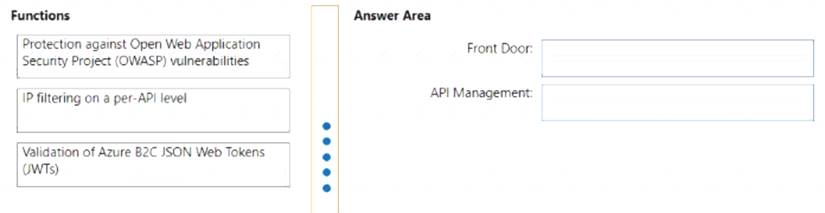
Solution:
Front Door: Protection against Open Web Application Security Project (OWASP) vulnerabilities1
API Management: IP filtering on a per-API level2 and validation of Azure B2C JSON Web Tokens (JWTs)3 References:
1: Azure Front Door - Web Application Firewall 2: Azure API Management policy reference - ip-filter 3: to validate an Azure B2C JWT token in a web API?
Does this meet the goal?
- A. Yes
- B. Not Mastered
Answer: A
NEW QUESTION 10
You have an on-premises network and an Azure subscription. The on-premises network has several branch offices.
A branch office in Toronto contains a virtual machine named VM1 that is configured as a file server. Users access the shared files on VM1 from all the offices.
You need to recommend a solution to ensure that the users can access the shares files as quickly as possible if the Toronto branch office is inaccessible.
What should you include in the recommendation?
- A. a Recovery Services vault and Azure Backup
- B. an Azure file share and Azure File Sync
- C. Azure blob containers and Azure File Sync
- D. a Recovery Services vault and Windows Server Backup
Answer: B
Explanation:
Use Azure File Sync to centralize your organization's file shares in Azure Files, while keeping the flexibility, performance, and compatibility of an on-premises file server. Azure File Sync transforms Windows Server into a quick cache of your Azure file share.
You need an Azure file share in the same region that you want to deploy Azure File Sync. Reference:
https://docs.microsoft.com/en-us/azure/storage/files/storage-sync-files-deployment-guide
NEW QUESTION 11
You manage a database environment for a Microsoft Volume Licensing customer named Contoso, Ltd. Contoso uses License Mobility through Software Assurance.
You need to deploy 50 databases. The solution must meet the following requirements: Support automatic scaling. Minimize Microsoft SQL Server licensing costs.
What should you include in the solution? To answer, select the appropriate options in the answer area.
NOTE: Each correct selection is worth one point.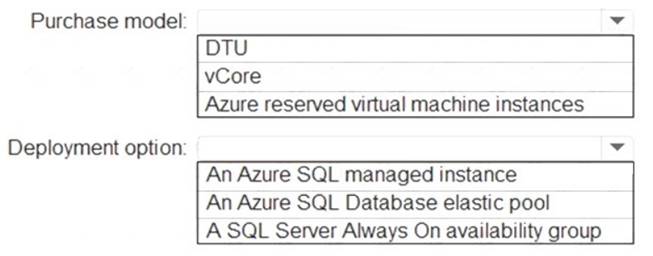
Solution:
Text, table Description automatically generated
Box 1: vCore
Virtual core (vCore)-based purchasing model (recommended). This purchasing model provides a choice between a provisioned compute tier and a serverless compute tier. With the provisioned compute tier, you choose the exact amount of compute resources that are always provisioned for your workload. With the serverless compute tier, you specify the autoscaling of the compute resources over a configurable compute range
Box 2: An Azure SQL Database Elastic pool
Azure SQL Database provides the following deployment options for a database:
Single database represents a fully managed, isolated database. Elastic pool is a collection of single databases with a shared set of resources, such as CPU or memory.Single databases can be moved into and out of an elastic pool.
Reference:
https://docs.microsoft.com/en-us/azure/azure-sql/database/purchasing-models
Does this meet the goal?
- A. Yes
- B. Not Mastered
Answer: A
NEW QUESTION 12
You migrate App1 to Azure. You need to ensure that the data storage for App1 meets the security and compliance requirement
What should you do?
- A. Create an access policy for the blob
- B. Modify the access level of the blob service.
- C. Implement Azure resource locks.
- D. Create Azure RBAC assignments.
Answer: A
Explanation:
Scenario: Once App1 is migrated to Azure, you must ensure that new data can be written to the app, and the modification of new and existing data is prevented for a period of three years.
As an administrator, you can lock a subscription, resource group, or resource to prevent other users in your organization from accidentally deleting or modifying critical resources. The lock overrides any permissions the user might have.
Reference:
https://docs.microsoft.com/en-us/azure/azure-resource-manager/management/lock-resources
NEW QUESTION 13
You plan to automate the deployment of resources to Azure subscriptions.
What is a difference between using Azure Blueprints and Azure Resource Manager (ARM) templates?
- A. ARM templates remain connected to the deployed resources.
- B. Only ARM templates can contain policy definitions.
- C. Blueprints remain connected to the deployed resources.
- D. Only Blueprints can contain policy definitions.
Answer: C
Explanation:
With Azure Blueprints, the relationship between the blueprint definition (what should be deployed) and the blueprint assignment (what was deployed) is preserved. This connection supports improved tracking and auditing of deployments. Azure Blueprints can also upgrade several subscriptions at once that are governed by the same blueprint.
Reference:
https://docs.microsoft.com/en-us/answers/questions/26851/how-is-azure-blue-prints-different-from-resource-m.h
NEW QUESTION 14
You have an Azure App Service web app that uses a system-assigned managed identity.
You need to recommend a solution to store their settings of the web app as secrets in an Azure key vault The solution must meet the following requirements:
• Minimize changes to the app code,
• Use the principle of least privilege.
What should you include in the recommendation? To answer, select the appropriate options in the answer area.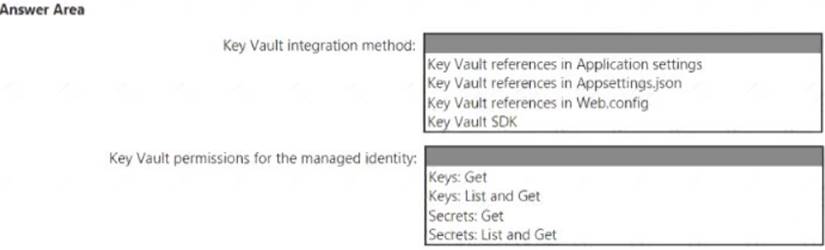
Solution:
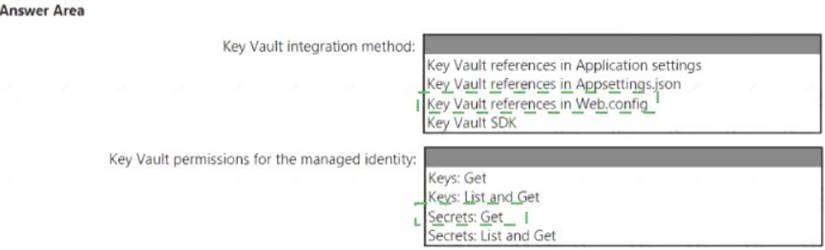
Does this meet the goal?
- A. Yes
- B. Not Mastered
Answer: A
NEW QUESTION 15
You plan to migrate App1 to Azure.
You need to recommend a storage solution for App1 that meets the security and compliance requirements. Which type of storage should you recommend, and how should you recommend configuring the storage? To answer, select the appropriate options in the answer area.
NOTE: Each correct selection is worth one point.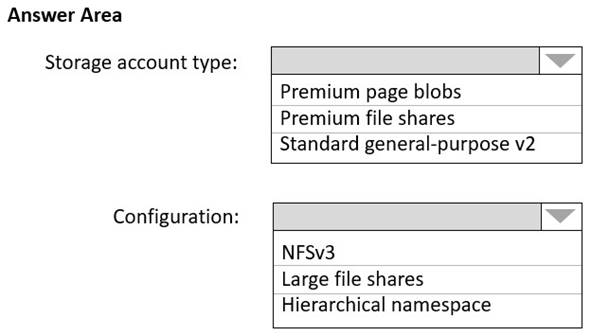
Solution:
Text, table Description automatically generated
Box 1: Standard general-purpose v2
Standard general-purpose v2 supports Blob Storage.
Azure Storage provides data protection for Blob Storage and Azure Data Lake Storage Gen2. Scenario:
Litware identifies the following security and compliance requirements:
 Once App1 is migrated to Azure, you must ensure that new data can be written to the app, and the modification of new and existing data is prevented for a period of three years.
 On-premises users and services must be able to access the Azure Storage account that will host the data in App1. Access to the public endpoint of the Azure Storage account that will host the App1 data must be prevented. All Azure SQL databases in the production environment must have Transparent Data Encryption (TDE) enabled. App1 must NOT share physical hardware with other workloads. Box 2: NFSv3
Scenario: Plan: Migrate App1 to Azure virtual machines.
Blob storage now supports the Network File System (NFS) 3.0 protocol. This support provides Linux file system compatibility at object storage scale and prices and enables Linux clients to mount a container in Blob storage from an Azure Virtual Machine (VM) or a computer on-premises. Reference:
https://docs.microsoft.com/en-us/azure/storage/blobs/data-protection-overview
Does this meet the goal?
- A. Yes
- B. Not Mastered
Answer: A
NEW QUESTION 16
You have an Azure subscription that contains an Azure Blob storage account named store1.
You have an on-premises file server named Setver1 that runs Windows Sewer 2016. Server1 stores 500 GB of company files.
You need to store a copy of the company files from Server 1 in store1.
Which two possible Azure services achieve this goal? Each correct answer presents a complete solution. NOTE: Each correct selection is worth one point
- A. an Azure Batch account
- B. an integration account
- C. an On-premises data gateway
- D. an Azure Import/Export job
- E. Azure Data factory
Answer: DE
Explanation:
https://docs.microsoft.com/en-us/azure/storage/common/storage-import-export-data-from-blobs https://docs.microsoft.com/en-us/answers/questions/31113/fastest-method-to-copy-500gb-table-from-on-premise
NEW QUESTION 17
You have an Azure subscription that contains the resources shown in the following table.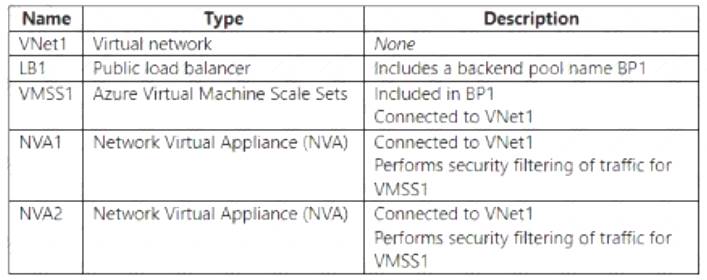
You need to recommend a load balancing solution that will distribute incoming traffic for VMSS1 across NVA1 and NVA2. The solution must minimize administrative effort.
What should you include in the recommendation?
- A. Gateway Load Balancer
- B. Azure Front Door
- C. Azure Application Gateway
- D. Azure Traffic Manager
Answer: B
NEW QUESTION 18
Note: This question is part of a series of questions that present the same scenario. Each question in the series contains a unique solution that might meet the stated goals. Some question sets might have more than one correct solution, while others might not have a correct solution.
After you answer a question in this section, you will NOT be able to return to it. As a result, these questions will not appear in the review screen.
Your company plans to deploy various Azure App Service instances that will use Azure SQL databases. The App Service instances will be deployed at the same time as the Azure SQL databases.
The company has a regulatory requirement to deploy the App Service instances only to specific Azure regions. The resources for the App Service instances must reside in the same region.
You need to recommend a solution to meet the regulatory requirement.
Solution: You recommend using an Azure Policy initiative to enforce the location of resource groups. Does this meet the goal?
- A. Yes
- B. No
Answer: B
Explanation:
This solution does not meet the goal because an Azure Policy initiative can only enforce the location of resources, not resource groups. Resource groups are not a resource type that can be targeted by Azure Policy1. To enforce the location of resource groups, you need to use Azure Resource Manager templates2 or Azure PowerShell3 to create them in the desired regions.
References:
1: Understand scope in Azure Policy 2: Create resource groups with Azure Resource Manager templates 3: Create resource groups with Azure PowerShell
NEW QUESTION 19
......
P.S. Dumps-files.com now are offering 100% pass ensure AZ-305 dumps! All AZ-305 exam questions have been updated with correct answers: https://www.dumps-files.com/files/AZ-305/ (249 New Questions)
