
Master the AZ-305 Designing Microsoft Azure Infrastructure Solutions content and be ready for exam day success quickly with this Certleader AZ-305 actual exam. We guarantee it!We make it a reality and give you real AZ-305 questions in our Microsoft AZ-305 braindumps.Latest 100% VALID Microsoft AZ-305 Exam Questions Dumps at below page. You can use our Microsoft AZ-305 braindumps and pass your exam.
Free AZ-305 Demo Online For Microsoft Certifitcation:
NEW QUESTION 1
You need to recommend a solution that meets the application development requirements. What should you include in the recommendation?
- A. an Azure Container Registry instance
- B. deployment slots
- C. Continuous Integration/Continuous Deployment (CI/CD) sources
- D. the Azure App Configuration service
Answer: B
NEW QUESTION 2
You have to deploy an Azure SQL database named db1 for your company. The databases must meet the following security requirements
When IT help desk supervisors query a database table named customers, they must be able to see the full number of each credit card
When IT help desk operators query a database table named customers, they must only see the last four digits of each credit card number
A column named Credit Card rating in the customers table must never appear in plain text in the database system. Only client applications must be able to decrypt the information that is stored in this column
Which of the following can be implemented for the Credit Card rating column security requirement?
- A. Always Encrypted
- B. Azure Advanced Threat Protection
- C. Transparent Data Encryption
- D. Dynamic Data Masking
Answer: A
Explanation:
https://docs.microsoft.com/en-us/sql/relational-databases/security/encryption/always-encrypted-database-engine
NEW QUESTION 3
You plan to migrate App1 to Azure.
You need to recommend a high-availability solution for App1. The solution must meet the resiliency requirements.
What should you include in the recommendation? To answer, select the appropriate options in the answer area.
NOTE: Each correct selection is worth one point.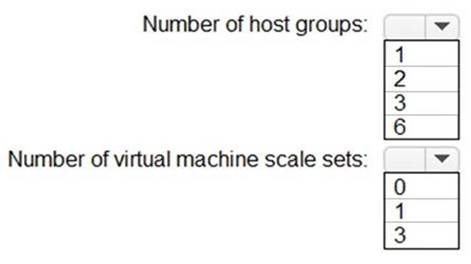
Solution:
Graphical user interface, text, application, email Description automatically generated
Box 1: 3
Scenario: App1 must meet the following requirements:
 Be hosted in an Azure region that supports availability zones. Maintain availability if two availability zones in the local Azure region fail.
A host group is a resource that represents a collection of dedicated hosts. You create a host group in a region and an availability zone, and add hosts to it.
Use Availability Zones for fault isolation
Availability zones are unique physical locations within an Azure region. Each zone is made up of one or more datacenters equipped with independent power, cooling, and networking. A host group is created in a single availability zone. Once created, all hosts will be placed within that zone. To achieve high availability across zones, you need to create multiple host groups (one per zone) and spread your hosts accordingly.
Box 2: 1
Scenario: App1 must meet the following requirements:
Be hosted on Azure virtual machines that support automatic scaling.An Azure virtual machine scale set can automatically increase or decrease the number of VM instances that run your application. This automated and elastic behavior reduces the management overhead to monitor and optimize the performance of your application.
Reference:
https://docs.microsoft.com/en-us/azure/virtual-machines/dedicated-hosts
https://docs.microsoft.com/en-us/azure/virtual-machine-scale-sets/virtual-machine-scale-sets-autoscale-overview
Does this meet the goal?
- A. Yes
- B. Not Mastered
Answer: A
NEW QUESTION 4
You have an Azure subscription named Sub1 that is linked to an Azure AD tenant named contoso.com.
You plan to implement two ASP.NET Core apps named App1 and App2 that will be deployed to 100 virtual machines in Sub1. Users will sign in to App1 and App2 by using their contoso.com credentials.
App1 requires read permissions to access the calendar of the signed-m user. App2 requires write permissions to access the calendar of the signed-in user.
You need to recommend an authentication and authorization solution for the apps. The solution must meet the following requirements:
• Use the principle of least privilege.
• Minimize administrative effort
What should you include in the recommendation? To answer, select the appropriate options in the answer area. NOTE: Each correct selection is worth one pent.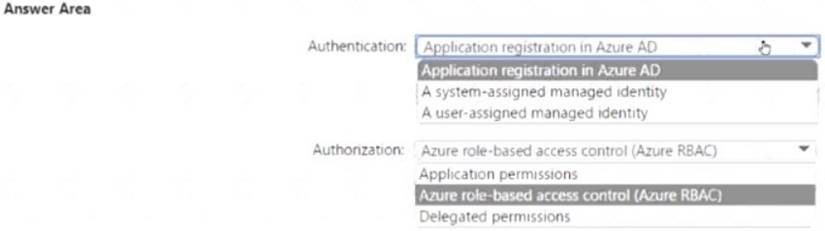
Solution:
Graphical user interface, text, application Description automatically generated
Does this meet the goal?
- A. Yes
- B. Not Mastered
Answer: A
NEW QUESTION 5
You have the Azure subscriptions shown in the following table.
Contoso.onmicrosft.com contains a user named User1.
You need to deploy a solution to protect against ransomware attacks. The solution must meet the following requirements:
• Ensure that all the resources in Sub1 are backed up by using Azure Backup.
• Require that User1 first be assigned a role for Sub2 before the user can make major changes to the backup configuration.
What should you create in each subscription? To answer, select the appropriate options in the answer area. NOTE: Each correct selection is worth one point.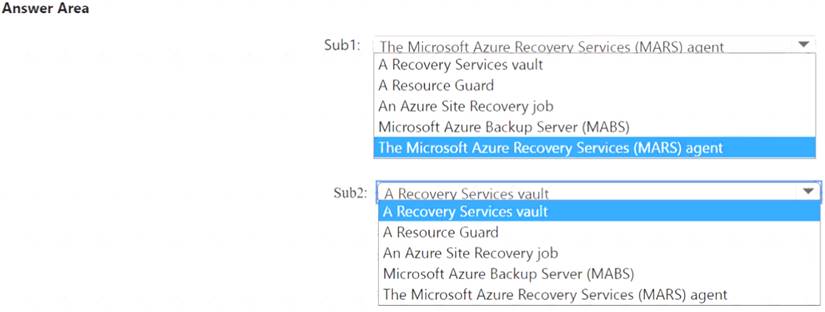
Solution:
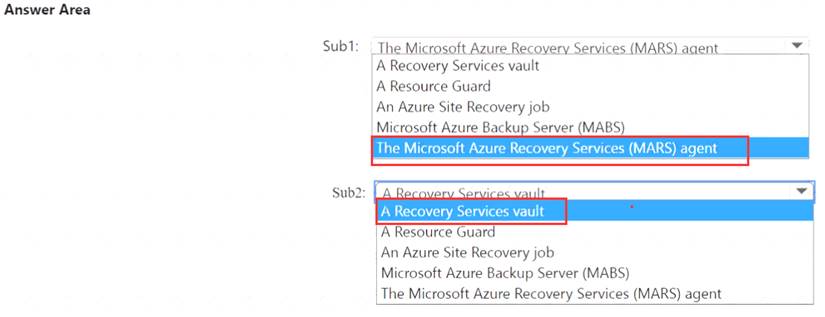
Does this meet the goal?
- A. Yes
- B. Not Mastered
Answer: A
NEW QUESTION 6
A company needs a datastore created in Azure for an application. Below are the key requirements for the data store.
Ability to store JSON based items
Ability to use SQL like queries on the datastore Ability to provide low latency access to data items
Which of the following would you consider as the data store?
- A. Azure BLOB storage
- B. Azure CosmosDB
- C. Azure HDInsight
- D. Azure Redis
Answer: B
NEW QUESTION 7
You are planning an Azure solution that will host production databases for a high-performance application. The solution will include the following components: Two virtual machines that will run Microsoft SQL Server 2016, will be deployed to different data centers in the same Azure region, and will be part of an Always On availability group.
 SQL Server data that will be backed up by using the Automated Backup feature of the SQL Server IaaS Agent Extension (SQLIaaSExtension)
You identify the storage priorities for various data types as shown in the following table.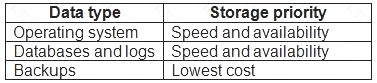
Which storage type should you recommend for each data type? To answer, drag the appropriate storage types to the correct data types. Each storage type may be used once, more than once, or not at all. You may need to drag the split bar between panes or scroll to view content.
NOTE: Each correct selection is worth one point.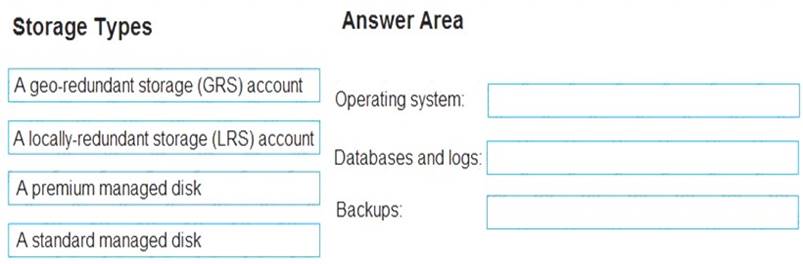
Solution:
Graphical user interface, text, application, email Description automatically generated
Does this meet the goal?
- A. Yes
- B. Not Mastered
Answer: A
NEW QUESTION 8
Your network contains an on-premises Active Directory forest.
You discover that when users change jobs within your company, the membership of the user groups are not being updated. As a result, the users can access resources that are no longer relevant to their job.
You plan to integrate Active Directory and Azure Active Directory (Azure AD) by using Azure AD Connect. You need to recommend a solution to ensure that group owners are emailed monthly about the group
memberships they manage.
What should you include in the recommendation?
- A. conditional access policies
- B. Tenant Restrictions
- C. Azure AD access reviews
- D. Azure AD Identity Protection
Answer: C
Explanation:
Reference:
https://docs.microsoft.com/en-us/azure/active-directory/governance/access-reviews-overview
NEW QUESTION 9
Your company plans to deploy various Azure App Service instances that will use Azure SQL databases. The App Service instances will be deployed at the same time as the Azure SQL
databases.
The company has a regulatory requirement to deploy the App Service instances only to specific Azure regions. The resources for the App Service instances must reside in the same region.
You need to recommend a solution to meet the regulatory requirement.
Solution: You recommend using an Azure policy to enforce the location of resource groups. Does this meet the goal?
- A. Yes
- B. No
Answer: A
NEW QUESTION 10
You have an Azure subscription that contains a storage account.
An application sometimes writes duplicate files to the storage account.
You have a PowerShell script that identifies and deletes duplicate files in the storage account. Currently, the script is run manually after approval from the operations manager.
You need to recommend a serverless solution that performs the following actions:  Runs the script once an hour to identify whether duplicate files existProcesses an email response from the operations manager specifying whether the deletion was approved Runs the script if the deletion was approved
What should you include in the recommendation?
- A. Azure Logic Apps and Azure Functions
- B. Azure Pipelines and Azure Service Fabric
- C. Azure Logic Apps and Azure Event Grid
- D. Azure Functions and Azure Batch
Answer: A
Explanation:
You can schedule a powershell script with Azure Logic Apps.
When you want to run code that performs a specific job in your logic apps, you can create your own function by using Azure Functions. This service helps you create Node.js, C#, and F# functions so you don't have to build a complete app or infrastructure to run code. You can also call logic apps from inside Azure functions. Azure Functions provides serverless computing in the cloud and is useful for performing tasks such as these examples:
Reference:
https://docs.microsoft.com/en-us/azure/logic-apps/logic-apps-azure-functions
NEW QUESTION 11
You have an on-premises app named App1. Customers use App1 to manage digital images. You plan to migrate App1 to Azure.
You need to recommend a data storage solution for Appl. The solution must meet the following image storage requirements:
• Encrypt images at rest.
• Allow files up to 50 MB.
• Manage access to the images by using Azure Web Application Firewall (WAF) on Azure Front Door. The solution must meet the following customer account requirements:
• Support automatic scale out of the storage.
• Maintain the availability of App1 if a datacenter fails.
• Support reading and writing data from multiple Azure regions.
Which service should you include in the recommendation for each type of data? To answer, drag the appropriate services to the correct type of data. Each service may be used once, more than once, or not at all. You may need to drag the split bar between panes or scroll to view content.
NOTE: Each correct selection is worth one point.
Solution:
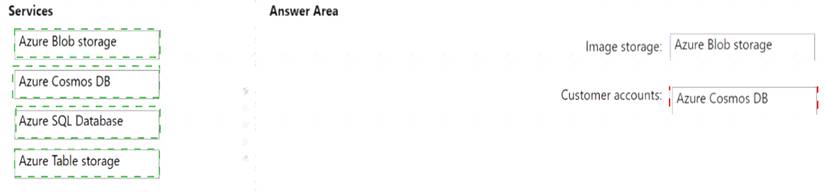
Does this meet the goal?
- A. Yes
- B. Not Mastered
Answer: A
NEW QUESTION 12
You have the Azure resources shown in the following table.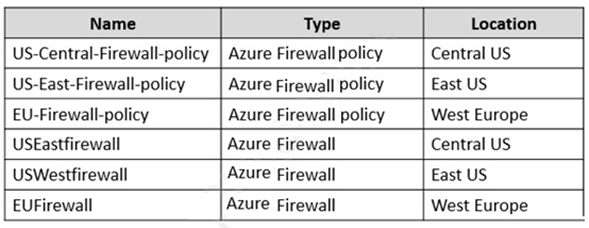
You need to deploy a new Azure Firewall policy that will contain mandatory rules for all Azure Firewall deployments. The new policy will be configured as a parent policy for the existing policies.
What is the minimum number of additional Azure Firewall policies you should create?
- A. 1
- B. 2
- C. 3
Answer: B
Explanation:
Firewall policies work across regions and subscriptions. Place all your global configurations in the parent policy.
Note: Policies can be created in a hierarchy. You can create a parent/global policy that will contain configurations and rules that will apply to all/a number of firewall instances. Then you create a child policy that inherits from the parent; note that rules changes in the parent instantly appear in the child. The child is associated with a firewall and applies configurations/rules from the parent policy and the child policy instantly to the firewall.
Reference: https://aidanfinn.com/?p=22006
NEW QUESTION 13
You are evaluating the components of the migration to Azure that require you to provision an Azure Storage account.
For each of the following statements, select Yes if the statement is true. Otherwise, select No. NOTE: Each correct selection is worth one point.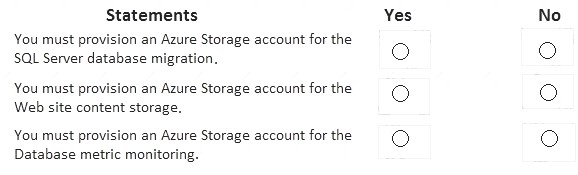
Solution:
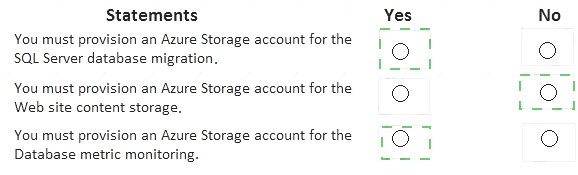
Does this meet the goal?
- A. Yes
- B. Not Mastered
Answer: A
NEW QUESTION 14
You have an Azure subscription.
You need to deploy an Azure Kubernetes Service (AKS) solution that will use Windows Server 2019 nodes. The solution must meet the following requirements:
• Minimize the time it takes to provision compute resources during scale-out operations.
• Support autoscaling of Windows Server containers. Which scaling option should you recommend?
- A. horizontal pod autoscaler
- B. Kubernetes version 1.20.2 or newer
- C. cluster autoscaler
- D. Virtual nodes
- E. with Virtual Kubelet ACI
Answer: C
Explanation:
https://docs.microsoft.com/en-us/azure/aks/cluster-autoscaler#about-the-cluster-autoscaler
NEW QUESTION 15
Your company has an app named App1 that uses data from the on-premises Microsoft SQL Server databases shown in the following table.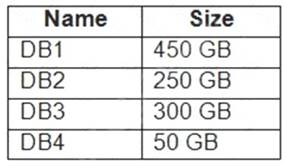
App1 and the data are used on the first day of the month only. The data is not expected to grow more than 3% each year.
The company is rewriting App1 as an Azure web app and plans to migrate all the data to Azure. You need to migrate the data to Azure SQL Database. The solution must minimize costs. Which service tier should you use?
- A. vCore-based Business Critical
- B. vCore-based General Purpose
- C. DTU-based Standard
- D. DTU-based Basic
Answer: C
Explanation:
DTU-based Standard supports databases up to 1 TB in size. Reference:
https://docs.microsoft.com/en-us/azure/azure-sql/database/service-tiers-dtu
NEW QUESTION 16
You need to design a highly available Azure SQL database that meets the following requirements:
* Failover between replicas of the database must occur without any data loss.
* The database must remain available in the event of a zone outage.
* Costs must be minimized.
Which deployment option should you use?
- A. Azure SQL Database Business Critical
- B. Azure SQL Database Managed Instance Business Critical
- C. Azure SQL Database Serverless
- D. Azure SQL Database Premium
Answer: D
Explanation:
General Purpose / Standard prevents data loss through high available storage
https://docs.microsoft.com/en-us/azure/azure-sql/database/service-tier-general-purpose?view=azuresql. This architectural model relies on high availability and reliability of Azure Blob storage that transparently replicates database files and guarantees no data loss if underlying infrastructure failure happens. General Purpose / Standard support Zone Redundancy For General Purpose tier the zone-redundant configuration is Generally Available in the following regions:
https://docs.microsoft.com/en-us/azure/azure-sql/database/high-availability-sla?view=azuresql&tabs=azure-pow Without any information regarding the usage pattern, serverless is possible. Other option is D https://docs.microsoft.com/en-us/azure/azure-sql/database/serverless-tier-overview?view=azuresql
NEW QUESTION 17
You have an on-premises network and an Azure subscription. The on-premises network has several branch offices.
A branch office in Toronto contains a virtual machine named VM1 that is configured as a file server. Users access the shared files on VM1 from all the offices.
You need to recommend a solution to ensure that the users can access the shares files as quickly as possible if
the Toronto branch office is inaccessible.
What should you include in the recommendation?
- A. a Recovery Services vault and Azure Backup
- B. an Azure file share and Azure File Sync
- C. Azure blob containers and Azure File Sync
- D. a Recovery Services vault and Windows Server Backup
Answer: B
Explanation:
Use Azure File Sync to centralize your organization's file shares in Azure Files, while keeping the flexibility, performance, and compatibility of an on-premises file server. Azure File Sync transforms Windows Server into a quick cache of your Azure file share.
You need an Azure file share in the same region that you want to deploy Azure File Sync. Reference:
https://docs.microsoft.com/en-us/azure/storage/files/storage-sync-files-deployment-guide
NEW QUESTION 18
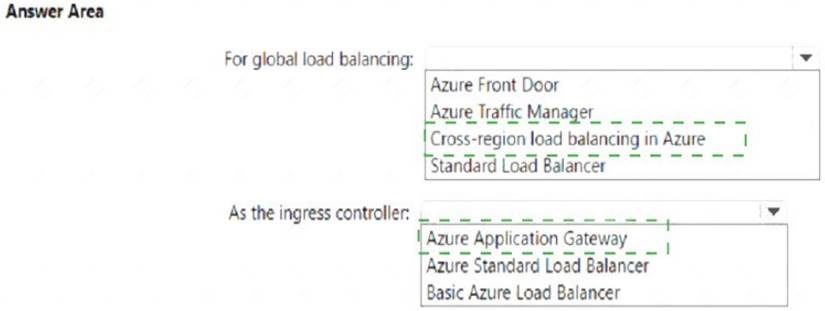
You plan to deploy a containerized web app that will be hosted in five Azure Kubernetes Service (AKS) clusters. Each cluster will be hosted in a different Azure region.
You need to provide access to the app from the internet. The solution must meet the following requirements:
• Incoming HTTPS requests must be routed to the cluster that has the lowest network latency.
• HTTPS traffic to individual pods must be routed via an ingress controller.
• In the event of an AKS cluster outage, failover time must be minimized.
What should you include in the solution? To answer, select the appropriate options in the answer area.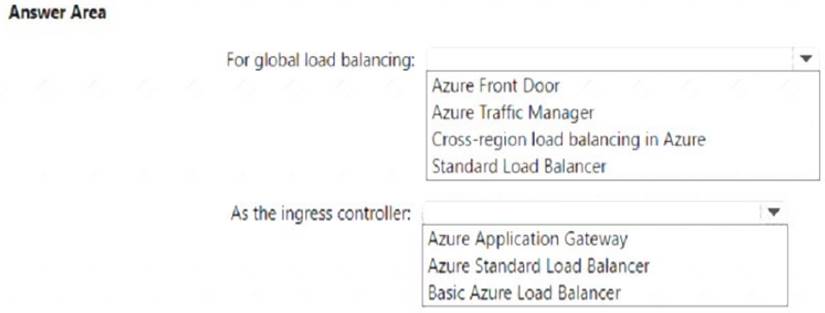
Solution:
Does this meet the goal?
- A. Yes
- B. Not Mastered
Answer: A
NEW QUESTION 19
......
P.S. Certleader now are offering 100% pass ensure AZ-305 dumps! All AZ-305 exam questions have been updated with correct answers: https://www.certleader.com/AZ-305-dumps.html (249 New Questions)
