
Exam Code: AZ-400 (Practice Exam Latest Test Questions VCE PDF)
Exam Name: Microsoft Azure DevOps Solutions (beta)
Certification Provider: Microsoft
Free Today! Guaranteed Training- Pass AZ-400 Exam.
NEW QUESTION 1
Note: This question is part of * series of questions that present the same scenario. Each question in the series contains a unique solution that might meet the stated
goals. Some question sett might have more than one correct solution, while others might not have a correct solution.
After you answer a question in this section, you will NOT be able to return to it. As a result, these questions will not appear in the review screen.
You have an approval process that contains a condition. The condition requires that releases be approved by a team leader before they are deployed.
You have a poky stating that approvals must occur within eight hour.
You discover that deployments fail if the approvals take longer than two hours. You need to ensure that the deployments only fail if the approvals take longer than eight hours.
Solution: From Post-deployment conditions, you modify the Time between reevaluation of gates option.
Does this meet the goal?
- A. Yes
- B. No
Answer: B
Explanation:
Use a gate From Pre-deployment conditions instead. References: https://docs.microsoft.com/enus/ azure/devops/pipelines/release/approvals/gates
NEW QUESTION 2
DRAG DROP
You need to configure Azure Automation for the computer in Group7.
Which three actions should you perform in sequence? To answer, move the appropriate actions from the list of actions to the answer area and arrange them in the correct order.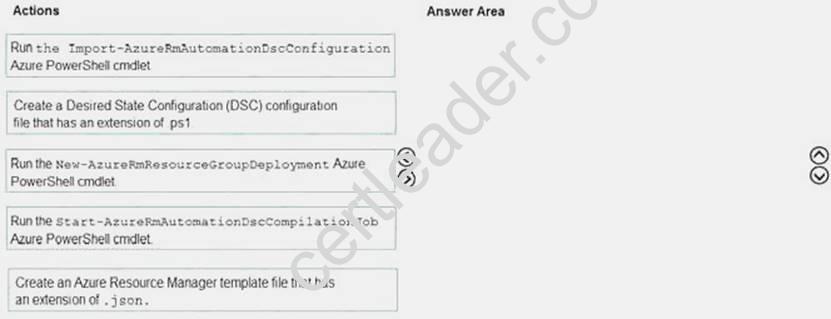
- A. Mastered
- B. Not Mastered
Answer: A
Explanation:
Step 1: Create a Desired State Configuration (DSC) configuration file that has an extension of .ps1.
Step 2: Run the Import-AzureRmAutomationDscConfiguration Azure Powershell cmdlet
The Import-AzureRmAutomationDscConfiguration cmdlet imports an APS Desired State Configuration (DSC) configuration into Azure Automation. Specify the path of an APS script that contains a single DSC configuration.
Example:
PS C:>Import-AzureRmAutomationDscConfiguration -AutomationAccountName "Contoso17"-ResourceGroupName "ResourceGroup01" -SourcePath "C:DSCclient.ps1" -Force
This command imports the DSC configuration in the file named client.ps1 into the Automation account named Contoso17. The command specifies the Force parameter. If there is an existing DSC configuration, this command replaces it. Step 3: Run the Start-AzureRmAutomationDscCompilationJob Azure Powershell
cmdlet
The Start-AzureRmAutomationDscCompilationJob cmdlet compiles an APS Desired State Configuration (DSC) configuration in Azure Automation.
References:
https://docs.microsoft.com/en-us/powershell/module/azurerm.automation/importazurermautomationdscconfiguration https://docs.microsoft.com/en-us/powershell/module/azurerm.automation/startazurermautomationdsccompilationjob
NEW QUESTION 3
Note: This question is part of a series of questions that present the same scenario. Each question in the series contains a unique solution that might meet the stated goals. Some question sets might have more than one correct solution, while others might not have a correct solution.
After you answer a question in this section, you will NOT be able to return to it. As a result, these questions will not appear in the review screen.
You plan to create a release pipeline that will deploy Azure resources by using Azure Resource Manager templates. The release pipeline will create the following resources:
„hTwo resource groups
„hFour Azure virtual machines in one resource group
„hTwo Azure SQL databases in other resource group
You need to recommend a solution to deploy the resources.
Solution: Create a main template that will deploy the resources in one resource group and a nested template that will deploy the resources in the other resource group.
Does this meet the goal?
- A. Yes
- B. No
Answer: B
Explanation:
Use two linked templates, instead of the nested template.
References: https://docs.microsoft.com/en-us/azure/azure-resourcemanager/ resource-group-linked-templates
NEW QUESTION 4
Your company . concerned that when developers introduce open source Libraries, it creates licensing compliance issues.
You need to add an automated process to the build pipeline to detect when common open source libraries are added to the code base.
What should you use?
- A. Code Style
- B. Microsoft Visual SourceSafe
- C. Black Duck
- D. Jenkins
Answer: C
Explanation:
Secure and Manage Open Source Software
Black Duck helps organizations identify and mitigate open source security, license compliance and code-quality risks across application and container portfolios. Black Duck Hub and its plugin for Team Foundation Server (TFS) allows you to automatically find and fix open source security vulnerabilities during the build process, so you can proactively manage risk. The integration allows you to receive alerts and fail builds when any Black Duck Hub policy violations are met.
Note: WhiteSource would also be a good answer, but it is not an option here. References:
https://marketplace.visualstudio.com/items?itemName=black-duck-software.hub-tfs
NEW QUESTION 5
You have a GitHub repository.
You create a new repository in Azure DevOps.
You need to recommend a procedure to clone the repository from GitHub to Azure DevOps.
What should you recommend?
- A. Create a webhook.
- B. Create a service connection for GitHub.
- C. From Import a Git repository, click Import
- D. Create a pull request.
- E. Create a personal access token in Azure DevOp
Answer: C
NEW QUESTION 6
HOTSPOT
How should you complete the code to initialize App Center in the mobile application? To answer, select the appropriate options in the answer area.
NOTE: Each correct selection a worth one point.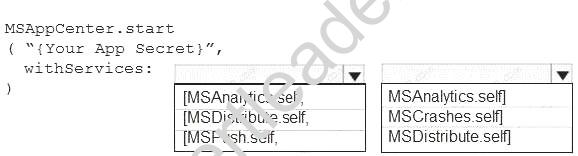
- A. Mastered
- B. Not Mastered
Answer: A
Explanation:
Scenario: Visual Studio App Center must be used to centralize the reporting of mobile application crashes and device types in use.
In order to use App Center, you need to opt in to the service(s) that you want to use, meaning by default no services are started and you will have to explicitly call each of them when starting the SDK.
Insert the following line to start the SDK in your app's AppDelegate class in the didFinishLaunchingWithOptions method.
MSAppCenter.start("{Your App Secret}", withServices: [MSAnalytics.self, MSCrashes.self])
References: https://docs.microsoft.com/en-us/appcenter/sdk/getting-started/ios
NEW QUESTION 7
You need to recommend a Docker container build strategy that meets the following requirements
¡E Minimizes image sues
¡E Minimizes the security surface area of the final image What should you include m the recommendation?
- A. multi-stage builds
- B. single-stage builds
- C. PowerShell Desired State Configuration (DSC)
- D. Docker Swarm
Answer: A
Explanation:
Multi-stage builds are a new feature requiring Docker 17.05 or higher on the daemon and client. Multistage builds are useful to anyone who has struggled to optimize Dockerfiles while keeping them easy to read and maintain. References: https://docs.docker.com/develop/develop-images/multistage-build/
NEW QUESTION 8
Note: This question is part of a series of questions that present the same scenario. Each question in the series contains a unique solution that might meet the stated goals. Some question sets might have more than one correct solution, while others might not have a correct solution
After you answer a question in this section, you will NOT be able to return to it. As a result, these questions will not appear in the review screen
Your company has a project in Azure DevOps for a new web application. You need to ensure that when code is checked in, a build runs automatically.
Solution: From the Continuous deployment trigger settings of the release pipeline, you enable the Pull request trigger setting.
Does the meet the goal?
- A. Yes
- B. No
Answer: B
Explanation:
In Visual Designer you enable continuous integration (CI) by:
„hSelect the Triggers tab.
„hEnable Continuous integration. References:
https://docs.microsoft.com/en-us/azure/devops/pipelines/get-started-designer
NEW QUESTION 9
Where should the build and release agents for the investment planning applications suite run? To answer, select the appropriate options in the answer area
NOTE: Each correct selection is worth one point.
- A. Mastered
- B. Not Mastered
Answer: A
Explanation: 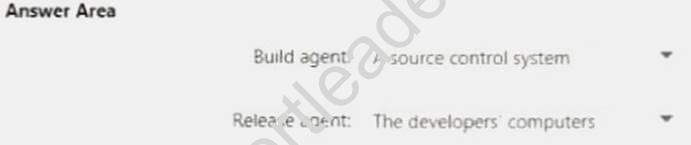
Case Study: 2 Overview
Existing Environment
This is a case study Case studies are not limed separately. You can use as much exam time at you would like to complete each case. However there may be additional case studies and sections on this exam. You must manage your time to ensure that you are able to complete all questions included on this exam in the time provided.
To answer the questions included in a case study, you will need to reference information that is provided m the case study Case studies might contain exhibits and other resources that provide more information about the scenario that is described in the case study. Each question is independent of the other questions in this case study.
At the end of the case study, a review screen will appear. This screen allows you to review your answers and to mate changes before you move to the next section of the exam, After you begin a new section, you cannot return to this section.
To start the case study
To display the first question in this case study, click the Next button. Use the buttions in the left pane to explore the content of the case study before you answer the questions. Clicking these buttions displays information such as business requirements, existing environment and problem statements. If the case study has
an All Information tab, note that the information displayed on identical to the Information displayed on the subsequent tabs. When you are ready to answer a question, click the question button to return to the question.
Requirements
Contoso plans to improve its IT development and operations processes implementing Azue DevOps principles. Contoso has an Azure subscription and creates an Azure DevOPs organization.
The Azure DevOps organization includes:
„hThe Docker extension
„hA deployment pool named Pool7 that contains 10 Azure virtual machines that run Windows Server 2021.
The Azure subscription contains an Azure Automation account. Planned Changes
Contoso plans to create projects in Azure DevOps as shown in the following table.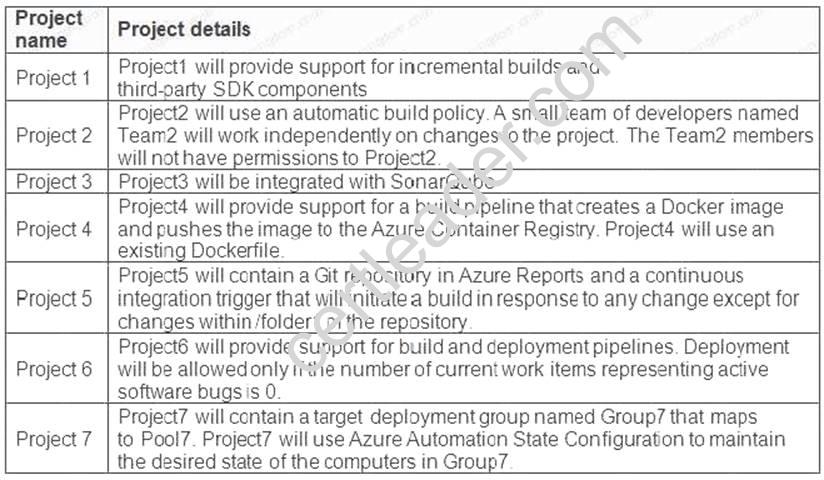
Technical Requirements
Contoso identities the following technical requirements:
¡E Implement build agents rot Project 1.
¡E Whenever possible, use Azure resources
¡EAvoid using deprecated technologies
¡E Implement a code flow strategy for Project2 that will:
¡EEnable Team 2 to submit pull requests for Project2.
¡E Enable Team 2 to work independently on changes to a copy of Project?
¡E Ensure that any intermediary changes performed by Tram2 on a copy of Project2 will be subject to the same restrictions as the ones defied in the build policy of Project2.
¡E Whenever possible. Implement automation and minimize administrative effort.
¡E Implement Protect3, Project5, Project6, and Project7 based on the planned changes.
¡E Implement Project4 and configure the project to push Docker images to Azure Container Reentry.
NEW QUESTION 10
You plan to share packages that you wrote, tested, validated, and deployed by using Azure Artifacts.
You need to release multiple builds of each package by using a single feed. The solution must limit the release of packages that are in development.
What should you use?
- A. global symbols
- B. local symbols
- C. upstream sources
- D. views
Answer: C
Explanation:
Upstream sources enable you to manage all of your product's dependencies in a single feed. We recommend publishing all of the packages for a given product to that product's feed, and managing that product's dependencies from remote feeds in the same feed, via upstream sources. This setup has a few benefits:
„hSimplicity: your NuGet.config, .npmrc, or settings.xml contains exactly one feed (your feed).
„hDeterminism: your feed resolves package requests in order, so rebuilding
the same codebase at the same commit or changeset uses the same set of packages
„hProvenance: your feed knows the provenance of packages it saved via upstream sources, so you can verify that you're using the original package, not a custom or malicious copy published to your feed
„hPeace of mind: packages used via upstream sources are guaranteed to be saved in the feed on first use; if the upstream source is disabled/removed, or the remote feed goes down or deletes a package you depend on, you can continue to develop and build
References: https://docs.microsoft.com/enus/ azure/devops/artifacts/concepts/upstream-sources?view=vsts
NEW QUESTION 11
You use Azure SQL Database Intelligent Insights and Azure Application Insights foe monitoring.
You need to write ad-hoc Queries against the monitoring data. Which Query language should you use?
- A. PL/pgSQL
- B. Transact-SQL
- C. Azure Log Analytics
- D. PL/SQL
Answer: C
Explanation:
Data analysis in Azure SQL Analytics is based on Log Analytics language for your custom querying and reporting.
References: https://docs.microsoft.com/en-us/azure/azure-monitor/insights/azure-sql
NEW QUESTION 12
Note: This question n part of a series of questions that present the same scenario. Each question in the series contains a unique solution that might meet the stated goals. Some question sets might have more than one correct solution, while others might not have a correct solution
After you answer a question in this section, you will NOT be able to return to it. As a result these questions will not appear in the review screen.
You have an approval process that contains a condition. The condition requires that releases be approved by a team leader before they are deployed.
You have a policy stating that approvals must occur within eight hours.
You discover that deployments fail if the approvals lake longer than two hours. You need to ensure that the deployments only fail if the approvals take longer than eight hours.
Solution: From Pre-deployment conditions, you modify the Timeout setting for predeployment approvals.
Does this meet the goal?
- A. Yes
- B. No
Answer: B
Explanation:
Use a gate instead of an approval instead.
References: https://docs.microsoft.com/enus/ azure/devops/pipelines/release/approvals/gates
NEW QUESTION 13
Note: This question is part of a series of questions that present the same scenario. Each question in the series contains a unique solution that m.ght meet the stated goals. Some question sets might have more than one correct solution, while others might not have a correct solution.
After you answer a question in this section, you win NOT be able to return to it. As a result, these questions win not appear in the review screen.
You integrate a cloud- hosted Jenkins server and a new Azure DevOps deployment You need Azure DevOps to send a notification to Jenkins when a developer commits changes to a branch in Azure Repos.
Solution: You create a service hook subscription that uses the code pushed event. Does this meet the goal?
- A. Yes
- B. NO
Answer: A
Explanation:
You can create a service hook for Azure DevOps Services and TFS with Jenkins. References:
https://docs.microsoft.com/en-us/azure/devops/service-hooks/services/jenkins
NEW QUESTION 14
DRAG DROP
You need to configure Azure Automation for the computers in Pool7.
Which three actions should you perform in sequence? To answer, move the appropriate actions from the list of actions to the answer area and arrange them m the correct order.
- A. Mastered
- B. Not Mastered
Answer: A
Explanation: 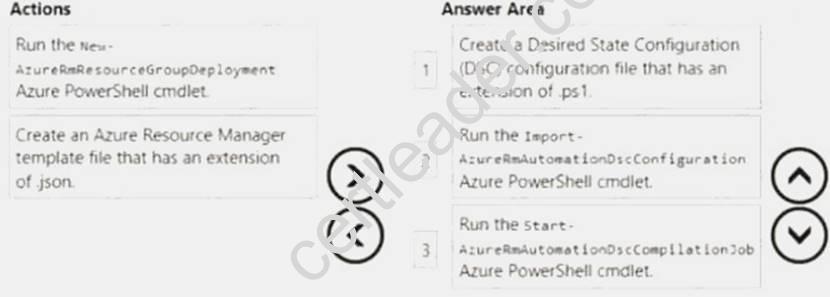
NEW QUESTION 15
HOTSPOT
Your company is building a new web application.
You plan to collect feedback from pilot users on the features being delivered. All the pilot users have a corporate computer that has Google Chrome and the Microsoft Test & Feedback extension installed. The pilot users will test the application by using Chrome.
You need to identify which access levels are required to ensure that developers can request and gather feedback from the pilot users. The solution must use the principle of least privilege.
Which access levels m Azure DevOps should you identify? To answer, select the
appropriate options in the answer area
NOTE: Each correct selection is worth one point.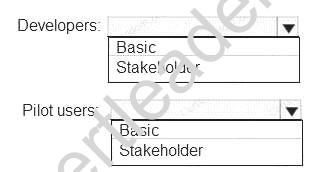
- A. Mastered
- B. Not Mastered
Answer: A
Explanation:
Box 1: Basic
Assign Basic to users with a TFS CAL, with a Visual Studio Professional subscription, and to users for whom you are paying for Azure Boards & Repos in an organization.
Box 2: Stakeholder
Assign Stakeholders to users with no license or subscriptions who need access to a limited set of features.
Note:
You assign users or groups of users to one of the following access levels: Basic: provides access to most features
VS Enterprise: provides access to premium features
Stakeholders: provides partial access, can be assigned to unlimited users for free References: https://docs.microsoft.com/enus/ azure/devops/organizations/security/access-levels?view=vsts
NEW QUESTION 16
DRAG DROP
You need to implement Project6.
Which three actions should you perform in sequence? To answer, move the appropriate actions from the list of actions to the answer area and arrange them m the correct order.
- A. Mastered
- B. Not Mastered
Answer: A
Explanation: 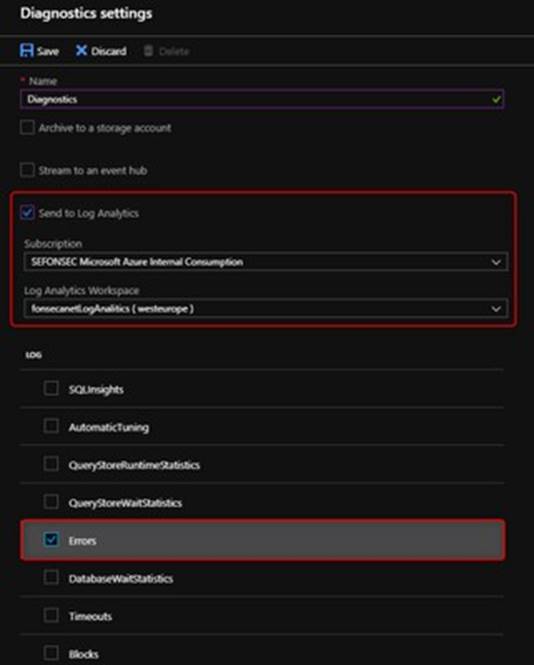
NEW QUESTION 17
Note: This question is part of a series of questions that present the same scenario. Each question in the series contains a unique solution that might meet the stated goals. Some question sets might have more than one correct solution, while others might not have a correct solution.
After you answer a question in this section, you will NOT be able to return to it. As a result, these questions will not appear in the review screen.
You plan to create a release pipeline that will deploy Azure resources by using Azure Resource Manager templates. The release pipeline will create the following resources:
„hTwo resource groups
„hFour Azure virtual machines in one resource group
„hTwo Azure SQL databases in other resource group
You need to recommend a solution to deploy the resources.
Solution: Create a main template that has two linked templates, each of which will deploy the resource in its respective group.
Does this meet the goal?
- A. Yes
- B. No
Answer: A
Explanation:
To deploy your solution, you can use either a single template or a main template with many related templates. The related template can be either a separate file that is linked to from the main template, or a template that is nested within the main template.
References: https://docs.microsoft.com/en-us/azure/azure-resourcemanager/resource-group-linked-templates
NEW QUESTION 18
DRAG DROP
You have an Azure Kubermets Service (AKS) implementation that is RBAC-enabled You plan to use Azure Container Instances as a hosted development environment to run containers in the AKS implementation.
You need to conjure Azure Container Instances as a hosted environment for running me containers in AKS. Which three actions should you perform m sequence?
To answer, move the appropriate actions from the list of actions to the answer area and arrange them in the correct order.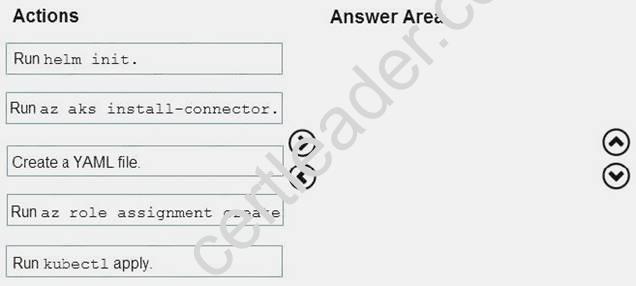
- A. Mastered
- B. Not Mastered
Answer: A
Explanation:
Step 1: Create a YAML file.
If your AKS cluster is RBAC-enabled, you must create a service account and role binding for use with Tiller. To create a service account and role binding, create a file named rbac-virtual-kubelet.yaml
Step 2: Run kubectl apply.
Apply the service account and binding with kubectl apply and specify your rbacvirtual- kubelet.yaml file.
Step 3: Run helm init.
Configure Helm to use the tiller service account: helm init --service-account tiller
You can now continue to installing the Virtual Kubelet into your AKS cluster. References: https://docs.microsoft.com/en-us/azure/aks/virtual-kubelet
NEW QUESTION 19
Your company has an on-premises Bitbucket Server that is used for Git-based source control. The server is protected by a firewall that blocks inbound Internet traffic.
You plan to use Azure DevOps to manage the build and release processes Which two components are required to integrate Azure DevOps and Bitbucket? Each correct answer presents part of the solution.
NOTE: Each correct selection is worth one port.
- A. an External Git service connection
- B. a Microsoft hosted agent
- C. service hooks
- D. a self- hosted agent
- E. a deployment M group
Answer: AD
Explanation:
When a pipeline uses a remote, 3rd-party repository host such as Bitbucket Cloud, the repository is configured with webhooks that notify Azure Pipelines Server or TFS when code has changed and a build should be triggered. Since on-premises installations are normally protected behind a firewall, 3rd-party webhooks are unable to reach the on-premises server. As a workaround, you can use the External Git repository type which uses polling instead of webhooks to trigger a build when code has changed.
References: https://docs.microsoft.com/enus/ azure/devops/pipelines/repos/pipeline-options-for
NEW QUESTION 20
Your company develops an app for OS. All users of the app have devices that are members of a private distribution group in Microsoft Visual Studio App Center. You plan to distribute a new release of the app.
You need to identify which certificate file you require to distribute the new release from App Center.
Which file type should you upload to App Center?
- A. .cer
- B. .pvk
- C. .pfx
- D. .p12
Answer: D
NEW QUESTION 21
In Azure DevOps, you create Project3.
You need to meet the requirements of the project. What should you do first?
- A. From Azure DevOps, create a service endpoint.
- B. From SonarQube, obtain an authentication token.
- C. From Azure DevOps, modify the build definition.
- D. From SonarQube, create a projec
Answer: A
Explanation:
The first thing to do is to declare your SonarQube server as a service endpoint in your VSTS/DevOps project settings.
References: https://docs.sonarqube.org/display/SCAN/Analyzing+with+SonarQube+Extension+fo r+vsts-TFS
NEW QUESTION 22
Your company is building a new solution in Java.
The company currently uses a SonarQube server to analyze the code of .NET solutions.
You need to analyze and monitor the code quality of the Java solution. Which task types should you add to the build pipeline?
- A. Octopus
- B. Chef
- C. Maven
- D. Grunt
Answer: A
NEW QUESTION 23
......
Recommend!! Get the Full AZ-400 dumps in VCE and PDF From 2passeasy, Welcome to Download: https://www.2passeasy.com/dumps/AZ-400/ (New 111 Q&As Version)
