
We provide real CAS-003 exam questions and answers braindumps in two formats. Download PDF & Practice Tests. Pass CompTIA CAS-003 Exam quickly & easily. The CAS-003 PDF type is available for reading and printing. You can print more and practice many times. With the help of our CompTIA CAS-003 dumps pdf and vce product and material, you can easily pass the CAS-003 exam.
Online CompTIA CAS-003 free dumps demo Below:
NEW QUESTION 1
Company policy requires that all company laptops meet the following baseline requirements: Software requirements:
Antivirus
Anti-malware Anti-spyware Log monitoring
Full-disk encryption
Terminal services enabled for RDP Administrative access for local users Hardware restrictions:
Bluetooth disabled FireWire disabled WiFi adapter disabled
Ann, a web developer, reports performance issues with her laptop and is not able to access any network resources. After further investigation, a bootkit was discovered and it was trying to access external websites. Which of the following hardening techniques should be applied to mitigate this specific issue from reoccurring? (Select TWO).
- A. Group policy to limit web access
- B. Restrict VPN access for all mobile users
- C. Remove full-disk encryption
- D. Remove administrative access to local users
- E. Restrict/disable TELNET access to network resources
- F. Perform vulnerability scanning on a daily basis
- G. Restrict/disable USB access
Answer: DG
Explanation:
A rootkit is a collection of computer software, typically malicious, designed to enable access to a computer or areas of its software that would not otherwise be allowed (for example, to an unauthorized user) while at the same time masking its existence or the existence of other software. A bootkit is similar to a rootkit except the malware infects the master boot record on a hard disk. Malicious software such as bootkits or rootkits typically require administrative privileges to be installed.
Therefore, one method of preventing such attacks is to remove administrative access for local users. A common source of malware infections is portable USB flash drives. The flash drives are often plugged into less secure computers such as a user’s home computer and then taken to work and plugged in to a work computer. We can prevent this from happening by restricting or disabling access to USB devices.
Incorrect Answers:
A: Using a group policy to limit web access is not a practical solution. Users in a company often require Web access so restricting it will affect their ability to do their jobs.
B: Rootkits or Bootkits would not be caught by connecting to the network over a VPN so disabling VPN access will not help.
C: Removing full-disk encryption will not prevent Bootkits.
E: Bootkits are not caught by connecting to network resources using Telnet connection so disabling Telnet access to resources will not help.
F: Performing vulnerability scanning on a daily basis might help you to quickly detect Bootkits. However, vulnerability scanning does nothing to actually prevent the Bootkits.
References: https://en.wikipedia.org/wiki/Rootkit
NEW QUESTION 2
An assessor identifies automated methods for identifying security control compliance through validating sensors at the endpoint and at Tier 2. Which of the following practices satisfy continuous monitoring of authorized information systems?
- A. Independent verification and validation
- B. Security test and evaluation
- C. Risk assessment
- D. Ongoing authorization
Answer: D
Explanation:
Ongoing assessment and authorization is often referred to as continuous monitoring. It is a process
that determines whether the set of deployed security controls in an information system continue to be effective with regards to planned and unplanned changes that occur in the system and its environment over time.
Continuous monitoring allows organizations to evaluate the operating effectiveness of controls on or near a real-time basis. Continuous monitoring enables the enterprise to detect control failures quickly because it transpires immediately or closely after events in which the key controls are utilized.
Incorrect Answers:
A: Independent verification and validation (IV&V) is executed by a third party organization not involved in the development of a product. This is not considered continuous monitoring of authorized information systems.
B: Security test and evaluation is not considered continuous monitoring of authorized information systems.
C: Risk assessment is the identification of potential risks and threats. It is not considered continuous monitoring of authorized information systems.
References:
http://www.fedramp.net/ongoHYPERLINK "http://www.fedramp.net/ongoing-assessment-andauthorization- continuous-monitoring"ing-assessment-andHYPERLINK
"http://www.fedramp.net/ongoing-assessment-and-authorization-continuous-monitoring"- authorization-continuous-monitoring https://www.techopedia.com/definition/24836/independent-verification-and-validation--
iHYPERLINK "https://www.techopedia.com/definition/24836/independent-verification-andvalidation-- iv&v"vHYPERLINK "https://www.techopedia.com/definition/24836/independentverification-
and-validation--iv&v"&HYPERLINK "https://www.techopedia.com/definition/24836/independent-verification-and-validation--iv&v"v
Gregg, Michael, and Billy Haines, CASP CompTIA Advanced Security Practitioner Study Guide, John Wiley & Sons, Indianapolis, 2012, pp. 213, 219
NEW QUESTION 3
A user asks a security practitioner for recommendations on securing a home network. The user recently purchased a connected home assistant and multiple IoT devices in an effort to automate the home. Some of the IoT devices are wearables, and other are installed in the user’s automobiles. The current home network is configured as a single flat network behind an ISP-supplied router. The router has a single IP address, and the router performs NAT on incoming traffic to route it to individual devices.
Which of the following security controls would address the user’s privacy concerns and provide the BEST level of security for the home network?
- A. Ensure all IoT devices are configured in a geofencing mode so the devices do not work when removed from the home networ
- B. Disable the home assistant unless actively using it, and segment the network so each IoT device has its own segment.
- C. Install a firewall capable of cryptographically separating network traffic require strong authentication to access all IoT devices, and restrict network access for the home assistant based on time-of-day restrictions.
- D. Segment the home network to separate network traffic from users and the IoT devices, ensure security settings on the home assistant support no or limited recording capability, and install firewall rules on the router to restrict traffic to the home assistant as much as possible.
- E. Change all default passwords on the IoT devices, disable Internet access for the IoT devices and the home assistant, obtain routable IP addresses for all devices, and implement IPv6 and IPSec protections on all network traffic.
Answer: B
NEW QUESTION 4
An organization has established the following controls matrix: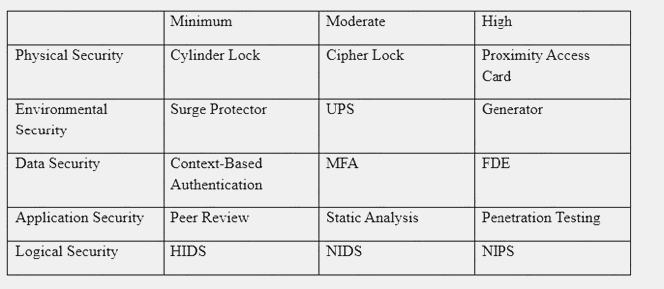
The following control sets have been defined by the organization and are applied in aggregate fashion:
Systems containing PII are protected with the minimum control set. Systems containing medical data are protected at the moderate level. Systems containing cardholder data are protected at the high level.
The organization is preparing to deploy a system that protects the confidentially of a database containing PII and medical data from clients. Based on the controls classification, which of the following controls would BEST meet these requirements?
- A. Proximity card access to the server room, context-based authentication, UPS, and full-disk encryption for the database server.
- B. Cipher lock on the server room door, FDE, surge protector, and static analysis of all application code.
- C. Peer review of all application changes, static analysis of application code, UPS, and penetration testing of the complete system.
- D. Intrusion detection capabilities, network-based IPS, generator, and context-based authenticatio
Answer: D
NEW QUESTION 5
An accountant at a small business is trying to understand the value of a server to determine if the business can afford to buy another server for DR. The risk manager only provided the accountant with the SLE of $24,000, ARO of 20% and the exposure factor of 25%. Which of the following is the correct asset value calculated by the accountant?
- A. $4,800
- B. $24,000
- C. $96,000
- D. $120,000
Answer: C
Explanation:
The annualized loss expectancy (ALE) is the product of the annual rate of occurrence (ARO) and the single loss expectancy (SLE). It is mathematically expressed as: ALE = ARO x SLE
Single Loss Expectancy (SLE) is mathematically expressed as: Asset value (AV) x Exposure Factor (EF) Thus if SLE = $ 24,000 and EF = 25% then the Asset value is SLE/EF = $ 96,000
References: http://www.financeformulas.net/Return_on_Investment.html https://en.wikipedia.org/wiki/Risk_assessmeHYPERLINK "https://en.wikipedia.org/wiki/Risk_assessment"nt
NEW QUESTION 6
Since the implementation of IPv6 on the company network, the security administrator has been unable to identify the users associated with certain devices utilizing IPv6 addresses, even when the devices are centrally managed.
en1: flags=8863<UP,BROADCAST,SMART,RUNNING,SIMPLEX,MULTICAST> mtu 1500
ether f8:1e:af:ab:10:a3
inet6 fw80::fa1e:dfff:fee6:9d8%en1 prefixlen 64 scopeid 0x5 inet 192.168.1.14 netmask 0xffffff00 broadcast 192.168.1.255 inet6 2001:200:5:922:1035:dfff:fee6:9dfe prefixlen 64 autoconf
inet6 2001:200:5:922:10ab:5e21:aa9a:6393 prefixlen 64 autoconf temporary nd6 options=1<PERFORMNUD>
media: autoselect status: active
Given this output, which of the following protocols is in use by the company and what can the system administrator do to positively map users with IPv6 addresses in the future? (Select TWO).
- A. The devices use EUI-64 format
- B. The routers implement NDP
- C. The network implements 6to4 tunneling
- D. The router IPv6 advertisement has been disabled
- E. The administrator must disable IPv6 tunneling
- F. The administrator must disable the mobile IPv6 router flag
- G. The administrator must disable the IPv6 privacy extensions
- H. The administrator must disable DHCPv6 option code 1
Answer: BG
Explanation:
IPv6 makes use of the Neighbor Discovery Protocol (NDP). Thus if your routers implement NDP you will be able to map users with IPv6 addresses. However to be able to positively map users with IPv6 addresses you will need to disable IPv6 privacy extensions.
Incorrect Answers:
A: Devices making use of the EUI-64 format means that the last 64 bits of IPv6 unicast addresses are used for interface identifiers. This is not shown in the exhibit above.
C: 6to4 tunneling is used to connect IPv6 hosts or networks to each other over an IPv4 backbone. This type of tunneling is not going to ensure positive future mapping of users on the network. Besides 6to4 does not require configured tunnels because it can be implemented in border routers without a great deals of router configuration.
D: The exhibit is not displaying that the router IPv6 has been disabled. The IPv6 Neighbor Discovery's Router Advertisement message contains an 8-bit field reserved for single-bit flags. Several protocols have reserved flags in this field and others are preparing to reserve a sufficient number of flags to exhaust the field.
E: Disabling the tunneling of IPv6 does not ensure positive future IPv6 addressing.
F: The IPv6 router flag is used to maintain reachability information about paths to active neighbors, thus it should not be disabled if you want to ensure positive mapping of users in future.
H: DHCPv6 is a network protocol for configuring IPv6 hosts with IP addresses, IP prefixes and other configuration data that is necessary to function properly in an IPv6 network. This should not be disabled.
References:
Gregg, Michael, and Billy Haines, CASP CompTIA Advanced Security Practitioner Study Guide, John Wiley & Sons, Indianapolis, 2012, pp. 49
http://wwwHYPERLINK "http://www.tcpipguide.com/free/t_IPv6InterfaceIdentifiersandPhysicalAddressMapping- 2.htm".HYPERLINK
"http://www.tcpipguide.com/free/t_IPv6InterfaceIdentifiersandPhysicalAddressMapping- 2.htm"tcpipguide.com/free/t_IPv6InterfaceIdentifiersandPhysicalAddressMapping-2.htm
NEW QUESTION 7
A software development team has spent the last 18 months developing a new web-based front-end that will allow clients to check the status of their orders as they proceed through manufacturing. The marketing team schedules a launch party to present the new application to the client base in two weeks. Before the launch, the security team discovers numerous flaws that may introduce dangerous vulnerabilities, allowing direct access to a database used by manufacturing. The development team did not plan to remediate these vulnerabilities during development. Which of the following SDLC best practices should the development team have followed?
- A. Implementing regression testing
- B. Completing user acceptance testing
- C. Verifying system design documentation
- D. Using a SRTM
Answer: D
NEW QUESTION 8
A software development manager is running a project using agile development methods. The company cybersecurity engineer has noticed a high number of vulnerabilities have been making it into production code on the project.
Which of the following methods could be used in addition to an integrated development environment to reduce the severity of the issue?
- A. Conduct a penetration test on each function as it is developed
- B. Develop a set of basic checks for common coding errors
- C. Adopt a waterfall method of software development
- D. Implement unit tests that incorporate static code analyzers
Answer: D
NEW QUESTION 9
DRAG DROP
A security administrator must configure the database server shown below the comply with the four requirements listed. Drag and drop the appropriate ACL that should be configured on the database server to its corresponding requirement. Answer options may be used once or not at all.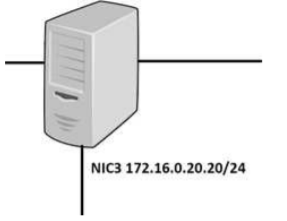
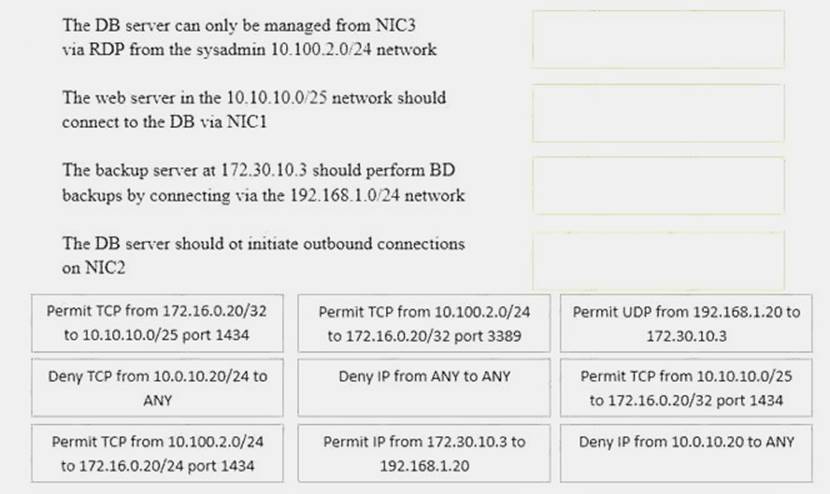
Solution:
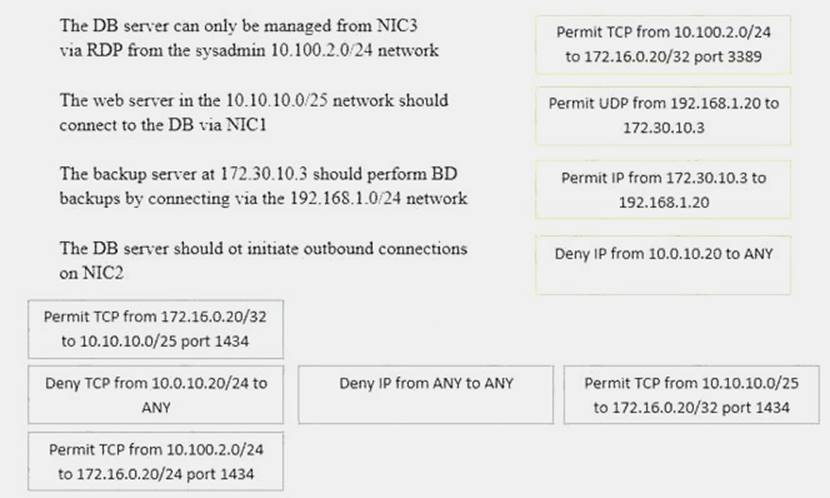
Does this meet the goal?
- A. Yes
- B. Not Mastered
Answer: A
NEW QUESTION 10
The code snippet below controls all electronic door locks to a secure facility in which the doors should only fail open in an emergency. In the code, “criticalValue” indicates if an emergency is underway: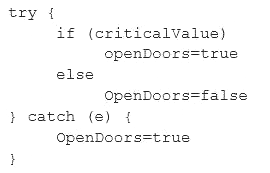
Which of the following is the BEST course of action for a security analyst to recommend to the software developer?
- A. Rewrite the software to implement fine-grained, conditions-based testing
- B. Add additional exception handling logic to the main program to prevent doors from being opened
- C. Apply for a life-safety-based risk exception allowing secure doors to fail open
- D. Rewrite the software’s exception handling routine to fail in a secure state
Answer: B
NEW QUESTION 11
An organization has implemented an Agile development process for front end web application development. A new security architect has just joined the company and wants to integrate security activities into the SDLC.
Which of the following activities MUST be mandated to ensure code quality from a security perspective? (Select TWO).
- A. Static and dynamic analysis is run as part of integration
- B. Security standards and training is performed as part of the project
- C. Daily stand-up meetings are held to ensure security requirements are understood
- D. For each major iteration penetration testing is performed
- E. Security requirements are story boarded and make it into the build
- F. A security design is performed at the end of the requirements phase
Answer: AD
Explanation:
SDLC stands for systems development life cycle. An agile project is completed in small sections called iterations. Each iteration is reviewed and critiqued by the project team. Insights gained from the critique of an iteration are used to determine what the next step should be in the project. Each
project iteration is typically scheduled to be completed within two weeks.
Static and dynamic security analysis should be performed throughout the project. Static program analysis is the analysis of computer software that is performed without actually executing programs (analysis performed on executing programs is known as dynamic analysis). In most cases the analysis is performed on some version of the source code, and in the other cases, some form of the object code.
For each major iteration penetration testing is performed. The output of a major iteration will be a functioning part of the application. This should be penetration tested to ensure security of the application.
Incorrect Answers:
B: Security standards and training does not ensure code quality from a security perspective. The only way to ensure code quality is to test the code itself.
C: Ensuring security requirements are understood does not ensure code quality from a security perspective. The only way to ensure code quality is to test the code itself.
E: Storyboarding security requirements does not ensure code quality from a security perspective. The only way to ensure code quality is to test the code itself.
F: A security design does not ensure code quality from a security perspective. The only way to ensure code quality is to test the code itself.
References: https://en.wikipedia.org/wiki/Static_program_analysis
http://searchcio.techtarget.HYPERLINK "http://searchcio.techtarget.com/definition/Agile-projectmanagement" com/definition/Agile-project-management
NEW QUESTION 12
An external penetration tester compromised one of the client organization’s authentication servers and retrieved the password database. Which of the following methods allows the penetration tester to MOST efficiently use any obtained administrative credentials on the client organization’s other systems, without impacting the integrity of any of the systems?
- A. Use the pass the hash technique
- B. Use rainbow tables to crack the passwords
- C. Use the existing access to change the password
- D. Use social engineering to obtain the actual password
Answer: A
Explanation:
With passing the hash you can grab NTLM credentials and you can manipulate the Windows logon sessions maintained by the LSA component. This will allow you to operate as an administrative user and not impact the integrity of any of the systems when running your tests.
Incorrect Answers:
B: Making use of rainbow tables and cracking passwords will have a definite impact on the integrity of the other systems that are to be penetration tested.
C: Changing passwords will impact the integrity of the other systems and is not a preferable method to conduct penetration testing.
D: Social engineering is not the preferred way to accomplish the goal of penetration testing and
gaining administrative credentials on the client’s network. References:
Gregg, Michael, and Billy Haines, CASP CompTIA Advanced Security Practitioner Study Guide, John Wiley & Sons, Indianapolis, 2012, pp. 17, 351
NEW QUESTION 13
A company wants to perform analysis of a tool that is suspected to contain a malicious payload. A forensic analyst is given the following snippet:
^32^[34fda19(fd^43gfd/home/user/lib/module.so.343jk^rfw(342fds43g
Which of the following did the analyst use to determine the location of the malicious payload?
- A. Code deduplicators
- B. Binary reverse-engineering
- C. Fuzz testing
- D. Security containers
Answer: B
NEW QUESTION 14
A large organization has recently suffered a massive credit card breach. During the months of Incident Response, there were multiple attempts to assign blame for whose fault it was that the incident occurred. In which part of the incident response phase would this be addressed in a controlled and productive manner?
- A. During the Identification Phase
- B. During the Lessons Learned phase
- C. During the Containment Phase
- D. During the Preparation Phase
Answer: B
Explanation:
The Lessons Learned phase is the final step in the Incident Response process, when everyone involved reviews what happened and why.
Incorrect Answers:
A: The Identification Phase is the second step in the Incident Response process that deals with the detection of events and incidents.
C: The Containment Phase is the third step in the Incident Response process that deals with the planning, training, and execution of the incident response plan.
D: The Preparation Phase is the first step in the Incident Response process that deals with policies and procedures required to attend to the potential of security incidents.
References:
Gregg, Michael, and Billy Haines, CASP CompTIA Advanced Security Practitioner Study Guide, John Wiley & Sons, Indianapolis, 2012, p. 249
NEW QUESTION 15
A malware infection spread to numerous workstations within the marketing department. The workstations were quarantined and replaced with machines. Which of the following represents a FINAL step in the prediction of the malware?
- A. The workstations should be isolated from the network.
- B. The workstations should be donated for refuse.
- C. The workstations should be reimaged
- D. The workstations should be patched and scanne
Answer: C
NEW QUESTION 16
A pharmacy gives its clients online access to their records and the ability to review bills and make payments. A new SSL vulnerability on a special platform was discovered, allowing an attacker to capture the data between the end user and the web server providing these services. After invest the new vulnerability, it was determined that the web services providing are being impacted by this new threat. Which of the following data types a MOST likely at risk of exposure based on this new threat? (Select TWO)
- A. Cardholder data
- B. intellectual property
- C. Personal health information
- D. Employee records
- E. Corporate financial data
Answer: AC
NEW QUESTION 17
A systems security engineer is assisting an organization’s market survey team in reviewing requirements for an upcoming acquisition of mobile devices. The engineer expresses concerns to the survey team about a particular class of devices that uses a separate SoC for baseband radio I/O. For which of the following reasons is the engineer concerned?
- A. These devices can communicate over networks older than HSPA+ and LTE standards, exposing device communications to poor encryptions routines
- B. The organization will be unable to restrict the use of NFC, electromagnetic induction, and Bluetooth technologies
- C. The associated firmware is more likely to remain out of date and potentially vulnerable
- D. The manufacturers of the baseband radios are unable to enforce mandatory access controls within their driver set
Answer: B
NEW QUESTION 18
An advanced threat emulation engineer is conducting testing against a client’s network. The engineer conducts the testing in as realistic a manner as possible. Consequently, the engineer has been gradually ramping up the volume of attacks over a long period of time. Which of the following combinations of techniques would the engineer MOST likely use in this testing? (Choose three.)
- A. Black box testing
- B. Gray box testing
- C. Code review
- D. Social engineering
- E. Vulnerability assessment
- F. Pivoting
- G. Self-assessment
- H. White teaming
- I. External auditing
Answer: AEF
NEW QUESTION 19
The helpdesk is receiving multiple calls about slow and intermittent Internet access from the finance department. The following information is compiled:
Caller 1, IP 172.16.35.217, NETMASK 255.255.254.0
Caller 2, IP 172.16.35.53, NETMASK 255.255.254.0
Caller 3, IP 172.16.35.173, NETMASK 255.255.254.0
All callers are connected to the same switch and are routed by a router with five built-in interfaces. The upstream router interface’s MAC is 00-01-42-32-ab-1a
A packet capture shows the following:
09:05:15.934840 arp reply 172.16.34.1 is-at 00:01:42:32:ab:1a (00:01:42:32:ab:1a)
09:06:16.124850 arp reply 172.16.34.1 is-at 00:01:42:32:ab:1a (00:01:42:32:ab:1a)
09:07:25.439811 arp reply 172.16.34.1 is-at 00:01:42:32:ab:1a (00:01:42:32:ab:1a)
09:08:10.937590 IP 172.16.35.1 > 172.16.35.255: ICMP echo request, id 2305, seq 1, length 65534
09:08:10.937591 IP 172.16.35.1 > 172.16.35.255: ICMP echo request, id 2306, seq 2, length 65534
09:08:10.937592 IP 172.16.35.1 > 172.16.35.255: ICMP echo request, id 2307, seq 3, length 65534
Which of the following is occurring on the network?
- A. A man-in-the-middle attack is underway on the network.
- B. An ARP flood attack is targeting at the router.
- C. The default gateway is being spoofed on the network.
- D. A denial of service attack is targeting at the route
Answer: D
Explanation:
The above packet capture shows an attack where the attacker is busy consuming your resources (in this case the router) and preventing normal use. This is thus a Denial Of Service Attack.
Incorrect Answers:
A: A man-in-the-middle attack is when an attacker intercepts and perhaps changes the data that is transmitted between two users. The packet capture is not indicative of a man-in-the-middle attack. B: With an ARP flood attack thousands of spoofed data packets with different physical addresses are sent to a device. This is not the case here.
C: A gateway being spoofed show up as any random number that the attacker feels like listing as the caller. This is not what is exhibited in this case.
References:
Gregg, Michael, and Billy Haines, CASP CompTIA Advanced Security Practitioner Study Guide, John Wiley & Sons, Indianapolis, 2012, p. 286
NEW QUESTION 20
......
Recommend!! Get the Full CAS-003 dumps in VCE and PDF From Dumps-hub.com, Welcome to Download: https://www.dumps-hub.com/CAS-003-dumps.html (New 555 Q&As Version)
