
It is more faster and easier to pass the Google Cloud-Digital-Leader exam by using Virtual Google Google Cloud Digital Leader exam questuins and answers. Immediate access to the Renovate Cloud-Digital-Leader Exam and find the same core area Cloud-Digital-Leader questions with professionally verified answers, then PASS your exam with a high score now.
Google Cloud-Digital-Leader Free Dumps Questions Online, Read and Test Now.
NEW QUESTION 1
You are migrating workloads to the cloud. The goal of the migration is to serve customers worldwide as quickly as possible According to local regulations, certain data is required to be stored in a specific geographic area, and it can be served worldwide. You need to design the architecture and deployment for your workloads.
What should you do?
- A. Select a public cloud provider that is only active in the required geographic area
- B. Select a private cloud provider that globally replicates data storage for fast data access
- C. Select a public cloud provider that guarantees data location in the required geographic area
- D. Select a private cloud provider that is only active in the required geographic area
Answer: C
Explanation:
The goal of the migration is to serve customers worldwide as quickly as possible According to local regulations, certain data is required to be stored in a specific geographic area, and it can be served worldwide" This characteristic are inherent to the public cloud provider
NEW QUESTION 2
Your organization is developing and deploying an application on Google Cloud. Tracking your Google Cloud spending needs to stay as simple as possible.
What should you do to ensure that workloads in the development environment are fully isolated from production workloads?
- A. Apply a unique tag to development resources
- B. Associate the development resources with their own network
- C. Associate the development resources with their own billing account
- D. Put the development resources in their own project
Answer: D
Explanation:
Reference: https://www.deps.co/blog/google-cloud-platform-good-bad-ugly/
Project resources are components that are necessary for successful project implementation. They include people, equipment, money, time, knowledge – basically, anything that you may require from the project planning to the project delivery phases.
NEW QUESTION 3
An organization is using machine learning to make predictions. One of their datasets
mistakenly includes mislabeled data. How will the prediction be impacted?
- A. Increased risk of privacy leaks
- B. Increased risk of inaccuracy
- C. Decreased model compatibility
- D. Decreased model training time
Answer: B
NEW QUESTION 4
An organization is planning its cloud expenditure. What should the organization do to control costs?
- A. Consider cloud resource costs as capital expenditure in annual planning.
- B. Use only cloud resources; they have no cloud infrastructure costs.
- C. Review cloud resource costs frequently because costs depend on usage.
- D. Assess cloud resources costs only when SLO is not met by their cloud provider.
Answer: C
NEW QUESTION 5
Which Google Cloud product gives you a consistent platform for multi-cloud application deployments and extends other Google Cloud services to your environment?
- A. Google Kubernetes Engine
- B. Virtual Public Cloud
- C. Compute Engine
- D. Anthos
Answer: D
Explanation:
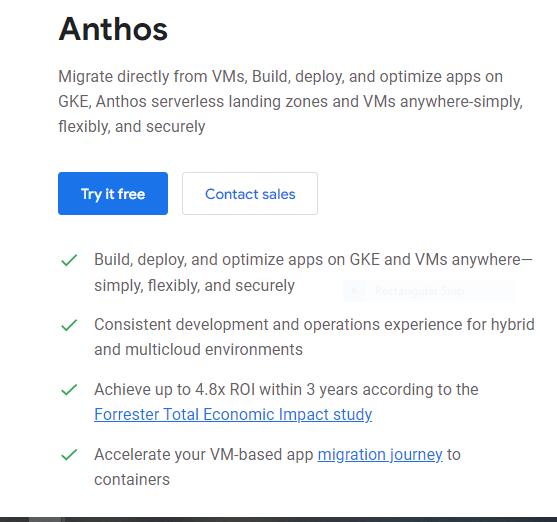
https://cloud.google.com/anthos
NEW QUESTION 6
Your customer's IT team is in the process of modernizing their customer-facing applications. They've witnessed others getting good results from employing microservices, and they're keen to adopt it themselves. The first application that they are modernizing has about 5 different sub-parts, which they have identified will be the services. They also identify that each of them has different scale requirements - some services like user login are less frequently used while others like transac-tions are heavily used. What technical strategy would you recommend for them?
- A. Containerize the services and orchestrate them with Google Kubernetes Engine.
- B. Retain the original application in Compute Engine and scale it as needed using Managed Instance Groups.
- C. Retain the original application as a backup and also for separately scaling the ser-vices, create new application binaries.
- D. Retain the original application in Compute Engine and scale it as needed using Unmanaged Instance Groups.
Answer: A
Explanation:
Containers and Kubernetes are ideal for the kind of requirement mentioned here - separate microservices that need to scale independently.
Google Kubernetes Engine (GKE) provides a managed environment for deploying, managing, and scaling your containerized applications using Google infrastructure. The GKE environment consists of multiple machines (specifically, Compute Engine instances) grouped together to form a cluster.
Reference link- https://cloud.google.com/kubernetes-engine/docs/concepts/kubernetes- engine-overview
NEW QUESTION 7
What does Cloud Logging help an organization do?
- A. Analyze live source code and log code updates.
- B. Deploy infrastructure as code.
- C. Analyze logs and accelerate application troubleshooting.
- D. Manage storage of custom VM images.
Answer: C
NEW QUESTION 8
Your customer is moving from AWS to Google Cloud. Data also needs to be moved. There is about 50TB of data. On AWS, the data resides in an S3 bucket. It is going to be moved to Cloud Storage. Data is also being continuously generated on S3 prior to the cutover. It is preferable that this is also periodically transferred. What is the best way to move the data?
- A. Use the gsutil command-line option
- B. Use the Google Cloud console to drag and drop the files easily
- C. Use the Storage Transfer Service
- D. Use a Transfer Appliance
Answer: C
Explanation:
Storage Transfer Service provides options that make data transfers and synchronization easier. We can also schedule one-time transfer operations or recurring transfer operations.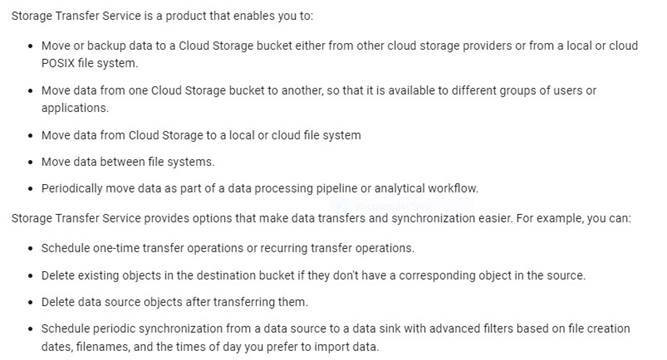
Reference link- https://cloud.google.com/storage-transfer/docs/overview
Reference link- https://cloud.google.com/architecture/transferring-data-from-amazon-s3- to-cloud-storage-using-vpc-service-controls-and-storage-transfer-service
NEW QUESTION 9
When an organization adopts cloud technology, how does their total cost of ownership (TCO) shift?
- A. Away from cost management toward capital expenditure
- B. Away from operational expenditure toward cost management
- C. Away from capital expenditure toward operational expenditure
- D. Away from operational expenditure toward capital expenditure
Answer: C
NEW QUESTION 10
How do Migrate for Compute Engine and Migrate for Anthos differ?
- A. Unlike Migrate for Anthos, Migrate for Compute Engine assumes that the migration source is VMware vSphere.
- B. Migrate for Compute Engine charges for ingress, but Migrate for Anthos does not.
- C. Migrate for Compute Engine is closed source, and Migrate for Anthos is open source.
- D. Migrate for Anthos migrates to containers, and Migrate for Compute Engine migrates to virtual machines.
Answer: D
Explanation:
Reference: https://cloud.google.com/migrate/anthos
Migrate workloads to Compute Engine with Migrate for Compute Engine. Migrate from Compute Engine to containers with Migrate for Anthos and GKE.
This method makes sense, for instance, in cases where you want to conduct a data-center migration and migrate all workloads into Compute Engine, and only at a second stage selectively modernize suitable workloads to containers.
Graphical user interface, text, application, email Description automatically generated
https://cloud.google.com/migrate/containers/docs/architecture
NEW QUESTION 11
Your organization needs to analyze data in order to gather insights into its daily operations. You only want to pay for the data you store and the queries you perform. Which Google Cloud product should your organization choose for its data analytics warehouse?
- A. Cloud SQL
- B. Dataproc
- C. Cloud Spanner
- D. BigQuery
Answer: D
Explanation:
BigQuery is an enterprise data warehouse for large amounts of relational structured data Serverless, highly scalable, and cost-effective multicloud data warehouse designed for business agility.
NEW QUESTION 12
Which of the following is/are core storage options available on the Google Cloud Platform?
- A. Cloud Storage and Cloud Data Store
- B. Cloud Spanner
- C. Cloud SQL and Google Big Table
- D. All of the above
Answer: D
Explanation:
Google Cloud Platform has other storage options to meet your needs for structured, unstructured, transactional and relational data. Core storage options: Cloud Storage, Cloud SQL, Cloud Spanner, Cloud Data Store and Google Big Table. Depending on your application, you might want to use one or several of these services to get the job done.
NEW QUESTION 13
A fitness band company is continuously ingesting data from millions of its consumers. Different kinds of data based on time, like location, heartbeat rate, temperature, movement, etc. are connect-ed. They need a high throughput database that can write data very fast. Since their users are spread across the world, they need the database to be geographically scalable. Consumers also want to see near-real-time visualizations of their activities. Which of these databases would be a good fit?
- A. Cloud SQL
- B. Bigtable
- C. Spanner
- D. Firestore
Answer: B
Explanation:
Bigtable is the best suited for time series data. It also has high read-write throughput and ability to scale globally.
NEW QUESTION 14
Which technology allows organizations to run multiple computer operating systems on a single piece of physical hardware?
- A. Hypervisor
- B. Containers
- C. Serverless computing
- D. Open source
Answer: A
NEW QUESTION 15
An organization needs to search an application's source code to identify a potential issue. The application is distributed across multiple containers.
Which Google Cloud product should the organization use?
- A. Google Cloud Console
- B. Cloud Trace
- C. Cloud Monitoring
- D. Cloud Logging
Answer: B
Explanation:
Cloud Trace is supposed to be the correct answer. It's an application performance management tool. It's a Google solution for monitoring application performance. It is a distributed tracing system that helps developers debug or fix and optimize their code
NEW QUESTION 16
......
100% Valid and Newest Version Cloud-Digital-Leader Questions & Answers shared by Certleader, Get Full Dumps HERE: https://www.certleader.com/Cloud-Digital-Leader-dumps.html (New 304 Q&As)
