
Real of Cloud-Digital-Leader practice materials and free download for Google certification for IT examinee, Real Success Guaranteed with Updated Cloud-Digital-Leader pdf dumps vce Materials. 100% PASS Google Cloud Digital Leader exam exam Today!
Free demo questions for Google Cloud-Digital-Leader Exam Dumps Below:
NEW QUESTION 1
Which of the following methods should you use when you require a dynamic way of provisioning VMs on Compute Engine when it is observed that the exact specifications will be in a dedicated configuration file and you want to follow Google’s recommended practices.
- A. Managed Instance Group
- B. Deployment Manager
- C. Cloud Composer
- D. Unmanaged Instance Group
Answer: B
Explanation:
The question is about a dynamic way to provision VM, it can be achieved by a Deployment manager or by using terraform. MIG is creating multiple machines based on templates by load balancing
NEW QUESTION 2
Your company security team manages access control to production systems using an LDAP directory group.
How is this access control managed in the Google Cloud production project?
- A. Assign the proper role to the Service Account in the project's IAM Policy
- B. Grant each user the roles/iam.serviceAccountUser role on a service account that exists in the Google Group.
- C. Assign the proper role to the Google Group in the project's IAM Policy.
- D. Create the project in a folder with the same name as the LDAP directory group.
Answer: C
Explanation:
Reference: https://cloud.google.com/blog/products/identity-security/achieving-identity-and-access-governance-on-google-cloud
NEW QUESTION 3
Which of the following is true while creating a boot persistent disk from a snapshot.
- A. You cannot apply a snapshot to an existing persistent disk, or apply a snapshot to persistent disks that belong to a different project than that snapshot.
- B. It is only possible to apply data from a snapshot when you first create a persistent disk.
- C. After you create a snapshot of a boot persistent disk, you can apply data from that snapshot to new persistent disks.
- D. All of the above.
Answer: D
Explanation:
When you create a virtual machine (VM) instance, you must also create a boot disk for the VM. You can use a public image, a custom image, or a snapshot that was taken from another boot disk. When you create a boot disk, limit the disk size to 2 TB to account for the limitations of MBR partitioning.
Compute Engine automatically creates a boot persistent disk when you create an instance. If you require additional data storage space for your instances, add one or more secondary instance storage options.
You might need to create a standalone boot persistent disk and attach it to an instance later, or resize a boot persistent disk to improve performance and add more space for additional applications or operating system files. That process is described in Add or resize a persistent disk.
As a best practice, do not use regional persistent disks for boot disks. In a failover situation, they do not force-attach to a VM.
After you create a snapshot of a boot persistent disk, you can apply data from that snapshot to new persistent disks. It is only possible to apply data from a snapshot when you first create a persistent disk. You cannot apply a snapshot to an existing persistent disk, or apply a snapshot to persistent disks that belong to a different project than that snapshot.
NEW QUESTION 4
A financial services company is running an experimental application workload that has a very large number of mathematical calculations involving floating-point numbers. The current application that is running on compute engine is not providing enough speed and throughput. What are the options to increase the processing performance?
- A. Use a serverless option like Cloud Functions that will automatically scale as much as required.
- B. Instead of using a "general purpose" machine family, use "compute-optimized" machine family.
- C. Since processing could also be dependent on reading and writing data to the disk, use a fast Local SSD.
- D. Attach GPUs to the virtual machine for number crunching.
Answer: D
Explanation:
Compute Engine provides graphics processing units (GPUs) that you can add to your virtual machines (VMs). You can use these GPUs to accelerate specific
workloads on your VMs such as machine learning and data processing. https://cloud.google.com/compute/docs/gpus
NEW QUESTION 5
An employee receives an email from their internet service provider asking for their bank account number and password.
Which cybersecurity threat is this?
- A. Ransomware
- B. Distributed Denial of Service
- C. Spamming
- D. Phishing
Answer: D
Explanation:
The difference between spam and phishing is that, while they both may be inbox-clogging nuisances, only one (phishing) is actively aiming to steal login credentials and other sensitive data. Spam is a tactic for hawking goods and services by sending unsolicited emails to bulk lists
NEW QUESTION 6
A customer of yours has an SLA with their client that a particular service will respond within 4 sec-onds. The end client has reported that it feels slower. Your engineers do a trial at the client site and notice that there seems to be a delay for many of the requests. It's your team's responsibility to iden-tify the issue quickly within the strict timeline for fixes according to the contract, and then fix it. What should you do?
- A. Recommend a move to serverless technologies which will scale automatically on demand.
- B. Add logging statements at multiple points in the application, build it, and deploy i
- C. Now new requests will give us information on latency in the logs.
- D. Check if the browsers used by the client are different from your
- E. If they are, that's most likely the issu
- F. Ensure that everybody uses the latest version of the browser that you are also using.
- G. Use Cloud Trace to collect latency data and track how requests propagate and why there is a delay.
Answer: D
Explanation:
Cloud Trace is a built-in tool in the Operations suite to identify issues like latency.
-> Such fixes are unlikely to change core issues like the service itself being architected or written sub-optimally. Though changes like browser, networking, etc. are helpful, it would be the wrong approach to first recommend that the customer upgrade all their hardware and software.
-> Rewriting code and logging information is going to be time consuming. In general though, logging should always be included in code and it can give good insights. But tracing is way more specific and comprehensive for this requirement.
-> In certain cases, we might identify scaling as the issue. But we should first identify the core problem. So, start with tracing. We can also achieve scale in server-ful technologies.
Reference link- https://cloud.google.com/trace
NEW QUESTION 7
An organization delivers a proactive healthcare service. They want to efficiently and automatically collect patient data.
What should the organization encourage the patients to do?
- A. Use at-home health screening devices and then upload their health data daily
- B. Wear Internet of Things (IoT) devices that upload their health data in real time
- C. Self-assess their health data and then document and upload it in real time
- D. Visit a nurse who will use Internet of Things (IoT) devices to collect and upload their health data
Answer: B
NEW QUESTION 8
Which of the followings are core components of Anthos?
- A. Infrastructure, container, and cluster management
- B. Secure software supply chain
- C. Multicluster & Configuration management
- D. All of the above are correct.
Answer: D
Explanation: 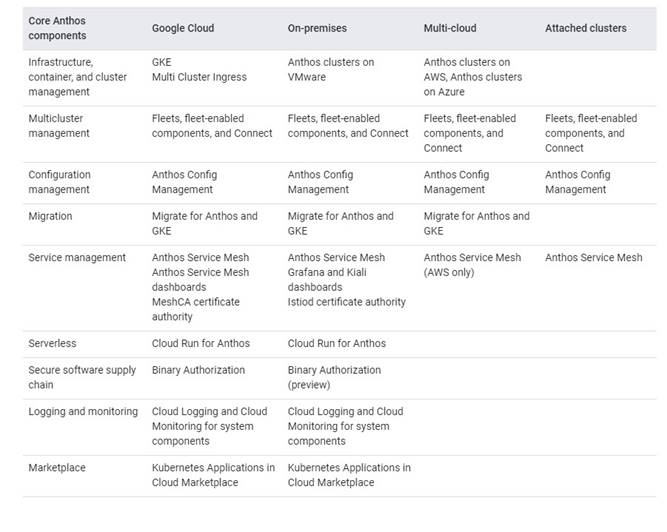
NEW QUESTION 9
You are consulting for a client who is migrating to Google Cloud. They presently have a matrix or-ganization. Their IT environments were managed around projects. Each team had multiple projects. All the projects had a flat structure under the company. What would you advise them when plan-ning for the move?
- A. On Google Cloud, create a folder corresponding to each tea
- B. Under that, there could be projects or further sub folders as the team decides.
- C. In terms of not disturbing the project developers and testers, advise them that the strategic decision is to retain the structure on Google Cloud also.
- D. Since a Project could spawn other sub-Projects, on Google Cloud it is better to as-sign a folder for each Project.
- E. The flat structure is what is currently used in IT organizations, and this can be used as-is which will provide the best results.
Answer: A
Explanation:
Folders for a related group of projects are the recommended approach.
-> A flat structure under the organization node is possible on Google Cloud, but it is not recommended. It becomes tougher to manage.
-> Projects cannot have sub-projects; there can only be resources within Projects.
Reference link- https://cloud.google.com/resource-manager/docs/cloud-platform- resource-hierarchy
NEW QUESTION 10
Your organization runs an application on virtual machines in Google Cloud. This application processes incoming images. This activity takes hours to create a result for each image. The workload for this application normally stays at a certain baseline level, but at regular intervals it spikes to a much greater workload. Your organization needs to control the cost to run this application.
What should your organization do?
- A. Purchase committed use discounts for the baseline load
- B. Purchase committed use discounts for the expected spike load
- C. Leverage sustained use discounts for your virtual machines
- D. Run the workload on preemptible VM instances
Answer: C
Explanation:
The idea of the Sustained Use discount is that the longer you run a VM instance in any given month, the bigger discount you will get from the list price.
Reference: https://www.parkmycloud.com/blog/google-sustained-use-discounts/
NEW QUESTION 11
An organization wants to transform multiple types of structured and unstructured data in the cloud from various sources. The data must be readily accessible for analysis and insights.
Which cloud data storage system should the organization use?
- A. Relational database
- B. Private data center
- C. Data field
- D. Data warehouse
Answer: D
Explanation:
It supports real-time insights. A data warehouse is an enterprise system used for the analysis and reporting of structured and semi-structured data from multiple sources, https://cloud.google.com/learn/what-is-a-data-warehouse
NEW QUESTION 12
An international bank is looking for a serverless warehouse solution that lets them perform smart analytics
Which Google Cloud product or service should the bank use?
- A. BigQuery
- B. Dataflow
- C. Compute Engine
- D. Cloud Spanner
Answer: A
Explanation:
The international bank should use Google Cloud's BigQuery service, which is a fully managed, serverless data warehouse that allows for high-speed analysis of large datasets. It provides a range of built-in functions for analytics and can easily integrate with other Google Cloud services.
NEW QUESTION 13
You are a DevOps Engineer in an E-commerce company that sells products globally, across the countries, Customers buy products, add them to carts or check-in stock from different parts of the world with different timestamps, you need to choose a database that can scale globally without any hassle and lots of developer support, it should be consistent across regions, can scale horizontally to support enormous user, automatically replicates, shards and even auto transaction pro-cessing. Which of the following database do you choose?
- A. Cloud SQL
- B. Cloud Spanner
- C. Cloud Firestore.
- D. Cloud Storage.
Answer: B
Explanation:
Cloud Spanner:
Fully managed relational database with unlimited scale, strong consistency, and up to 99.999% availability.
- Get all the benefits of relational semantics and SQL with unlimited scale
- Start at any size and scale with no limits as your needs grow
- Enjoy high availability with zero scheduled downtime and online schema changes
- Deliver high-performance transactions with strong consistency across regions and continents
- Focus on innovation, eliminating manual tasks with capabilities like automatic sharding
Automatic sharding
Cloud Spanner optimizes performance by automatically sharding the data based on request load and size of the data. As a result, you can spend less time worrying about how to scale your database and instead focus on scaling your business.
Strong transactional consistency
Purpose-built for external, strong, global transactional consistency.
Regional and multi-regional configurations
No matter where your users may be, apps backed by Cloud Spanner can read and write up-to-date strongly consistent data globally Additionally, when running a multi-region instance, your database is able to survive a regional failure, and offers industry-leading 99.999% availability.
Online schema changes with no downtime
Cloud Spanner users can make a schema change, whether it’s adding a column or adding an index while serving traffic with zero downtime. Hence you now have the flexibility to adapt your database to your business needs without compromising on the availability of your application.
NEW QUESTION 14
Your ed-tech start-up was originally launched in a small geography. Any user sign-ups, course progress, tests taken, etc. are captured on a self-managed MySQL database. Every
user generates many such transactions. Now you're taking the application globally and preparing for a much larger influx of users from all over the world. The existing MySQL server is unlikely to be able to scale. Which convenient option can be considered?
- A. Migrate to BigQuery
- B. Migrate to Cloud Spanner
- C. Migrate to Cloud SQL
- D. Migrate to Bigtable
Answer: B
Explanation:
Cloud Spanner is a global scale SQL database that scales extremely well. That would be the best choice.
NEW QUESTION 15
You want to build an application that will allow customers to register and login. It would be great to have the ability to secure it with multi-factor authentication and the ability to reset credentials. As a small startup, you want to build the main application as quickly as possible and have minimum overhead. Which might be a suitable option for you on Google Cloud?
- A. Since identity and credentials should be secure and private, do not trust other ser-vice providers.
- B. Cloud Identity
- C. Google Workspace
- D. Cloud Identity Platform
Answer: D
Explanation:
Cloud Identity Platform
Cloud Identity Platform allows you to manage identity and credentials for your consumer- facing applications. So that's the right one in this case to use. "Identity Platform is a customer identity and access management (CIAM) platform that helps organizations add identity and access management functionality to their applications, protect user accounts, and scale with confidence on Google Cloud."
Reference link- https://cloud.google.com/identity-platform
NEW QUESTION 16
......
P.S. Easily pass Cloud-Digital-Leader Exam with 304 Q&As 2passeasy Dumps & pdf Version, Welcome to Download the Newest 2passeasy Cloud-Digital-Leader Dumps: https://www.2passeasy.com/dumps/Cloud-Digital-Leader/ (304 New Questions)
