
Our pass rate is high to 98.9% and the similarity percentage between our DEA-C01 study guide and real exam is 90% based on our seven-year educating experience. Do you want achievements in the Snowflake DEA-C01 exam in just one try? I am currently studying for the Snowflake DEA-C01 exam. Latest Snowflake DEA-C01 Test exam practice questions and answers, Try Snowflake DEA-C01 Brain Dumps First.
Check DEA-C01 free dumps before getting the full version:
NEW QUESTION 1
Company A and Company B both have Snowflake accounts. Company A's account is hosted on a different cloud provider and region than Company B's account Companies A and B are not in the same Snowflake organization.
How can Company A share data with Company B? (Select TWO).
- A. Create a share within Company A's account and add Company B's account as a recipient of that share
- B. Create a share within Company A's account, and create a reader account that is a recipient of the share Grant Company B access to the reader account
- C. Use database replication to replicate Company A's data into Company B's account Create a share within Company B's account and grant users within Company B's account access to the share
- D. Create a new account within Company A's organization in the same cloud provider and region as Company B's account Use database replication to replicate CompanyA's data to the new account Create a share within the new account and add Company B's account as a recipient of that share
- E. Create a separate database within Company A's account to contain only those data setsthey wish to share with Company B Create a share within Company A's account and add all the objects within this separate database to the share Add Company B's account as a recipient of the share
Answer: AE
Explanation:
The ways that Company A can share data with Company B are:
✑ Create a share within Company A’s account and add Company B’s account as a recipient of that share: This is a valid way to share data between different accounts on different cloud platforms and regions. Snowflake supports cross-cloud and cross-region data sharing, which allows users to create shares and grant access to other accounts regardless of their cloud platform or region. However, this option may incur additional costs for network transfer and storage replication.
✑ Create a separate database within Company A’s account to contain only those data sets they wish to share with Company B Create a share within Company A’saccount and add all the objects within this separate database to the share Add Company B’s account as a recipient of the share: This is also a valid way to share data between different accounts on different cloud platforms and regions. This option is similar to the previous one, except that it uses a separate database to isolate the data sets that need to be shared. This can improve security and manageability of the shared data. The other options are not valid because:
✑ Create a share within Company A’s account, and create a reader account that is a recipient of the share Grant Company B access to the reader account: This option is not valid because reader accounts are not supported for cross-cloud or cross- region data sharing. Reader accounts are Snowflake accounts that can only consume data from shares created by their provider account. Reader accounts must be on the same cloud platform and region as their provider account.
✑ Use database replication to replicate Company A’s data into Company B’s account Create a share within Company B’s account and grant users within Company B’s account access to the share: This option is not valid because database replication cannot be used for cross-cloud or cross-region data sharing. Database replication is a feature in Snowflake that allows users to copy databases across accounts within the same cloud platform and region. Database replication cannot copy databases across different cloud platforms or regions.
✑ Create a new account within Company A’s organization in the same cloud provider and region as Company B’s account Use database replication to replicate Company A’s data to the new account Create a share within the new account and add Company B’s account as a recipient of that share: This option is not valid because it involves creating a new account within Company A’s organization, which may not be feasible or desirable for Company A. Moreover, this option is unnecessary, as Company A can directly share data with Company B without creating an intermediate account.
NEW QUESTION 2
Which use case would be BEST suited for the search optimization service?
- A. Analysts who need to perform aggregates over high cardinality columns
- B. Business users who need fast response times using highly selective filters
- C. Data Scientists who seek specific JOIN statements with large volumes of data
- D. Data Engineers who create clustered tables with frequent reads against clustering keys
Answer: B
Explanation:
The use case that would be best suited for the search optimization service is business users who need fast response times using highly selective filters. The search optimization service is a feature that enables faster queries on tables with high cardinality columns by creating inverted indexes on those columns. High cardinality columns are columns that have a large number of distinct values, such as customer IDs, product SKUs, or email addresses. Queries that use highly selective filters on high cardinality columns can benefit from the search optimization service because they can quickly locate the relevant rows without scanning the entire table. The other options are not best suited for the search optimization service. Option A is incorrect because analysts who need to perform aggregates over high cardinality columns will not benefit from the search optimization service, as they will still need to scan all the rows that match the filter criteria. Option C is incorrect because data scientists who seek specific JOIN statements with large volumes of data will not benefit from the search optimization service, as they will still need to perform join operations that may involve shuffling or sorting data across nodes. Option D is incorrect because data engineers who create clustered tables with frequent reads against clustering keys will not benefit from the search optimization service, as they already have an efficient way to organize and access data based on clustering keys.
NEW QUESTION 3
A new customer table is created by a data pipeline in a Snowflake schema where MANAGED ACCESSenabled.
…. Can gran access to the CUSTOMER table? (Select THREE.)
- A. The role that owns the schema
- B. The role that owns the database
- C. The role that owns the customer table
- D. The SYSADMIN role
- E. The SECURITYADMIN role
- F. The USERADMIN role with the manage grants privilege
Answer: ABE
Explanation:
The roles that can grant access to the CUSTOMER table are the role that owns the schema, the role that owns the database, and the SECURITYADMIN role. These roles have the ownership or the manage grants privilege on the schema or the database level, which allows them to grant access to any object within them. The other options are incorrect because they do not have the necessary privilege to grant access to the CUSTOMER table. Option C is incorrect because the role that owns the customer table cannot grant access to itself or to other roles. Option D is incorrect because the SYSADMIN role does not have the manage grants privilege by default and cannot grant access to objects that it does not own. Option F is incorrect because the USERADMIN role with the manage grants privilege can only grant access to users and roles, not to tables.
NEW QUESTION 4
Within a Snowflake account permissions have been defined with custom roles and role hierarchies.
To set up column-level masking using a role in the hierarchy of the current user, what command would be used?
- A. CORRECT_ROLE
- B. IKVOKER_ROLE
- C. IS_RCLE_IN_SESSION
- D. IS_GRANTED_TO_INVOKER_ROLE
Answer: C
Explanation:
The IS_ROLE_IN_SESSION function is used to set up column-level masking using a role in the hierarchy of the current user. Column-level masking is a feature in Snowflake that allows users to apply dynamic data masking policies to specific columns
based on the roles of the users who access them. The IS_ROLE_IN_SESSION function takes a role name as an argument and returns true if the role is in the current user’s session, or false otherwise. The function can be used in a masking policy expression to determine whether to mask or unmask a column value based on the role of the user. For example:
CREATE OR REPLACE MASKING POLICY email_mask AS (val string) RETURNS string -
> CASE WHEN IS_ROLE_IN_SESSION(‘HR’) THEN val ELSE REGEXP_REPLACE(val, ‘(.).(.@.)’, ‘\1****\2’) END;
In this example, the IS_ROLE_IN_SESSION function is used to create a masking policy for an email column. The masking policy returns the original email value if the user has the HR role in their session, or returns a masked email value with asterisks if not.
NEW QUESTION 5
While running an external function, me following error message is received: Error:function received the wrong number of rows
What iscausing this to occur?
- A. External functions do not support multiple rows
- B. Nested arrays are not supported in the JSON response
- C. The JSON returned by the remote service is not constructed correctly
- D. The return message did not produce the same number of rows that it received
Answer: D
Explanation:
The error message “function received the wrong number of rows” is caused by the return message not producing the same number of rows that it received. External functions require that the remote service returns exactly one row for each input row that it receives from Snowflake. If the remote service returns more or fewer rows than expected, Snowflake will raise an error and abort the function execution. The other options are not causes of this error message. Option A is incorrect because external functions do support multiple rows as long as they match the input rows. Option B is incorrect because nested arrays are supported in the JSON response as long as they conform to the return type definition of the external function. Option C is incorrect because the JSON returned by the remote service may be constructed correctly but still produce a different number of rows than expected.
NEW QUESTION 6
Given the table sales which has a clustering key of column CLOSED_DATE which table function will return the average clustering depth for the SALES_REPRESENTATIVEcolumn for the North American region?
A)

C)
D)
- A. Option A
- B. Option B
- C. Option C
- D. Option D
Answer: B
Explanation:
The table function SYSTEM$CLUSTERING_DEPTH returns the average clustering depth for a specified column or set of columns in a table. The function takes two arguments: the table name and the column name(s). In this case, the table name is sales and the column name is SALES_REPRESENTATIVE. The function also supports a WHERE clause to filter the rows for which the clustering depth is calculated. In this case, the WHERE clause is REGION = ‘North America’. Therefore, the function call in Option B will return the desired result.
NEW QUESTION 7
A Data Engineer is working on a continuous data pipeline which receives data from Amazon Kinesis Firehose and loads the data into a staging table which will later be used in the data transformation process The average file size is 300-500 MB.
The Engineer needs to ensure that Snowpipe is performant while minimizing costs. How can this be achieved?
- A. Increase the size of the virtual warehouse used by Snowpipe.
- B. Split the files before loading them andset the SIZE_LIMIT option to 250 MB.
- C. Change the file compression size and increase the frequency of the Snowpipe loads
- D. Decrease the buffer size to trigger delivery of files sized between 100 to 250 MB in Kinesis Firehose
Answer: B
Explanation:
This option is the best way to ensure that Snowpipe is performant while minimizing costs. By splitting the files before loading them, the Data Engineer can reduce the size of each file and increase the parallelism of loading. By setting the SIZE_LIMIT option to 250 MB, the Data Engineer can specify the maximum file size that can be loaded bySnowpipe, which can prevent performance degradation or errors due to large files. The other options are not optimal because:
✑ Increasing the size of the virtual warehouse used by Snowpipe will increase the
performance but also increase the costs, as larger warehouses consume more credits per hour.
✑ Changing the file compression size and increasing the frequency of the Snowpipe
loads will not have much impact on performance or costs, as Snowpipe already supports various compression formats and automatically loads files as soon as they are detected in the stage.
✑ Decreasing the buffer size to trigger delivery of files sized between 100 to 250 MB
in Kinesis Firehose will not affect Snowpipe performance or costs, as Snowpipe does not depend on Kinesis Firehose buffer size but rather on its own SIZE_LIMIT option.
NEW QUESTION 8
A company is using Snowpipe to bring in millions of rows every day of Change Data Capture (CDC) into a Snowflake staging table on a real-time basis The CDC needs to get processedand combined with other data in Snowflake and land in a final table as part of the full data pipeline.
How can a Data engineer MOST efficiently process the incoming CDC on an ongoing basis?
- A. Create a stream on the staging table and schedule a task that transforms data from the stream only when the stream has data.
- B. Transform the data during the data load with Snowpipe by modifying the related copy into statement to include transformation steps such as case statements andJOIN'S.
- C. Schedule a task that dynamically retrieves the last time the task was run from information_schema-rask_hiSwOry and use that timestamp to process the delta of the new rows since the last time the task was run.
- D. Use a create ok replace table as statement that references the staging table and includes all the transformation SQ
- E. Use a task to run the full create or replace table as statement on a scheduled basis
Answer: A
Explanation:
The most efficient way to process the incoming CDC on an ongoing basis is to create a stream on the staging table and schedule a task that transforms data from the stream only when the stream has data. A stream is a Snowflake object that records changes made to a table, such as inserts, updates, or deletes. A stream can be queried like a table and can provide information about what rows have changed since the last time the stream was consumed. A task is a Snowflake object that can execute SQL statements on a schedule without requiring a warehouse. A task can be configured to run only when certain conditions are met, such as when a stream has data or when another task has completed successfully. By creating a stream on the staging table and scheduling a task that transforms data from the stream, the Data Engineer can ensure that only new or modified rows are processed and that no unnecessary computations are performed.
NEW QUESTION 9
When would a Data engineer use table with the flatten function instead of the lateral flatten combination?
- A. When TABLE with FLATTENrequires another source in the from clause to refer to
- B. WhenTABLE with FLATTENrequires no additional source m the from clause to refer to
- C. Whenthe LATERALFLATTENcombination requires no other source m the from clause to refer to
- D. When table withFLATTENis acting like a sub-query executed for each returned row
Answer: A
Explanation:
The TABLE function with the FLATTEN function is used to flatten semi- structured data, such as JSON or XML, into a relational format. The TABLE function returns a table expression that can be used in the FROM clause of a query. The TABLE function with the FLATTEN function requires another source in the FROM clause to refer to, such as a table, view, or subquery that contains the semi-structured data. For example: SELECT t.value:city::string AS city, f.value AS population FROM cities t, TABLE(FLATTEN(input => t.value:population)) f;
In this example, the TABLE function with the FLATTEN function refers to the cities table in the FROM clause, which contains JSON data in a variant column named value. The FLATTEN function flattens the population array within each JSON object and returns a table expression with two columns: key and value. The query then selects the city and population values from the table expression.
NEW QUESTION 10
A Data Engineer needs to load JSON output from some software into Snowflake using Snowpipe.
Which recommendations apply to this scenario? (Select THREE)
- A. Load large files (1 GB or larger)
- B. Ensure that data files are 100-250 MB (or larger) in size compressed
- C. Load a single huge array containing multiple records into a single table row
- D. Verify each value of each unique element stores a single native data type (string or number)
- E. Extract semi-structured data elements containing null values into relational columns before loading
- F. Create data files that are less than 100 MB and stage them in cloud storage at a sequence greater than once each minute
Answer: BDF
Explanation:
The recommendations that apply to this scenario are:
✑ Ensure that data files are 100-250 MB (or larger) in size compressed: This recommendation will improve Snowpipe performance by reducing the number of files that need to be loaded and increasing the parallelism of loading. Smallerfiles can cause performance degradation or errors due to excessive metadata operations or network latency.
✑ Verify each value of each unique element stores a single native data type (string or number): This recommendation will improve Snowpipe performance by avoiding data type conversions or errors when loading JSON data into variant columns. Snowflake supports two native data types for JSON elements: string and number. If an element has mixed data types across different files or records, such as string and boolean, Snowflake will either convert them to string or raise an error, depending on the FILE_FORMAT option.
✑ Create data files that are less than 100 MB and stage them in cloud storage at a sequence greater than once each minute: This recommendation will minimize Snowpipe costs by reducing the number of notifications that need to be sent to Snowpipe for auto-ingestion. Snowpipe charges for notifications based on the number of files per notification and the frequency of notifications. By creating smaller files and staging them at a lower frequency, fewer notifications will be needed.
NEW QUESTION 11
What are characteristics of Snowpark Python packages? (Select THREE).
Third-party packages can be registered as a dependency to the Snowpark session using the session, import () method.
- A. Python packages can access any external endpoints
- B. Python packages can only be loaded in a local environment
- C. Third-party supported Python packages are locked down to prevent hitting
- D. The SQL command DESCRIBE FUNCTION will list the imported Python packages of the Python User-Defined Function (UDF).
- E. Querying information schema .packages will provide a list of supported Python packages and versions
Answer: ADE
Explanation:
The characteristics of Snowpark Python packages are:
✑ Third-party packages can be registered as a dependency to the Snowpark session using the session.import() method.
✑ The SQL command DESCRIBE FUNCTION will list the imported Python packages of the Python User-Defined Function (UDF).
✑ Querying information_schema.packages will provide a list of supported Python packages and versions.
These characteristics indicate how Snowpark Python packages can be imported, inspected, and verified in Snowflake. The other options are not characteristics of Snowpark Python packages. Option B is incorrect because Python packages can be loaded in both local and remote environments using Snowpark. Option C is incorrect because third-party supported Python packages are not locked down to prevent hitting external endpoints, but rather restricted by network policies and security settings.
NEW QUESTION 12
Which methods will trigger an action that will evaluate a DataFrame? (Select TWO)
- A. DataFrame.random_split ( )
- B. DataFrame.collect ()
- C. DateFrame.select ()
- D. DataFrame.col ( )
- E. DataFrame.show ()
Answer: BE
Explanation:
The methods that will trigger an action that will evaluate a DataFrame are DataFrame.collect() and DataFrame.show(). These methods will force the execution of any pending transformations on the DataFrame and return or display the results. The other options are not methods that will evaluate a DataFrame. Option A, DataFrame.random_split(), is a method that will split a DataFrame into two or more DataFrames based on random weights. Option C, DataFrame.select(), is a method that will project a set of expressions on a DataFrame and return a new DataFrame. Option D, DataFrame.col(), is a method that will return a Column object based on a column name in a DataFrame.
NEW QUESTION 13
Which system role is recommended for a custom role hierarchy to be ultimately assigned to?
- A. ACCOUNTADMIN
- B. SECURITYADMIN
- C. SYSTEMADMIN
- D. USERADMIN
Answer: B
Explanation:
The system role that is recommended for a custom role hierarchy to be ultimately assigned to is SECURITYADMIN. This role has the manage grants privilege on all objects in an account, which allows it to grant access privileges to other roles or revoke them as needed. This role can also create or modify custom roles and assign them to users or other roles. By assigning custom roles to SECURITYADMIN, the role hierarchy can be managed centrally and securely. The other options are not recommended system roles for a custom role hierarchy to be ultimately assigned to. Option A is incorrect because ACCOUNTADMIN is the most powerful role in an account, which has full access to all objects and operations. Assigning custom roles to ACCOUNTADMIN can pose a security risk and should be avoided. Option C is incorrect because SYSTEMADMIN is a role that has full access to all objects in the public schema of the account, but not to other schemas or databases. Assigning custom roles to SYSTEMADMIN can limit the scope and flexibility of the role hierarchy. Option D is incorrect because USERADMIN is a role that can manage users and roles in an account, but not grant access privileges to other objects. Assigning custom roles to USERADMIN can prevent the role hierarchy from controlling access to data and resources.
NEW QUESTION 14
A Data Engineer is evaluating the performance of a query in a development environment.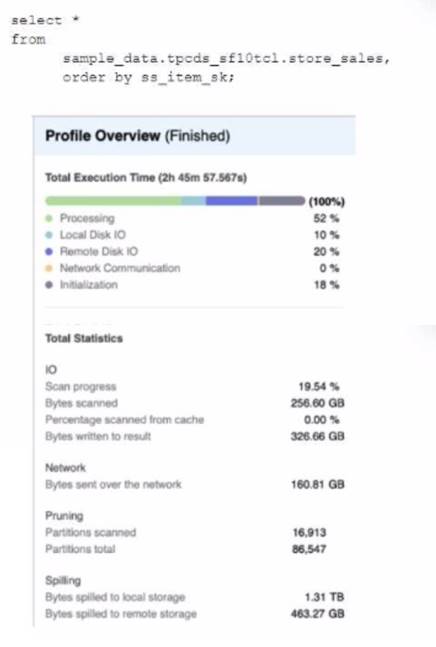
Based on the Query Profile what are some performance tuning options the Engineer can use? (Select TWO)
- A. Add a LIMIT to the ORDER BY If possible
- B. Use a multi-cluster virtual warehouse with the scaling policy set to standard
- C. Move the query to a larger virtual warehouse
- D. Create indexes to ensure sorted access to data
- E. Increase the max cluster count
Answer: AC
Explanation:
The performance tuning options that the Engineer can use based on the Query Profile are:
✑ Add a LIMIT to the ORDER BY If possible: This option will improve performance by reducing the amount of data that needs to be sorted and returned by the query. The ORDER BY clause requires sorting all rows in the input before returning them, which can be expensive and time-consuming. By adding a LIMIT clause, the query can return only a subset of rows that satisfy the order criteria, which can reduce sorting time and network transfer time.
✑ Create indexes to ensure sorted access to data: This option will improve performance by reducing the amount of data that needs to be scanned and filtered by the query. The query contains several predicates on different columns, such as o_orderdate, o_orderpriority, l_shipmode, etc. By creating indexes on these columns, the query can leverage sorted access to data and prune unnecessary micro-partitions or rows that do not match the predicates. This can reduce IO time and processing time.
The other options are not optimal because:
✑ Use a multi-cluster virtual warehouse with the scaling policy set to standard: This option will not improve performance, as the query is already using a multi-cluster virtual warehouse with the scaling policy set to standard. The Query Profile shows that the query is using a 2XL warehouse with 4 clusters and a standard scaling policy, which means that the warehouse can automatically scale up or down based on the load. Changing the warehouse size or the number of clusters will not affect the performance of this query, as it is already using the optimal resources.
✑ Increase the max cluster count: This option will not improve performance, as the query is not limited by the max cluster count. The max cluster count is a parameter that specifies the maximum number of clusters that a multi-cluster virtual warehouse can scale up to. The Query Profile shows that the query is using a 2XL warehouse with 4 clusters and a standard scaling policy, which means that the warehouse can automatically scale up or down based on theload. The default max cluster count for a 2XL warehouse is 10, which means that the warehouse can scale up to 10 clusters if needed. However, the query does not need more than 4 clusters, as it is not CPU-bound or memory-bound. Increasing the max cluster count will not affect the performance of this query, as it will not use more clusters than necessary.
NEW QUESTION 15
Assuming a Data Engineer has all appropriate privileges and context which statements would be used to assess whether the User-Defined Function (UDF), MTBATA3ASZ. SALES .REVENUE_BY_REGION, exists and is secure? (Select TWO)
- A. SHOW DS2R FUNCTIONS LIKE 'REVEX'^BYJIESION' IN SCHEMA SALES;
- B. SELECT IS_SECURE FROM SNOWFLAK
- C. INFCRXATION_SCKZM
- D. FUNCTIONS WHERE FUNCTI0N_3CHEMA = 'SALES' AND FUNCTI CN_NAXE =•ftEVEXUE_BY_RKXQH4;
- E. SELECT IS_SEC"JRE FROM INFOR>LVTICN_SCHEM
- F. FUNCTIONS WHERE FUNCTION_SCHEMA = 'SALES1 AND FUNGTZON_NAME = ' REVENUE_BY_REGION';
- G. SHOW EXTERNAL FUNCTIONS LIKE ‘REVENUE_BY_REGION’IB SCHEMA SALES;
- H. SHOW SECURE FUNCTIONS LIKE 'REVENUE 3Y REGION' IN SCHEMA SALES;
Answer: AB
Explanation:
The statements that would be used to assess whether the UDF, MTBATA3ASZ. SALES .REVENUE_BY_REGION, exists and is secure are:
✑ SHOW DS2R FUNCTIONS LIKE ‘REVEX’^BYJIESION’ IN SCHEMA SALES;:
This statement will show information about the UDF, including its name, schema, database, arguments, return type, language, and security option. If the UDF does not exist, the statement will return an empty result set.
✑ SELECT IS_SECURE FROM SNOWFLAKE. INFCRXATION_SCKZMA.
FUNCTIONS WHERE FUNCTI0N_3CHEMA = ‘SALES’ AND FUNCTI CN_NAXE
= •ftEVEXUE_BY_RKXQH4;: This statement will query the SNOWFLAKE.INFORMATION_SCHEMA.FUNCTIONS view, which contains metadata about the UDFs in the current database. The statement will return the IS_SECURE column, which indicates whether the UDF is secure or not. If the UDF does not exist, the statement will return an empty result set. The other statements are not correct because:
✑ SELECT IS_SEC"JRE FROM INFOR>LVTICN_SCHEMA. FUNCTIONS WHERE
FUNCTION_SCHEMA = ‘SALES1 AND FUNGTZON_NAME = ’
REVENUE_BY_REGION’;: This statement will query the INFORMATION_SCHEMA.FUNCTIONS view, which contains metadata about the UDFs in the current schema. However, the statement has a typo in the schema name (‘SALES1’ instead of ‘SALES’), which will cause it to fail or return incorrect results.
✑ SHOW EXTERNAL FUNCTIONS LIKE ‘REVENUE_BY_REGION’ IB SCHEMA
SALES;: This statement will show information about external functions, not UDFs. External functions are Snowflake functions that invoke external services via HTTPS requests and responses. The statement will not return any results for the UDF.
✑ SHOW SECURE FUNCTIONS LIKE ‘REVENUE 3Y REGION’ IN SCHEMA
SALES;: This statement is invalid because there is no such thing as secure functions in Snowflake. Secure functions are a feature of some other databases, such as PostgreSQL, but not Snowflake. The statement will cause a syntax error.
NEW QUESTION 16
A Data Engineer has created table t1 with datatype VARIANT: create or replace table t1 (cl variant);
The Engineer has loaded the following JSON data set. which has information about 4 laptop models into the table: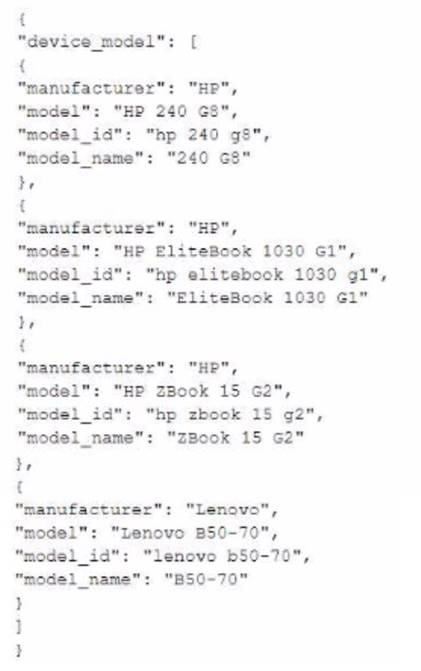
The Engineer now wants to query that data set so that results are shown as normal structured data. The result should be 4 rows and 4 columns without the double quotes surrounding the data elements in the JSON data.
The result should be similar to the use case where the data was selected from a normal
relational table z2 where t2 has string data type columns model id. model, manufacturer, and =iccisi_r.an=. and is queried with the SQL clause select * from t2;
Which select command will produce the correct results?
A)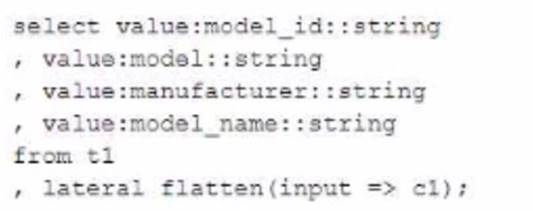
B)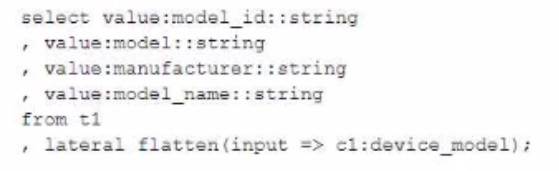
C)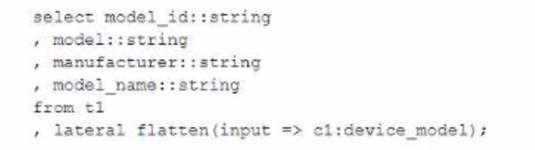
D)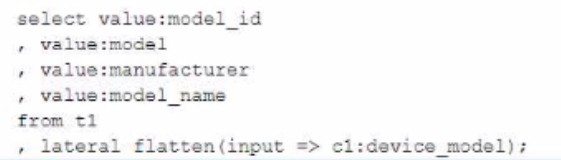
- A. Option A
- B. Option B
- C. Option C
- D. Option D
Answer: B
NEW QUESTION 17
The JSON below is stored in a variant column named v in a table named jCustRaw: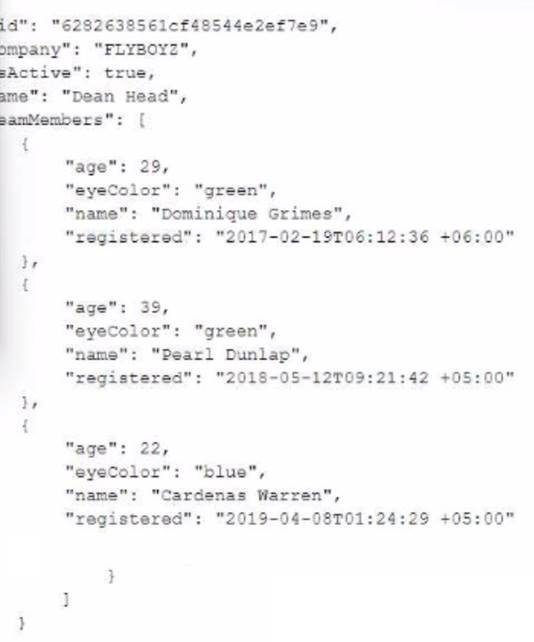
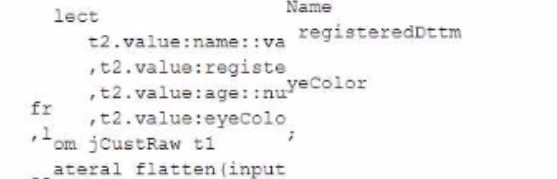
Which query will return one row per team member (stored in the teamMembers array) along all of the attributes of each team member?
A)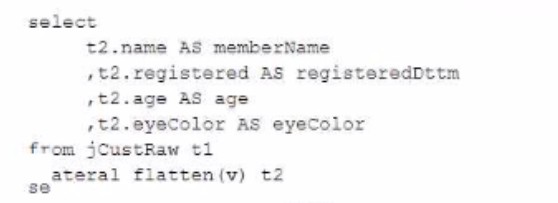
C)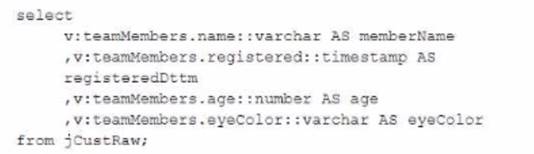
D)
- A. Option A
- B. Option B
- C. Option C
- D. Option D
Answer: B
NEW QUESTION 18
A secure function returns data coming through an inbound share
What will happen if a Data Engineer tries to assign usage privileges on this function to an outbound share?
- A. An error will be returned because the Engineer cannot share data that has already been shared
- B. An error will be returned because only views and secure stored procedures can be shared
- C. An error will be returned because only secure functions can be shared with inboundshares
- D. The Engineer will be able to share the secure function with other accounts
Answer: A
Explanation:
An error will be returned because the Engineer cannot share data that has already been shared. A secure function is a Snowflake function that can access data from an inbound share, which is a share that is created by another account and consumed by the current account. A secure function can only be shared with an inbound share, not an outbound share, which is a share that is created by the current account and shared with other accounts. This is to prevent data leakage or unauthorized access to the data from the inbound share.
NEW QUESTION 19
Which Snowflake objects does the Snowflake Kafka connector use? (Select THREE).
- A. Pipe
- B. Serverless task
- C. Internal user stage
- D. Internal table stage
- E. Internal named stage
- F. Storage integration
Answer: ADE
Explanation:
The Snowflake Kafka connector uses three Snowflake objects: pipe, internal table stage, and internal named stage. The pipe object is used to load data from an external stage into a Snowflake table using COPY statements. The internal table stage is used to store files that are loaded from Kafka topics into Snowflake using PUT commands. The internal named stage is used to store files that are rejected by the COPY statements due to errors or invalid data. The other options are not objects that are used by the Snowflake Kafka connector. Option B, serverless task, is an object that can execute SQL statements on a schedule without requiring a warehouse. Option C, internal user stage, is an object that can store files for a specific user in Snowflake using PUT commands. Option F, storage integration, is an object that can enable secure access to external cloud storage services without exposing credentials.
NEW QUESTION 20
......
Thanks for reading the newest DEA-C01 exam dumps! We recommend you to try the PREMIUM DumpSolutions.com DEA-C01 dumps in VCE and PDF here: https://www.dumpsolutions.com/DEA-C01-dumps/ (65 Q&As Dumps)
