
Master the HPE6-A42 Implementing Aruba WLAN (IAW) 8 content and be ready for exam day success quickly with this Testking HPE6-A42 latest exam. We guarantee it!We make it a reality and give you real HPE6-A42 questions in our HP HPE6-A42 braindumps.Latest 100% VALID HP HPE6-A42 Exam Questions Dumps at below page. You can use our HP HPE6-A42 braindumps and pass your exam.
Online HP HPE6-A42 free dumps demo Below:
NEW QUESTION 1
A network administrator wants to assign an authentication server group to the WPA2-Enterprise WLAN. Which profile should the administrator modify?
- A. Virtual AP
- B. SSID
- C. AAA
- D. L2 Authentication
Answer: C
NEW QUESTION 2
What is a reason for a company to choose to deploy an Aruba 7024 Mobility Controller (MC) rather than an Aruba 7010 MC?
- A. to support 802.11ac Aps rather than only 802.11n APs
- B. to support more wireless users
- C. to support more POE devices directly connected to the MC
- D. to support a faster firewall throughput rate
Answer: C
NEW QUESTION 3
A network administrator creates an employee WLAN on an Aruba solution that uses WLAN
WPA2-Enterprise security and an external RADIUS server. When the administrator tests the WLAN, the test client receives limited connectivity and cannot access any resources, but the RADIUS server shows that the user authenticated successfully.
What should the administrator check as a possible source of this issue?
- A. the connectivity between the AP that the client is associated to and the MC
- B. the firewall role and policy that apply to this user
- C. the certificate on the RADIUS server
- D. the connectivity between the Master Controller (MC) for the client and the RADIUS server
Answer: B
NEW QUESTION 4
Which task can an Aruba Air Monitor (AM) perform?
- A. Analyze wireless traffic patterns at the application level.
- B. Optimize RF through the AP channel and transmit power plans.
- C. Analyze RF signals to determine the cause of non-802.11 interference.
- D. Help to detect rogue APs in the environment.
Answer: D
NEW QUESTION 5
An Aruba Mobility Master (MM)-based solution has two Virtual MM nodes, a primary and a backup node. The solution must support 30 Virtual Mobility Controllers (VMCs) that will support a total of 960 APs.
Which VMC licenses meet the needs and DO NOT unnecessarily exceed them?
- A. two 1000 VMC licenses (MC-VA-1000)
- B. one 1000 VMC license (MC-VA-1000)
- C. two 50 VMC licenses (MC-VA-50)
- D. one 50 VMC license (MC-VA-50)
Answer: B
NEW QUESTION 6
What is one reason for a network administrator to visit the Dashboard > Usage window on an Aruba Mobility Master (MM)?
- A. to check license usage and determine the need for additional licenses
- B. to analyze short terms trends in network usage by client, AP, and application
- C. to view system usage statistics for the MM and troubleshoot potential issues
- D. to generate reports about traffic patterns and network usage over the past several months
Answer: B
NEW QUESTION 7
For which use case should network administrators set up Aruba access points (APs) as multi-zone APs?
- A. The company has multiple small branch offices where APs at each branch office must forward internet traffic locally and corporate traffic over a secure tunnel to a centralized Mobility Controller (MC).
- B. The company has some devices that support both 5GHz and 2.4GHz, and the APs must operate in both frequency bands.
- C. The company requires high availability for its wireless services, and APs must be able to be controlled by more than one Mobility Controller (MC) in case a controller fails.
- D. The company has a Mobility Manager (MM)-based solution that requires APs to terminate to multiple controllers that reside in different administrative domains.
Answer: D
NEW QUESTION 8
What is one difference between an Aruba firewall access controle rule and an application rule?
- A. An application rule cannot use the packet source and destination IP addresses as part of its match criteria.
- B. An access rule can filter non-IP traffic, as well as IPv4 and IPv6 traffic.
- C. An access rule cannot apply different actions to different types of traffic sent to the same destination.
- D. An application rule can filter traffic at a higher layer beyond the TCP or UDP port.
Answer: D
NEW QUESTION 9
A network administrator configures an Aruba Mobility Master (MM)-based solution to provide wireless access to employees. The solution must meet these criteria: Authenticate users to a network RADIUS server Enforce different Aruba firewall rules based on the user department How can the administrator meet these criteria in the simplest way?
- A. Have the RADIUS server assign users in different departments to different VLAN
- B. Apply firewall policies based on IP ranges.
- C. Have the RADIUS server send different roles for users in different department
- D. Apply role-basedfirewall policies.
- E. Create multiple zones on the M
- F. Assign different departments and sets of firewall policies to different zones.
- G. Create a different WLAN and SSID for each departmen
- H. Apply different firewall policies to each WLAN.
Answer: B
NEW QUESTION 10
A network manager wants to implement an Aruba wireless solution that accommodates 802.1X with EAP-TLS. All wireless users will utilize Active Directory (AD) accounts to authenticate.
Which device will the authenticator forward the authentication requests to in this type of solution?
- A. APs
- B. RADIUS server
- C. Mobility Controller (MC)
- D. Mobility Master (MM)
Answer: C
NEW QUESTION 11
Which deployment option for Aruba Controllers is new to ArubaOS 8?
- A. deployment as virtual appliances
- B. deployment in standalone mode
- C. deployment in master-local mode
- D. deployment as branch office controller
Answer: A
NEW QUESTION 12
Refer to the exhibit.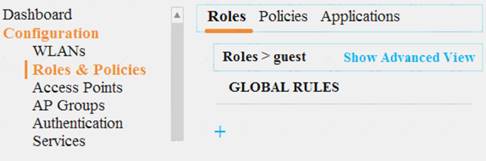
A network administrator adds a global rule in the area shown in the exhibit. Where does the global rule take effect?
- A. It immediately applies only to the guest role, as part of the final policy applied to the role.Administrators cannot apply the rule to other roles.
- B. It immediately applies to the guest role and other roles, as part of the first policy applied to the role.
- C. It immediately applies to the guest role and other roles, as part of the final policy applied to the role.
- D. It immediately applies only to the guest role and other roles, as part of the first policy applied to the role.Administrators can choose to apply the rule to other roles.
Answer: D
NEW QUESTION 13
A company has an Aruba solution. The company wants to support a guest WLAN with the internal captive portal, but the company also wants to develop their own custom portal pages.
What correctly describes the level of customization that the internal captive portal supports?
- A. The internal captive portal must use the default pages without modification, but administrators can upload pages developed externally.
- B. Administrators can modify the default internal captive portal pages, but cannot upload pages developped externally.
- C. Administrators can modify the default internal captive portal pages or upload pages developped externally.
- D. The internal captive portal must use the default pages without modification, and administrators cannot upload pages developped externally.
Answer: C
NEW QUESTION 14
A company has an Aruba Mobility Master (MM)-based solution. Under which circumstance will an AP radio change channel without the use of the Mobility Master (MM)?
- A. when the MM detects that a different channel has significantly better quality
- B. when the Mobility Controller (MC) detects a rogue AP on the channel
- C. when the AP detects a large amount of interference on its channel
- D. when the Client Match rules indicate that nearby clients do not support the current channel
Answer: C
NEW QUESTION 15
A company deploys a wireless network in a typical office environment with many surfaces where the signal can bounce. Which 802.11 technology uses the characteristics of this environment to increase wireless speeds?
- A. Channel bonding
- B. Multiple Input Multiple Output (MIMO)
- C. Transmit Power Control (TPC)
- D. QAM modulation
Answer: B
NEW QUESTION 16
Refer to the exhibit.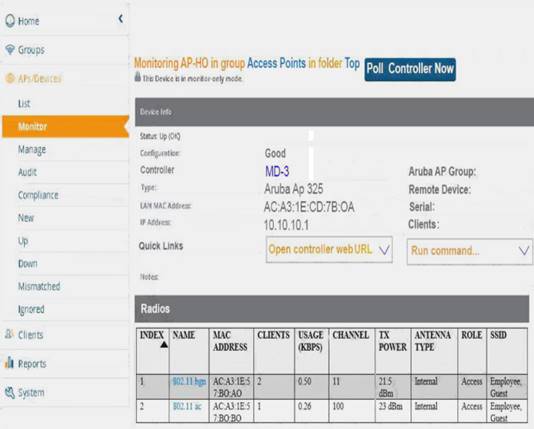
A network administrator needs to use Aruba AirWave to view statistics for an AP’s 802.11ac radio. How can the administrator update the information on-demand rather than wait the typical interval?
- A. Click Poll Controller Now
- B. Click the 802.11ac link
- C. Log out of the interface and log back in
- D. Refresh the browser
Answer: A
NEW QUESTION 17
An Aruba Mobility Master (MM)-based solution has a WLAN that uses WPA2-Enterprise security. A test login on a wireless client fails.
How can a network administrator determine whether the RADIUS server rejected the credentials or another issue occurred?
- A. View Technical Support information for the MM.
- B. Ping the IP address configured as the RADIUS server.
- C. Use the MM AAA Server Test Diagnostic tool.
- D. Use the tools in the MM Dashboard > Security window.
Answer: C
NEW QUESTION 18
Which pre-defined role allows DHCP, DNS, and internal captive portal redirection for a guest WLAN?
- A. exam_guest-guest-logon
- B. authorized
- C. guest-logon
- D. guest
Answer: C
NEW QUESTION 19
What is the difference between WPA and WPA2 encryption?
- A. WPA encryption uses symmetric keys, and WPA2 encryption uses asymmetric keys.
- B. WPA encryption acts at Layer 3, and WPA2 encryption acts at Layer 2.
- C. WPA encryption works only with preshared key (PSK) authentication, and WPA2 encryption works with both PSK and 802.1X.
- D. WPA encryption uses TKIP by default, and WPA2 encryption uses AES by default.
Answer: D
NEW QUESTION 20
A network administrator adds several new APs to an Aruba solution that uses AirMatch. The administrator does not want to change the channel for the existing APs, but wants the new APs to receive a provisional plan for their channels and power.
What should the administrator do to meet this goal?
- A. Run an on-demand quick AirMatch optimization.
- B. Run an on-demand incremental AirMatch optimization.
- C. Temporarily enable ARM on the existing and new APs, while AirMatch scheduling remains enabled.
- D. Temporarily disable AirMatch scheduling, and then enable ARM on the existing and new APs.
Answer: B
NEW QUESTION 21
What is one difference between captive portal authentication and 802.1X authentication?
- A. 802.1X authentication always authenticates the wireless client, while captive portal authentication always authenticates the wireless user.
- B. 802.1X authentication occurs at Layer 2, while captive portal authentication occurs at Layer 3.
- C. 802.1X authentication must use an LDAP server, while captive portal authentication can use a RADIUS server or an LDAP server.
- D. 802.1X authentication is typically implemented without encryption, while captive authentication is often combined with WPA or WPA2.
Answer: B
NEW QUESTION 22
Refer to the exhibit.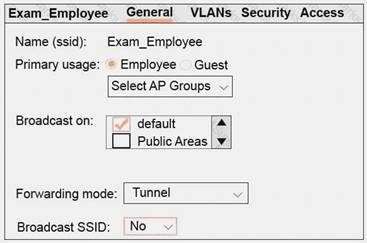
What describes the behavior for this WLAN?
- A. APs in the default group broadcast the SSI
- B. Clients can connect to the WLAN on APs in the default group only.
- C. No APs broadcast the SSI
- D. Clients cannot connect to the WLAN until administrators activate it.
- E. No APs broadcast the SSI
- F. Clients can connect to the WLAN on APs in the default gorup only.
- G. APs in the default group broadcast the SSI
- H. Clients can connect to the WLAN on APs in any group.
Answer: C
NEW QUESTION 23
Refer to the exhibit.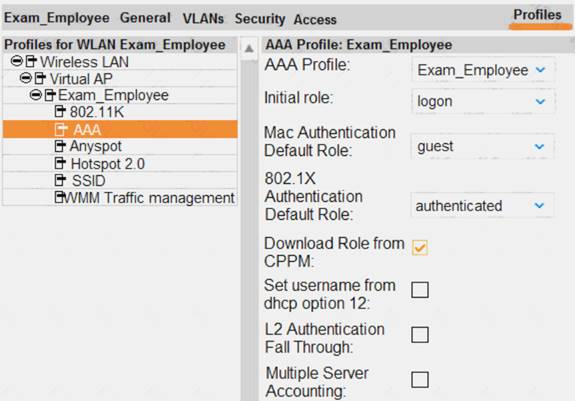
The exhibit shows the AAA profile for a WLAN on an Aruba solution. This WLAN uses 802.1X to authenticate users to a RADIUS server. A user successfully authenticates with 802.1X, but the RADIUS server does not send a role assignment.
How does the Aruba firewall handle the role assignment for this user?
- A. It does not assign a role.
- B. It applies the Aruba VSA role employee.
- C. It assigns the logon role.
- D. It assigns the authenticated role.
Answer: D
NEW QUESTION 24
......
Thanks for reading the newest HPE6-A42 exam dumps! We recommend you to try the PREMIUM Certstest HPE6-A42 dumps in VCE and PDF here: https://www.certstest.com/dumps/HPE6-A42/ (122 Q&As Dumps)
