
Exam Code: HPE6-A70 (Practice Exam Latest Test Questions VCE PDF)
Exam Name: Implementing Aruba WLAN (IAW) 8.4
Certification Provider: HP
Free Today! Guaranteed Training- Pass HPE6-A70 Exam.
HP HPE6-A70 Free Dumps Questions Online, Read and Test Now.
NEW QUESTION 1
Which Aruba controller supports a maximum of 512 APs?
- A. Aruba 7010
- B. Aruba 7030
- C. Aruba 7210
- D. Aruba 7240
Answer: C
NEW QUESTION 2
A company has an Aruba solution and wants to provide guests with wireless access. The company wants to
assign guests IP addresses in subnets that exist only within the Aruba solution.
Which feature should network administrators set up so guests can send traffic on the Internet without changes to the company routing solution?
- A. Enable NAT on the VLAN assigned to the guest WLAN.
- B. Set up a dynamic default gateway on the Mobility Controllers (MCs).
- C. Create destination NAT rules for the guest role.
- D. Enable policy-based routing for the guest traffic.
Answer: A
NEW QUESTION 3
What is one difference between captive portal authentication and 802.1X authentication?
- A. 802.1X authentication always authenticates the wireless client, while captive portal authentication always authenticates the wireless user.
- B. 802.1X authentication occurs at Layer 2, while captive portal authentication occurs at Layer 3.
- C. 802.1X authentication must use an LDAP server, while captive portal authentication can use a RADIUS server or an LDAP server.
- D. 802.1X authentication is typically implemented without encryption, while captive authentication is often combined with WPA or WPA2.
Answer: B
NEW QUESTION 4
An Aruba solution runs ArubaOS 8 and uses a standalone controller architecture. Which feature can administrators use to optimize the channel and power plan for the APs?
- A. ARM
- B. Rule Based Client Match
- C. AirMatch
- D. AppRF
Answer: A
NEW QUESTION 5
What is required for a WLAN that uses WPA2-Enterprise security?
- A. a Web server to host a login portal
- B. a shared password to secure access to the WLAN
- C. RADIUS server or servers
- D. a policy to allow unauthenticated users to receive RADIUS
Answer: C
NEW QUESTION 6
A company has an Aruba Mobility Master (MM)-based solution with a WLAN that assigns users to VLANs 10–19. The company wants the Aruba solution to act at Layer 3 to route wireless user traffic.
What must network administrators configure to permit the solution to forward traffic correctly?
- A. VLAN 10–19 interfaces and proper IP settings on the MM nodes
- B. trunk ports that support VLANs 10–19 on the managed Mobility Controllers (MCs)
- C. VLAN 10–19 interfaces on the Mobility Controllers (MCs) as the default gateway for wireless users
- D. trunk ports that support VLANs 10-19 on the MM nodes
Answer: C
NEW QUESTION 7
A company has an Aruba solution. The company wants to support a guest WLAN with the internal captive portal, but the company also wants to develop their own custom portal pages.
What correctly describes the level of customization that the internal captive portal supports?
- A. The internal captive portal must use the default pages without modification, but administrators can upload pages developed externally.
- B. Administrators can modify the default internal captive portal pages, but cannot upload pages developped externally.
- C. Administrators can modify the default internal captive portal pages or upload pages developped externally.
- D. The internal captive portal must use the default pages without modification, and administrators cannot upload pages developped externally.
Answer: C
NEW QUESTION 8
A company has an Aruba solution. A network administrator wants to prevent wireless users from accessing shopping web sites with a bad reputation.
What should the administrator set up to deny such traffic?
- A. an AppRF engine
- B. application filters in the Traffic Analysis dashboard
- C. firewall access control rules that specify HTTP and HTTPS services
- D. firewall application rules
Answer: D
NEW QUESTION 9
An Aruba Remote AP (RAP) operates in split-tunnel mode. How does the AP forward traffic?
- A. It sends all user traffic in a GRE tunnel to a central Mobility Controller (MC), and it sends control traffic in an IPsec tunnel to the controller.
- B. It sends traffic designed to the corporate network in an IPsec tunnel to a central Mobility Controller (MC), and it bridges other traffic locally.
- C. It sends user and control traffic in two separate IPsec tunnels to the Mobility Controller (MC).
- D. It sends all employee and control traffic in a GRE tunnel to a central Mobility Controller (MC), and it bridges all guest traffic locally.
Answer: B
NEW QUESTION 10
Refer to the exhibit.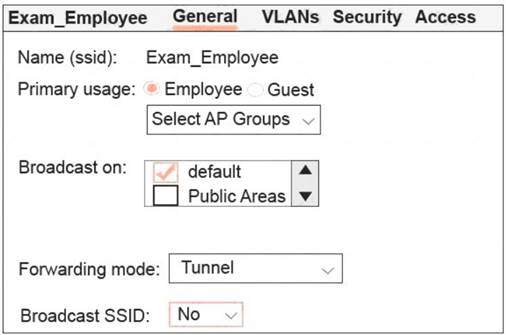
What describes the behavior for this WLAN?
- A. APs in the default group broadcast the SSI
- B. Clients can connect to the WLAN on APs in the default group only.
- C. No APs broadcast the SSI
- D. Clients cannot connect to the WLAN until administrators activate it.
- E. No APs broadcast the SSI
- F. Clients can connect to the WLAN on APs in the default group only.
- G. APs in the default group broadcast the SSI
- H. Clients can connect to the WLAN on APs in any group.
Answer: C
NEW QUESTION 11
Refer to the exhibit.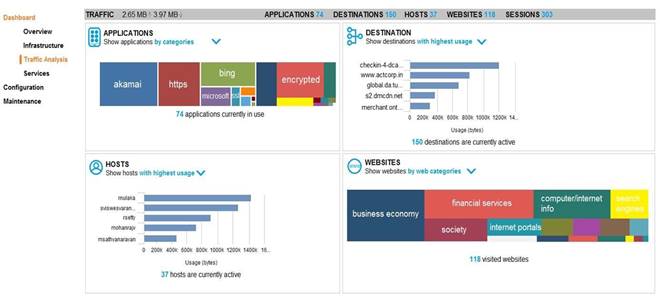
The exhibit shows output from a Mobility Master (MM) dashboard. What is a valid reason for the administrator to click the akamai square under applications?
- A. to see the break down for only the roles, destinations, WLANs, and devices that use this application
- B. to download a report about the usage of this application over time
- C. to create filter rules in order to control wireless user access to this application
- D. to set up bandwidth rule in order to control wireless user access to this application
Answer: A
NEW QUESTION 12
Which IEEE standard provides the highest transmission rates in the 2.4GHz frequency band?
- A. 802.11a
- B. 802.11ac
- C. 802.11g
- D. 802.11n
Answer: D
NEW QUESTION 13
Refer to the exhibit.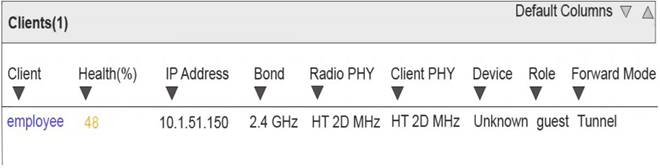
The exhibit shows output from a Mobility Master (MM) dashboard. What does the health status indicate?
- A. It takes the AP about twice as long to send data to the client as expected if all transmissions succeeded.
- B. About half of the heartbeats the client sends reaches the Mobility Manager (MM).
- C. The maximum data rate that 802.11ac supports is about twice as high as the data rate the client uses.
- D. The client device only complies with about half of the rules in the endpoint health policy.
Answer: A
NEW QUESTION 14
A company plans to deploy a Mobility Master (MM). The MM will manage 50 Mobility Controller (MC) appliances that will control a total of 680 APs, and 10 Virtual Mobility Controllers (VMCs) that will control a total of 160 APs.
How many MM licenses does the company require?
- A. 60
- B. 210
- C. 900
- D. 960
Answer: C
Explanation:
Starting with ArubaOS 8.0.1, the MM license is required to terminate devices (controllers or APs) on Mobility Master. If the Mobility Master does not have sufficient MM licenses and an AP fails to obtain a license, that AP can get an IP address and connect to its controller, but will not broadcast an SSID.
NEW QUESTION 15
What is one networking setting that a network administrator can configure for roles in an Aruba solution?
- A. DHCP pool
- B. ClientMatch rules
- C. source NAT
- D. bandwidth limit
Answer: D
NEW QUESTION 16
An Aruba solution has a WLAN that uses WPA2-Enterprise security. How are encryption keys dynamically managed for the wireless users?
- A. The MM generates and distributes keys to clients and access points (APs).
- B. Administrators configure identical key strings on the Mobility Controllers (MCs) and wireless client 802.1X settings.
- C. Keys are generated and distributed securely during each wireless user authentication process.
- D. Keys are derived from the preshared key configured on the WLAN and on each wireless client.
Answer: C
NEW QUESTION 17
A company deploys an Aruba wireless solution for the first time. In which deployment is clustering supported?
- A. deployment as Mobility Masters (MMs)
- B. deployment as a standalone VMC
- C. deployment in 7000 Series standalone mode
- D. deployment in master-local mode
Answer: A
NEW QUESTION 18
What is a reason for a company to choose to deploy an Aruba 7024 Mobility Controller (MC) rather than an Aruba 7010 MC?
- A. to support 802.11ac Aps rather than only 802.11n APs
- B. to support more wireless users
- C. to support more POE devices directly connected to the MC
- D. to support a faster firewall throughput rate
Answer: C
NEW QUESTION 19
Refer to the exhibits.
Exhibit 1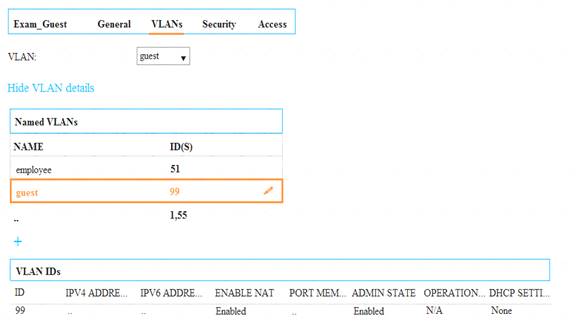
Exhibit 2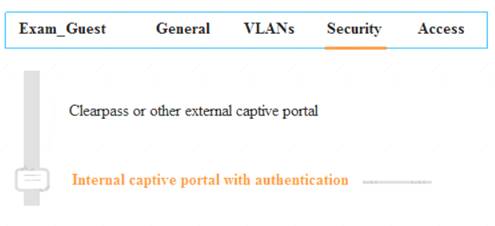
A network administrator configures a guest WLAN on an Aruba Mobility Master (MM)-based solution. The
exhibits show some of the settings for this WLAN.
Which settings must the administrator configure on each Mobility Controller (MC) at the device level for this configuration to function properly?
- A. an IPsec preshared key
- B. CPSec certificates
- C. a portal page
- D. VLAN 99 IP settings
Answer: D
NEW QUESTION 20
For which use case should network administrators set up Aruba access points (APs) as multi-zone APs?
- A. The company has multiple small branch offices where APs at each branch office must forward internet traffic locally and corporate traffic over a secure tunnel to a centralized Mobility Controller (MC).
- B. The company has some devices that support both 5GHz and 2.4GHz, and the APs must operate in both frequency bands.
- C. The company requires high availability for its wireless services, and APs must be able to be controlled by more than one Mobility Controller (MC) in case a controller fails.
- D. The company has a Mobility Manager (MM)-based solution that requires APs to terminate to multiple controllers that reside in different administrative domains.
Answer: D
NEW QUESTION 21
What are two criteria that distinguish different Aruba Mobility Controller (MC) models from each other?
- A. firewall speed and ability to act as a standalone controller or not
- B. number of supported users and firewall throughput
- C. number of supported APs and ability to support 802.11ac APs or not
- D. number of supported users and ability to support 802.11ac APs or not
Answer: B
NEW QUESTION 22
......
P.S. Easily pass HPE6-A70 Exam with 131 Q&As Thedumpscentre.com Dumps & pdf Version, Welcome to Download the Newest Thedumpscentre.com HPE6-A70 Dumps: https://www.thedumpscentre.com/HPE6-A70-dumps/ (131 New Questions)
