
Our pass rate is high to 98.9% and the similarity percentage between our 1z0-083 study guide and real exam is 90% based on our seven-year educating experience. Do you want achievements in the Oracle 1z0-083 exam in just one try? I am currently studying for the Oracle 1z0-083 exam. Latest Oracle 1z0-083 Test exam practice questions and answers, Try Oracle 1z0-083 Brain Dumps First.
Online 1z0-083 free questions and answers of New Version:
NEW QUESTION 1
Which two are true about the Automatic Database Diasnostic Monitor (ADDM)? (Choose two.)
- A. It analyzes a period of time corresponding to the 12 hours of activity.
- B. It runs automatically after each AWR snapshot.
- C. A DBA can run it manually.
- D. Results are written to the alert log.
- E. It analyzes a period of time corresponding to the last day of activity.
Answer: BC
NEW QUESTION 2
Which three are true about thresholds, metrics, and server-generated alerts? (Choose three.)
- A. All metrics are instance related.
- B. Cleared statefulalerts are displayed by querying DBA_ALERT_HISTORY.
- C. A space usage management alert is automatically cleared after the underlying problem is resolved.
- D. They are generated by SMON when a tablespace is 97% full.
- E. Metrics are statistical counts for aspecific unit.
- F. STATISTICS_LEVEL must be set to ALL to generate alerts.
Answer: BCE
NEW QUESTION 3
Examine these actions:
* 1. Create a new database for a recovery catalog.
* 2. Create a tablespace with sufficient space in the catalog database for the recovery catalog.
* 3.Configure ARCHIVELOG mode for the catalog database.
* 4. Create a user to own the recovery catalog schema with quota on the tablespace that will containthe catalog.
* 5. Grant the RECOVERY_CATALOG_OWNER role to the recovery catalog schema owner.
* 6.Grant the SYSBACKUP privilege to the recovery catalog schema owner.
Which are the minimum actions that must be performed before executing the CREATECATALOG command?
- A. 2, 4, 5, 6
- B. 1, 2, 3, 4, 5, 6
- C. 1, 2, 4, 5
- D. 2, 4, 5
- E. 1, 3, 4, 5
Answer: D
NEW QUESTION 4
Which three are true about the SQL Tuning Advisor? (Choose three.)
- A. It checks each query being analyzed for stale statistics.
- B. It checks each query being analyzed for missing statistics.
- C. It only recommends syntactic changes to SQL statements.
- D. It can recommend semantic changes to SQL statements.
- E. It considers all SQLstatements being analyzed by the advisor task as a group.
- F. It builds SQL profiles for each poorly performing SQL statement to prevent regressions.
Answer: ABF
NEW QUESTION 5
Which two are true about RMAN duplexed backup sets? (Choose two.)
- A. A duplexed backup set uses the same number of SBT channels as a non-duplexed backup set for the same number of files.
- B. A non-duplexed backup set written to disk can be duplexed to disk bybacking up the backup set that is already on disk.
- C. A non-duplexed backup set written to SBT can be duplexed to tape by backing up the backup set that is already on tape.
- D. A non-duplexed backup set written to disk can be duplexed to tape by backing upthe backup set that is already on disk.
- E. A non-duplexed backup set written to SBT can be duplexed to disk by backing up the backup set that is already on tape.
- F. A duplexed backup set always uses twice as many SBT channels as a non-duplexedbackup set for the same number of files.
Answer: DF
NEW QUESTION 6
How do you configure a CDB for local undo mode?
- A. Open the CDB instance in upgrade mod
- B. In cdb$root, execute alter database local undo on, and then restart the CDB instance.
- C. Open the CDB in read-only mod
- D. In cdb$root, execute alter database local undo on, and then change the CDB to read/write mode.
- E. Open the CDB instance in restricted mod
- F. In cdb$root, execute alter database local undo o
- G. create an undo tablespace in each PDB, and then restart the CDB instance
- H. Open the CDB instance in restricted mod
- I. In cdb$root, drop the undo tablespac
- J. Execute alter database local undo on in each PDB, and then restart the CDB instance.
- K. Open the CDB instance in upgrade mod
- L. In each PDB, execute alter database local undo on, create an undo tablespace, and then restart the CDB instance.
Answer: D
NEW QUESTION 7
Which three are true about monitoring waits for sessions and services? (Choose three.)
- A. V$SESSION_EVENT displays all waits for all past and existing sessions if the wait has occurred at least once for a session.
- B. V$SERVICE_EVENT displays all waits for all services if the wait has occurred at least once for a service.
- C. V$SESSION_WAIT_CLASS displays waits broken down by wait class only for waiting sessions.
- D. V$SESSION_WAIT and V$SESSION both contain details of the event on which a non-waiting session last waited.
- E. V$SESSION_EVENT displays all waits for all past sessions if the wait has occurred at least once for a session.
- F. V$SESSION_WAIT and V$SESSION both contain details of the event on which a session is currently waiting.
Answer: BDE
NEW QUESTION 8
Oracle Managed Files (OMF) is enabled in a CDB and thiscommand is successfully executed:
Which three are true? (Choose three.)
- A. Application PDBs that are subsequently created in the APP1 application container will be cloned from APP1$SEED.
- B. An application seed PDB is created for APP1.
- C. An application root PDB is created for APP1.
- D. A default service is created for the application root APP1.
- E. Application PDBs that are subsequently created in the APP1 application container will be cloned from PDB$SEED.
- F. APP1 can never be unplugged.
Answer: ABE
NEW QUESTION 9
Examine these queries and their output: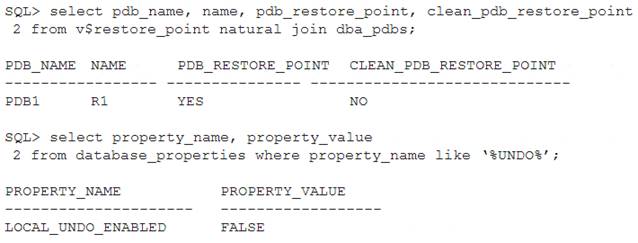
An online RMAN backup of the CDB was taken an hour before Restore Point R1 was created. You want to
recover PDB1 toRestore Point R1. How do you achieve this?
- A. Execute FLASHBACK PLUGGABLE DATABASE PDB1 TO RESTORE POINT R1 by using RMANwhile connected to PDB1.
- B. Execute FLASHBACK PLUGGABLE DATABASE PDB1 TO RESTORE POINT R1 by using SQLwhile connected to PDB1.
- C. Execute FLASHBACK PLUGGABLE DATABASE PDB1 TO RESTORE POINT R1 by using SQLwhile connected to CDB$ROOT.
- D. Execute FLASHBACK PLUGGABLE DATABASE PDB1 TO RESTORE POINT R1 by using RMANwhile connected to CDB$ROOT.
- E. This cannot be done due to the lack of aclean restore point.
Answer: B
NEW QUESTION 10
Which three are true about opatchauto? (Choose three.)
- A. It performs a shutdown and then a restart of all processes in both Oracle Grid Infrastructure and Oracle Database home during the patching process.
- B. It must be invoked by a user with root user privileges.
- C. Patches are appliedvia opatchauto.
- D. Users must always input patch plans to opatchauto.
- E. It requires the Oracle Grid Infrastructure and Oracle Database instances to be shut down before being invoked.
- F. It applies patches in nonrolling mode by default.
- G. It is used toapply interim patches to Oracle Grid Infrastructure and Oracle Database home combinations.
Answer: ABC
NEW QUESTION 11
Which two are true about RMAN backups when using a media manager to write backups to tape when there are only two tape drives? (Choose two.)
- A. SBT tape compression can be used even if no RMAN compression is configured.
- B. Any backup set written to the SBT device in this configuration can contain a maximum of two backup pieces.
- C. Any backup written to the SBT device in this configuration can contain a maximum of two backup sets.
- D. SBT tape compression and RMAN backup compression should be used in parallel.
- E. The SBT device should be configured to use PARALLELISM 2 to allow both tape drive to be used simultaneously.
Answer: DE
NEW QUESTION 12
Which three are true about upgrading Oracle Grid Infrastructure? (Choose three.)
- A. A direct upgrade can be performed only from the immediately preceding Oracle Grid Infrastructure version.
- B. The newer version is installed in a separate Oracle Grid Infrastructure home on the same server as the existing version.
- C. An existing Oracle base can be used.
- D. The upgrade process will automatically install all mandatory patches for the current version of Oracle Grid Infrastructure.
- E. Existing Oracle Database instances must be shut down before starting the upgrade.
- F. Only the grid user can perform the upgrade.
Answer: DEF
NEW QUESTION 13
Which two are true about Oracle Database Configuration Assistant (DBCA) templates? (Choose two.)
- A. The General Purpose of Transaction Processing templates are most suitable when concurrency and recoverability are key criteria.
- B. Oracle DBCA templates can store only logical structure and not database files.
- C. New templates can only be created by modifying an existing user-created template.
- D. The Data Warehouse template is most suitable when transaction response time is the key criterion.
- E. Oracle DBCAtemplates can be used to create new databases and duplicate existing databases.
Answer: AE
NEW QUESTION 14
Which two are true about Oracle Flashback features? (Choose two.)
- A. FLASHBACK QUERY can retrieve REDO records from ONLINE and ARCHIVED REDO LOG files.
- B. FLASHBACKVERSION QUERY can retrieve REDO records from ONLINE and ARCHIVED REDOLOG files.
- C. FLASHBACK TABLE can undrop a column.
- D. FLASHBACK DROP can undrop an index when undropping a table.
- E. After a database is restored from flashback logs using the FLASHBACKDATABASE command, it is sometimes rolled forward using redo logs.
Answer: DE
NEW QUESTION 15
Which three are located by using environment variables? (Choose three.)
- A. the Optimal Flexible Architecture (OFA) compliant path to storeOracle software and configuration files.
- B. the location of Oracle Net Services configuration files
- C. the list of a disk group names to be mounted by an Oracle Automatic Storage Management (ASM) instance at startup
- D. default directories for temporary files used by temporary tablespaces
- E. the temporary disk space used by Oracle Installer during installation
- F. the maximum number of database files that can be opened by a database instance
Answer: ABE
NEW QUESTION 16
Which three are true about Optimizer Statistics Advisor? (Choose three.)
- A. It can berun only manually.
- B. It is part of the DBMS_ADVISOR package.
- C. It can recommend changes to improve the statistics gathering process.
- D. It always analyzes all schemas in the database.
- E. It runs automatically every night by default.
- F. It is part of theDBMS_STATS package.
Answer: ACF
Explanation:
https://mikedietrichde.com/2017/08/22/oracle-optimizer-statistics-advisor-in-oracle-database-12-2-0-1/ https://www.oracle.com/technetwork/database/bi-datawarehousing/twp-bp-for-stats-gather-19c-5324205.pdf
NEW QUESTION 17
Which two are facets of performance planning that should always be considered or implemented for an Oracle Database environment? (Choose two.)
- A. defining primary keys for all tables to speed up all queries
- B. using check constraints to speed upupdates
- C. defining foreign keys for all tables to speed up joins
- D. the physical data model
- E. the configuration of storage arrays
Answer: AE
NEW QUESTION 18
Which three are true about Automatic Workload Repository (AWR), Automatic Database Diagnostic Monitor (ADDM), and the Manageability Monitor (MMON) background process? (Choose three.)
- A. ADDM can recommend shrinking the buffer cache.
- B. ADDM can recommend extending the buffer cache.
- C. By default, MMON creates an AWR snapshot every 30 minutes.
- D. ADDM performs itsanalysis only when a DBA requests it.
- E. By default, AWR snapshots are automatically purged after eight days.
- F. AWR snapshots must be deleted when no longer required by ADDM.
Answer: AEF
NEW QUESTION 19
Which three are true in Oracle 19c and later releases? (Choose three.)
- A. If the password file location changes, then the new location is used automatically by the Oracle Server.
- B. Schema Only accounts can be granted administrator privileges.
- C. All the Oracle-supplied accounts are Schema Only accounts.
- D. Privilege Analysis is included in Oracle Enterprise Edition and no longer requires Database Vault.
- E. Unified Auditing can be configured to audit only events that are issued indirectly by an audited user.
- F. Unified Auditing can be configured to audit only events that are issued directly by an audited user.
Answer: BCD
NEW QUESTION 20
......
100% Valid and Newest Version 1z0-083 Questions & Answers shared by Certleader, Get Full Dumps HERE: https://www.certleader.com/1z0-083-dumps.html (New 163 Q&As)
