
we provide Real CompTIA CS0-003 test question which are the best for clearing CS0-003 test, and to get certified by CompTIA CompTIA CySA+ Certification Beta Exam. The CS0-003 Questions & Answers covers all the knowledge points of the real CS0-003 exam. Crack your CompTIA CS0-003 Exam with latest dumps, guaranteed!
Free CS0-003 Demo Online For CompTIA Certifitcation:
NEW QUESTION 1
Which of the following does "federation" most likely refer to within the context of identity and access management?
- A. Facilitating groups of users in a similar function or profile to system access that requires elevated or conditional access
- B. An authentication mechanism that allows a user to utilize one set of credentials to access multiple domains
- C. Utilizing a combination of what you know, who you are, and what you have to grant authentication to a user
- D. Correlating one's identity with the attributes and associated applications the user has access to
Answer: B
Explanation:
Federation is a system of trust between two parties for the purpose of authenticating users and conveying information needed to authorize their access to resources. By using federation, a user can use one set of credentials to access multiple domains that trust each other.
NEW QUESTION 2
Which of the following items should be included in a vulnerability scan report? (Choose two.)
- A. Lessons learned
- B. Service-level agreement
- C. Playbook
- D. Affected hosts
- E. Risk score
- F. Education plan
Answer: DE
Explanation:
A vulnerability scan report should include information about the affected hosts, such as their IP addresses, hostnames, operating systems, and services. It should also include a risk score for each vulnerability, which indicates the severity and potential impact of the vulnerability on the host and the organization. Official References: https://www.first.org/cvss/
NEW QUESTION 3
An organization conducted a web application vulnerability assessment against the corporate website, and the following output was observed: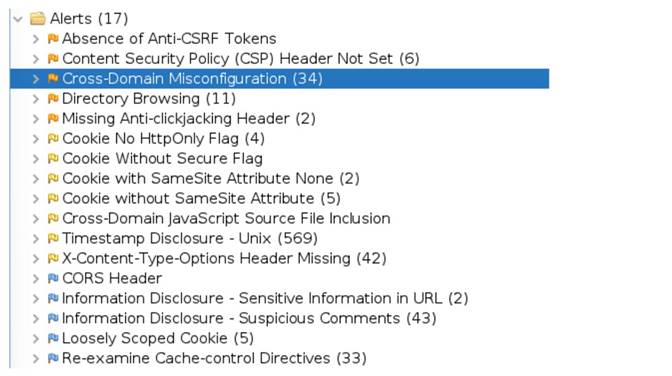
Which of the following tuning recommendations should the security analyst share?
- A. Set an Http Only flag to force communication by HTTPS.
- B. Block requests without an X-Frame-Options header.
- C. Configure an Access-Control-Allow-Origin header to authorized domains.
- D. Disable the cross-origin resource sharing header.
Answer: C
Explanation:
The output shows that the web application has a cross-origin resource sharing (CORS) header that allows any origin to access its resources. This is a security misconfiguration that could allow malicious websites to make requests to the web application on behalf of the user and access sensitive data or perform unauthorized actions. The tuning recommendation is to configure the Access-Control-Allow-Origin header to only allow authorized domains that need to access the web application’s resources. This would prevent unauthorized cross-origin requests and reduce the risk of cross-site request forgery (CSRF) attacks.
Reference: OWASP Top Ten | OWASP Foundation
NEW QUESTION 4
Which of the following techniques can help a SOC team to reduce the number of alerts related to the internal security activities that the analysts have to triage?
- A. Enrich the SIEM-ingested data to include all data required for triage.
- B. Schedule a task to disable alerting when vulnerability scans are executing.
- C. Filter all alarms in the SIEM with low severity.
- D. Add a SOAR rule to drop irrelevant and duplicated notifications.
Answer: B
NEW QUESTION 5
The management team requests monthly KPI reports on the company's cybersecurity program. Which of the following KPIs would identify how long a security threat goes unnoticed in the environment?
- A. Employee turnover
- B. Intrusion attempts
- C. Mean time to detect
- D. Level of preparedness
Answer: C
Explanation:
Mean time to detect (MTTD) is a metric that measures the average time it takes for an organization to discover or detect an incident. It is a key performance indicator in incident management and a measure of incident response capabilities. A low MTTD indicates that the organization can quickly identify security threats and minimize their impact12.
References: What Is MTTD (Mean Time to Detect)? A Detailed Explanation, Introduction to MTTD: Mean Time to Detect
NEW QUESTION 6
An analyst receives threat intelligence regarding potential attacks from an actor with seemingly unlimited time and resources. Which of the following best describes the threat actor attributed to the malicious activity?
- A. Insider threat
- B. Ransomware group
- C. Nation-state
- D. Organized crime
Answer: C
NEW QUESTION 7
A virtual web server in a server pool was infected with malware after an analyst used the internet to research a system issue. After the server was rebuilt and added back into the server pool, users reported issues with the website, indicating the site could not be trusted. Which of the following is the most likely cause of the server issue?
- A. The server was configured to use SSI- to securely transmit data
- B. The server was supporting weak TLS protocols for client connections.
- C. The malware infected all the web servers in the pool.
- D. The digital certificate on the web server was self-signed
Answer: D
Explanation:
A digital certificate is a document that contains the public key and identity information of a web server, and is signed by a trusted third-party authority called a certificate authority (CA). A digital certificate allows the web server to establish a secure connection with the clients using the HTTPS protocol, and also verifies the authenticity of the web server. A self-signed certificate is a digital certificate that is not signed by a CA, but by the web server itself. A self-signed certificate can cause issues with the website, as it may not be trusted by the clients or their browsers. Clients may receive warnings or errors when trying to access the website, indicating that the site could not be trusted or that the connection is not secure. Official References:
✑ https://www.comptia.org/blog/the-new-comptia-cybersecurity-analyst-your-questions-answered
✑ https://partners.comptia.org/docs/default-source/resources/comptia-cysa-cs0-002- exam-objectives
✑ https://www.techtarget.com/searchsecurity/quiz/Sample-CompTIA-CySA-test- questions-with-answers
NEW QUESTION 8
An analyst is suddenly unable to enrich data from the firewall. However, the other open intelligence feeds continue to work. Which of the following is the most likely reason the firewall feed stopped working?
- A. The firewall service account was locked out.
- B. The firewall was using a paid feed.
- C. The firewall certificate expired.
- D. The firewall failed open.
Answer: C
Explanation:
The firewall certificate expired. If the firewall uses a certificate to authenticate and encrypt the feed, and the certificate expires, the feed will stop working until the certificate is renewed or replaced. This can affect the data enrichment process and the security analysis. References: CompTIA CySA+ Study Guide: Exam CS0-003, 3rd Edition, Chapter 4: Security Operations and Monitoring, page 161.
NEW QUESTION 9
Which of the following describes how a CSIRT lead determines who should be communicated with and when during a security incident?
- A. The lead should review what is documented in the incident response policy or plan
- B. Management level members of the CSIRT should make that decision
- C. The lead has the authority to decide who to communicate with at any time
- D. Subject matter experts on the team should communicate with others within the specified area of expertise
Answer: A
Explanation:
The incident response policy or plan is a document that defines the roles and responsibilities, procedures and processes, communication and escalation protocols, and reporting and documentation requirements for handling security incidents. The lead should review what is documented in the incident response policy or plan to determine who should be communicated with and when during a security incident, as well as what information should be shared and how. The incident response policy or plan should also be aligned with the organizational policies and legal obligations regarding incident notification and disclosure.
NEW QUESTION 10
A systems administrator receives reports of an internet-accessible Linux server that is running very sluggishly. The administrator examines the server, sees a high amount of memory utilization, and suspects a DoS attack related to half-open TCP sessions consuming memory. Which of the following tools would best help to prove whether this server was experiencing this behavior?
- A. Nmap
- B. TCPDump
- C. SIEM
- D. EDR
Answer: B
Explanation:
TCPDump is the best tool to prove whether the server was experiencing a DoS attack related to half-open TCP sessions consuming memory. TCPDump is a command-line tool that can capture and analyze network traffic, such as TCP, UDP, and ICMP packets. TCPDump can help the administrator to identify the source and destination of the traffic, the TCP flags and sequence numbers, the packet size and frequency, and other information that can indicate a DoS attack. A DoS attack related to half-open TCP sessions is also known as a SYN flood attack, which is a type of volumetric attack that aims to exhaust the network bandwidth or resources of the target server by sending a large amount of TCP SYN requests and ignoring the TCP SYN-ACK responses. This creates a backlog of half-open connections on the server, which consume memory and CPU resources, and prevent legitimate connections from being established12. TCPDump can help the administrator to detect a SYN flood attack by looking for a high number of TCP SYN packets with different source IP addresses, a low number of TCP SYN-ACK packets, and a very low number of TCP ACK packets34. References: SYN flood DDoS attack | Cloudflare, What is a SYN flood attack and how to prevent it? | NETSCOUT, TCPDump - A Powerful Tool for Network Analysis and Security, How to Detect a SYN Flood Attack with TCPDump
NEW QUESTION 11
While reviewing web server logs, a security analyst found the following line:
<IMG SRC=’vbscript:msgbox("test")’>
Which of the following malicious activities was attempted?
- A. Command injection
- B. XML injection
- C. Server-side request forgery
- D. Cross-site scripting
Answer: D
Explanation:
XSS is a type of web application attack that exploits the vulnerability of a web server or browser to execute malicious scripts or commands on the client-side. XSS attackers inject malicious code, such as JavaScript, VBScript, HTML, or CSS, into a web page or application that is viewed by other users. The malicious code can then access or manipulate the user’s session, cookies, browser history, or personal information, or perform actions on behalf of the user, such as stealing credentials, redirecting to phishing sites, or installing malware12
The line in the web server log shows an example of an XSS attack using VBScript. The attacker tried to insert an <IMG> tag with a malicious SRC attribute that contains a VBScript code. The VBScript code is intended to display a message box with the text “test” when the user views the web page or application. This is a simple and harmless example of XSS, but it could be used to test the vulnerability of the web server or browser, or to launch more sophisticated and harmful attacks3
NEW QUESTION 12
A security analyst recently used Arachni to perform a vulnerability assessment of a newly developed web application. The analyst is concerned about the following output:
[+] XSS: In form input 'txtSearch' with action https://localhost/search.aspx [-] XSS: Analyzing response #1...
[-] XSS: Analyzing response #2... [-] XSS: Analyzing response #3...
[+] XSS: Response is tainted. Looking for proof of the vulnerability. Which of the following is the most likely reason for this vulnerability?
- A. The developer set input validation protection on the specific field of search.aspx.
- B. The developer did not set proper cross-site scripting protections in the header.
- C. The developer did not implement default protections in the web application build.
- D. The developer did not set proper cross-site request forgery protections.
Answer: B
Explanation:
The most likely reason for this vulnerability is B. The developer did not set proper cross-site scripting protections in the header. Cross-site scripting (XSS) is a type of web application vulnerability that allows an attacker to inject malicious code into a web page that is viewed by other users. XSS can be used to steal cookies, session tokens, credentials, or other sensitive information, or to perform actions on behalf of the victim1.
One of the common ways to prevent XSS attacks is to set proper HTTP response headers that instruct the browser how to handle the content of the web page. For example, the
Content-Type header can specify the MIME type and character encoding of the web page, which can help the browser avoid interpreting data as code. The X-XSS-Protection header can enable or disable the browser’s built-in XSS filter, which can block or sanitize suspicious scripts. The Content-Security-Policy header can define a whitelist of sources and directives that control what resources and scripts can be loaded or executed on the web page2.
According to the output of Arachni, a web application security scanner framework3, it detected an XSS vulnerability in the form input ‘txtSearch’ with action https://localhost/search.aspx. This means that Arachni was able to inject a malicious script into the input field and observe its execution in the response. This indicates that the developer did not set proper cross-site scripting protections in the header of search.aspx, which allowed Arachni to bypass the browser’s default security mechanisms and execute arbitrary code on the web page.
NEW QUESTION 13
A SOC manager receives a phone call from an upset customer. The customer received a vulnerability report two hours ago: but the report did not have a follow-up remediation response from an analyst. Which of the following documents should the SOC manager review to ensure the team is meeting the appropriate contractual obligations for the customer?
- A. SLA
- B. MOU
- C. NDA
- D. Limitation of liability
Answer: A
Explanation:
SLA stands for service level agreement, which is a contract or document that defines the expectations and obligations between a service provider and a customer regarding the quality, availability, performance, or scope of a service. An SLA may also specify the metrics, penalties, or remedies for measuring or ensuring compliance with the agreed service levels. An SLA can help the SOC manager review if the team is meeting the appropriate contractual obligations for the customer, such as response time, resolution time, reporting frequency, or communication channels.
NEW QUESTION 14
An older CVE with a vulnerability score of 7.1 was elevated to a score of 9.8 due to a widely available exploit being used to deliver ransomware. Which of the following factors would an analyst most likely communicate as the reason for this escalation?
- A. Scope
- B. Weaponization
- C. CVSS
- D. Asset value
Answer: B
Explanation:
Weaponization is a factor that describes how an adversary develops or acquires an exploit or payload that can take advantage of a vulnerability and deliver a malicious effect. Weaponization can increase the severity or impact of a vulnerability, as it makes it easier or more likely for an attacker to exploit it successfully and cause damage or harm. Weaponization can also indicate the level of sophistication or motivation of an attacker, as well as the availability or popularity of an exploit or payload in the cyber threat landscape. In this case, an older CVE with a vulnerability score of 7.1 was elevated to a score of 9.8 due to a widely available exploit being used to deliver ransomware. This indicates that weaponization was the reason for this escalation.
NEW QUESTION 15
Which of the following risk management principles is accomplished by purchasing cyber insurance?
- A. Accept
- B. Avoid
- C. Mitigate
- D. Transfer
Answer: D
Explanation:
Transfer is the risk management principle that is accomplished by purchasing cyber insurance. Transfer is a strategy that involves shifting the risk or its consequences to another party, such as an insurance company, a vendor, or a partner. Transfer does not eliminate the risk, but it reduces the potential impact or liability of the risk for the original party. Cyber insurance is a type of insurance that covers the losses and damages resulting from cyberattacks, such as data breaches, ransomware, denial-of-service attacks, or network disruptions. Cyber insurance can help transfer the risk of cyber incidents by providing financial compensation, legal assistance, or recovery services to the insured party. Official References:
✑ https://partners.comptia.org/docs/default-source/resources/comptia-cysa-cs0-002-exam-objectives
✑ https://www.comptia.org/certifications/cybersecurity-analyst
✑ https://www.comptia.org/blog/the-new-comptia-cybersecurity-analyst-your- questions-answered
NEW QUESTION 16
Each time a vulnerability assessment team shares the regular report with other teams, inconsistencies regarding versions and patches in the existing infrastructure are discovered. Which of the following is the best solution to decrease the inconsistencies?
- A. Implementing credentialed scanning
- B. Changing from a passive to an active scanning approach
- C. Implementing a central place to manage IT assets
- D. Performing agentless scanning
Answer: C
Explanation:
Implementing a central place to manage IT assets is the best solution to decrease the inconsistencies regarding versions and patches in the existing infrastructure. A central place to manage IT assets, such as a configuration management database (CMDB), can help the vulnerability assessment team to have an accurate and up-to-date inventory of all the hardware and software components in the network, as well as their relationships and dependencies. A CMDB can also track the changes and updates made to the IT assets, and provide a single source of truth for the vulnerability assessment team and other teams to compare and verify the versions and patches of the infrastructure12. Implementing credentialed scanning, changing from a passive to an active scanning approach, and performing agentless scanning are all methods to improve the vulnerability scanning process, but they do not address the root cause of the inconsistencies, which is the lack of a central place to manage IT assets3. References: What is a Configuration Management Database (CMDB)?, How to Use a CMDB to Improve Vulnerability Management, Vulnerability Scanning Best Practices
NEW QUESTION 17
......
P.S. Dumps-hub.com now are offering 100% pass ensure CS0-003 dumps! All CS0-003 exam questions have been updated with correct answers: https://www.dumps-hub.com/CS0-003-dumps.html (150 New Questions)
