
Want to know Examcollection MD-102 Exam practice test features? Want to lear more about Microsoft Endpoint Administrator certification experience? Study Certified Microsoft MD-102 answers to Renew MD-102 questions at Examcollection. Gat a success with an absolute guarantee to pass Microsoft MD-102 (Endpoint Administrator) test on your first attempt.
Online MD-102 free questions and answers of New Version:
NEW QUESTION 1
You have a computer named Computed that has Windows 10 installed. You create a Windows PowerShell script named config.psl.
You need to ensure that config.psl runs after feature updates are installed on Computer5. Which file should you modify on Computer5?
- A. LiteTouch.wsf
- B. SetupConfig.ini
- C. Unattendb*
- D. Unattend.xml
Answer: B
Explanation:
SetupConfig.ini is a file that can be used to customize the behavior of Windows Setup during feature updates. You can use this file to specify commands or scripts that run before or after the installation process. To run a PowerShell script after a feature update, you can use the PostOOBE parameter in SetupConfig.ini and specify the path to the script file. References: [SetupConfig.ini reference]
NEW QUESTION 2
You have a Microsoft Deployment Toolkit (MDT) deployment share.
From the Deployment Workbench, you open the New Task Sequence Wizard and select the Standard Client Upgrade Task Sequence task sequence template.
You discover that there are no operating system images listed on the Select OS page as shown in the following exhibit.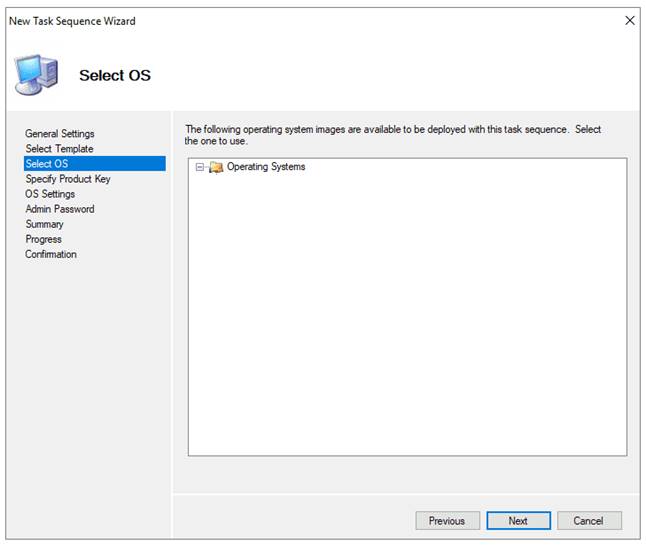
You need to be able to select an operating system image to perform a Windows 11 in-place upgrade. What should you do?
- A. Enable monitoring for the deployment share.
- B. Import a full set of source files.
- C. Import a custom image file.
- D. Run the Update Deployment Share Wizard
Answer: D
NEW QUESTION 3
You have a Microsoft 365 subscription.
All users have Microsoft 365 apps deployed.
You need to configure Microsoft 365 apps to meet the following requirements:
• Enable the automatic installation of WebView2 Runtime.
• Prevent users from submitting feedback.
Which two settings should you configure in the Microsoft 365 Apps admin center? To answer, select the appropriate settings in the answer area.
NOTE: Each correct selection is worth one point.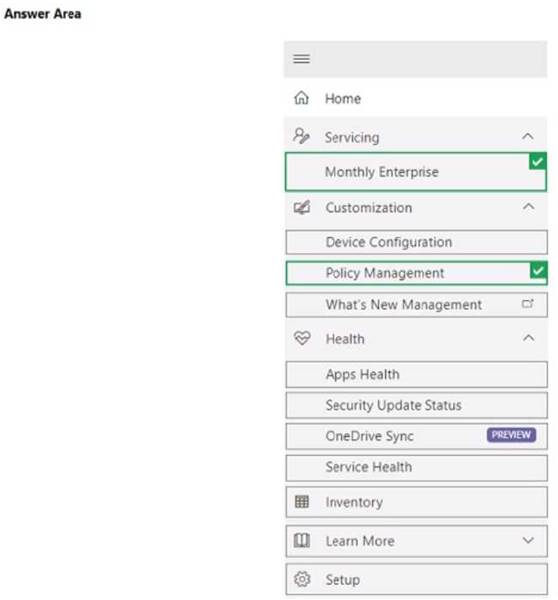
Solution:
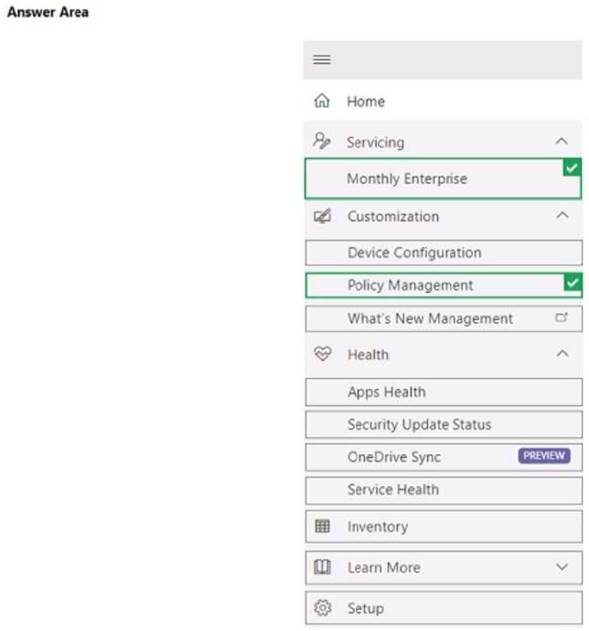
Does this meet the goal?
- A. Yes
- B. Not Mastered
Answer: A
NEW QUESTION 4
You have an Azure AD tenant named contoso.com that contains the devices shown in the following table.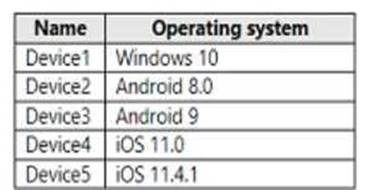
AH devices contain an app named App1 and are enrolled in Microsoft Intune.
You need to prevent users from copying data from App1 and pasting the data into other apps.
Which type of policy and how many policies should you create in Intune? To answer, select the appropriate options in the answer area.
NOTE: Each correct selection is worth one point.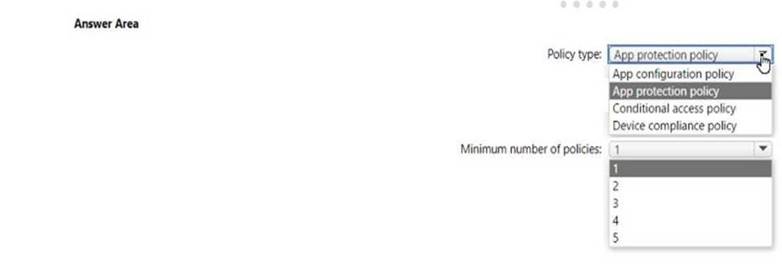
Solution:
of Corre Answer Only: The correct answer is app protection policy because it allows you to customize the settings of apps for iOS/iPadOS or Android devices1. One of the settings you can configure is Restrict cut, copy, and paste between other apps, which lets you prevent users from copying data from App1 and pasting the data into other apps2. You only need one policy to apply this setting to all devices that have App1 installe1d.
References: 1: App configuration policies for Microsoft Intune | Microsoft Learn https://learn.microsoft.com/en-us/mem/intune/apps/app-configuration-policies-overview 2: Troubleshoot restricting cut, copy, and paste between applications - Intune | Microsoft Learn
https://learn.microsoft.com/en-us/troubleshoot/mem/intune/app-protection-policies/troubleshoot-cut-copy-paste
Does this meet the goal?
- A. Yes
- B. Not Mastered
Answer: A
NEW QUESTION 5
You have a Microsoft 365 subscription that uses Microsoft Intune Suite. You use Microsoft Intune to manage devices.
You plan to deploy two apps named App1 and App2 to all Windows devices. App1 must be installed before App2.
From the Intune admin center, you create and deploy two Windows app (Win32) apps. You need to ensure that App1 is installed before App2 on every device.
What should you configure?
- A. the App1 deployment configurations
- B. a dynamic device group
- C. a detection rule
- D. the App2 deployment configurations
Answer: C
Explanation:
The correct answer is D because you can configure the dependencies for a Win32 app in the deployment configurations1. Dependencies are other Win32 apps that must be installed before your Win32 app can be installed1. You can add Win32 app dependencies only after your Win32 app has been added and uploaded to Intune2. In this case, you need to configure the App2 deployment configurations to add App1 as a dependency 2. References: 1: Microsoft Intune Win32 App Dependencies - MSEndpointMgr https://msendpointmgr.com/2019/06/03/new-intune-feature-win32-app-dependencies/ 2: Add and assign Win32 apps to Microsoft Intune | Microsoft Learn
https://learn.microsoft.com/en-us/mem/intune/apps/apps-win32-add
NEW QUESTION 6
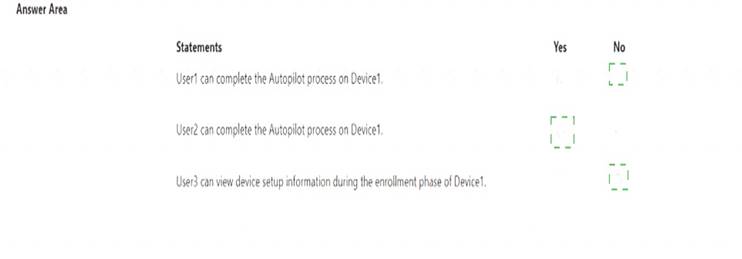
You have a Microsoft 365 subscription that uses Microsoft Intune and contains the users shown in the following table.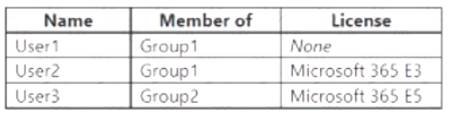
Group2 has been assigned in the Enrollment Status Page. You have the devices shown in the following table.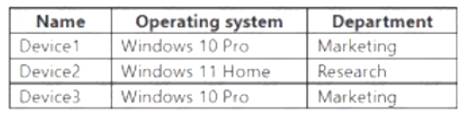
You capture and upload the hardware IDs of the devices in the marketing department. You configure Windows Autopilot.
For each of the following statements, select Yes if the statement is true. Otherwise select No. NOTE: Each correct selection is worth one point.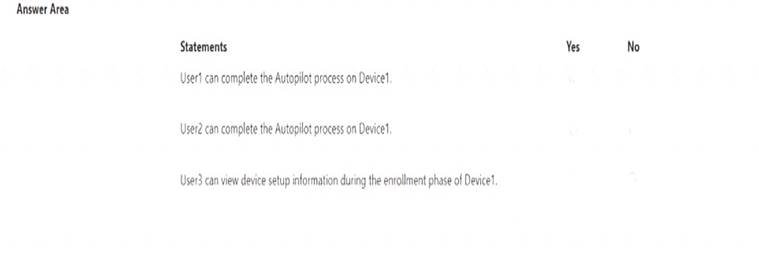
Solution:
Does this meet the goal?
- A. Yes
- B. Not Mastered
Answer: A
NEW QUESTION 7
You have a Microsoft 365 subscription that uses Microsoft Intune Suite. You use Microsoft Intune to manage devices.
Auto-enrollment in Intune is configured.
You have 100 Windows 11 devices in a workgroup.
You need to connect the devices to the corporate wireless network and enroll 100 new Windows devices in Intune.
What should you use?
- A. a provisioning package
- B. a Group Policy Object (GPO)
- C. mobile device management (MDM) automatic enrollment
- D. a device configuration policy
Answer: C
NEW QUESTION 8
You have a Microsoft 365 subscription that uses Microsoft Intune Suite. You use Microsoft Intune to manage devices. Azure AD joined Windows devices enroll automatically in Intune. You have the devices shown in the following table.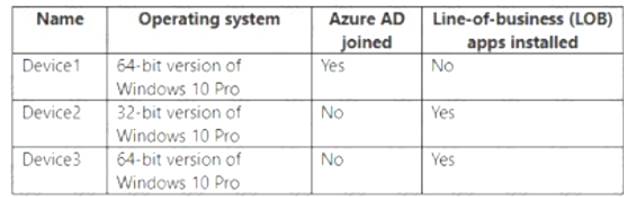
You are preparing to upgrade the devices to Windows 11. All the devices are compatible with Windows 11. You need to evaluate Windows Autopilot and in-place upgrade as deployment methods to implement
Windows 11 Pro on the devices, while retaining all user settings and applications.
Which devices can be upgraded by using each method? To answer, select the appropriate options in the answer area.
NOTE: Each correct selection is worth one point.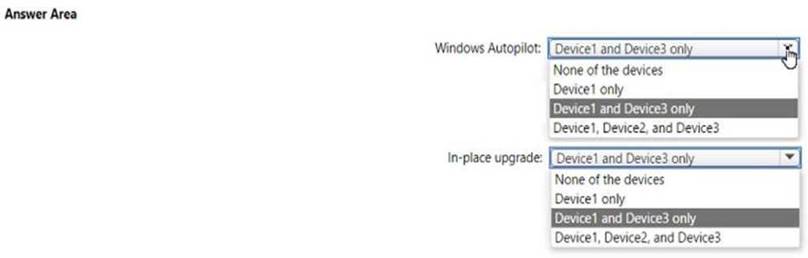
Solution:
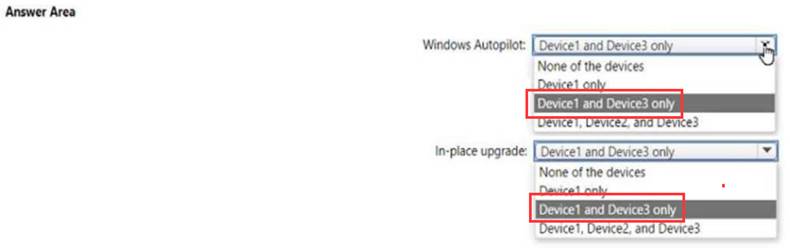
Does this meet the goal?
- A. Yes
- B. Not Mastered
Answer: A
NEW QUESTION 9
You use Microsoft Intune and Intune Data Warehouse.
You need to create a device inventory report that includes the data stored in the data warehouse. What should you use to create the report?
- A. the Azure portal app
- B. Endpoint analytics
- C. the Company Portal app
- D. Microsoft Power Bl
Answer: D
Explanation:
You can use the Power BI Compliance app to load interactive, dynamically generated reports for your Intune tenant. Additionally, you can load your tenant data in Power BI using the OData link. Intune provides connection settings to your tenant so that you can view the following sample reports and charts related to:
Devices Enrollment
App protection policy Compliance policy
Device configuration profiles Software updates
Device inventory logs
Note: Load the data in Power BI using the OData link
With a client authenticated to Azure AD, the OData URL connects to the RESTful endpoint in the Data Warehouse API that exposes the data model to your reporting client. Follow these instructions to use Power BI Desktop to connect and create your own reports. Sign in to the Microsoft Endpoint Manager admin center.
 Select Reports > Intune Data warehouse > Data warehouse. Retrieve the custom feed URL from the reporting blade, for example:
 Open Power BI Desktop. Choose File > Get Data. Select OData feed. Choose Basic. Type or paste the OData URL into the URL box. Select OK. If you have not authenticated to Azure AD for your tenant from the Power BI desktop client, type your credentials. To gain access to your data, you must authorize with Azure Active Directory (Azure AD) using OAuth 2.0. Select Organizational account. Type your username and password. Select Sign In. Select Connect. Select Load.
Reference: https://docs.microsoft.com/en-us/mem/intune/developer/reports-proc-get-a-link-powerbi
NEW QUESTION 10
Your network contains an Active Directory domain named adatum.com. The domain contains two computers named Computer1 and Computer2 that run Windows 10. Remote Desktop is enabled on Computer2.
The domain contains the user accounts shown in the following table.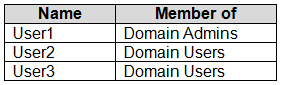
Computer2 contains the local groups shown in the following table.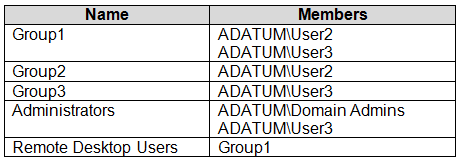
The relevant user rights assignments for Computed are shown in the following table.
For each of the following statements, select Yes if the statement is true. Otherwise, select No. NOTE: Each correct selection is worth one point.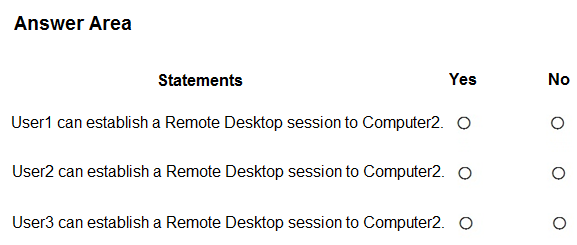
Solution:
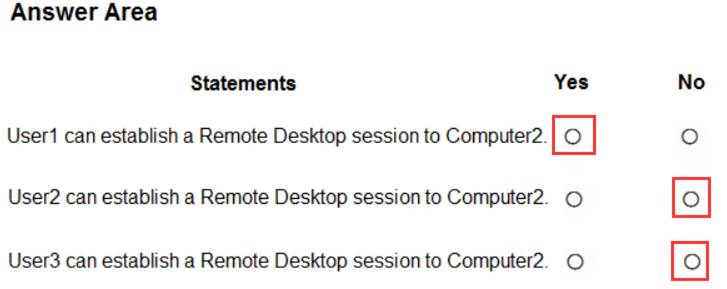
Does this meet the goal?
- A. Yes
- B. Not Mastered
Answer: A
NEW QUESTION 11
You have a Microsoft 365 subscription.
All computers are enrolled in Microsoft Intune.
You have business requirements for securing your Windows 11 environment as shown in the following table.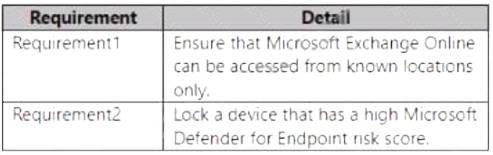
What should you implement to meet each requirement? To answer, select the appropriate options in the answer area. NOTE: Each correct selection is worth one point.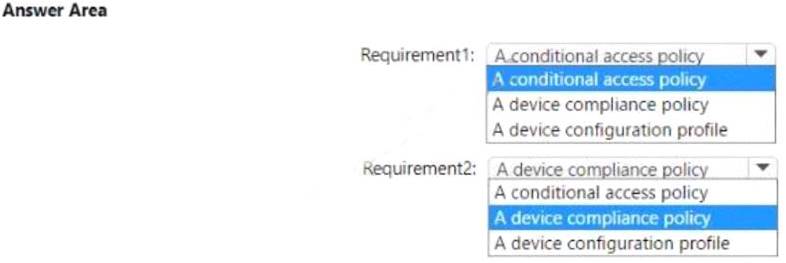
Solution:
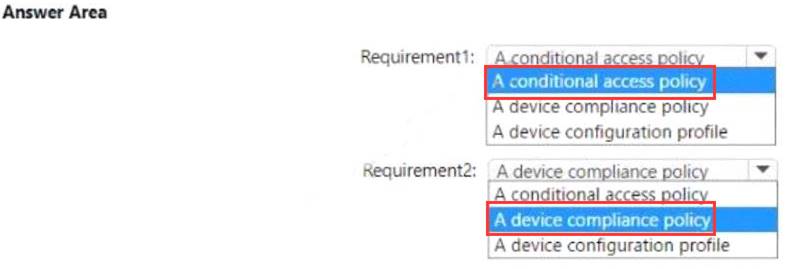
Does this meet the goal?
- A. Yes
- B. Not Mastered
Answer: A
NEW QUESTION 12
You have computer that run Windows 10 and connect to an Azure Log Analytics workspace. The workspace is configured to collect all available events from Windows event logs. The computers have the logged events shown in the following table.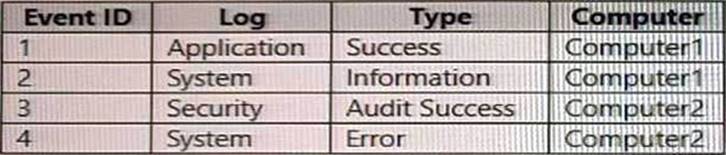
Which events are collected in the Log Analytics workspace?
- A. 1 only
- B. 2 and 3 only
- C. 1 and 3 only
- D. 1, 2, and 4 on
- E. 1, 2, 3, and 4
Answer: E
Explanation:
All events from Windows event logs are collected in the Log Analytics workspace, regardless of the event level or source. Therefore, events 1, 2, 3, and 4 are all collected in the workspace. References: https://docs.microsoft.com/en-us/azure/azure-monitor/agents/data-sources-windows-events
NEW QUESTION 13
You have a Microsoft 365 subscription that uses Microsoft Intune and contains the users shown in the following table.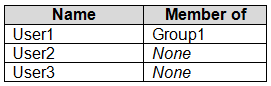
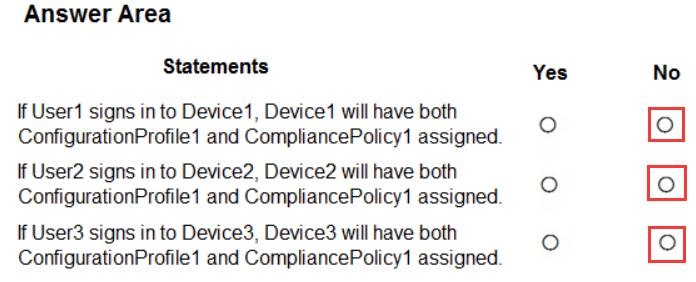
You create a policy set named Set1 as shown in the exhibit. (Click the Exhibit tab.) 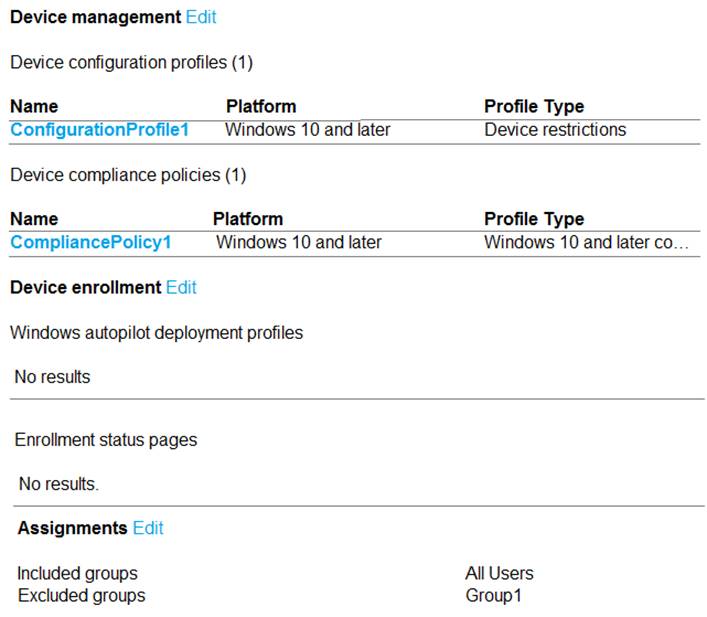
You enroll devices in Intune as shown in the following table.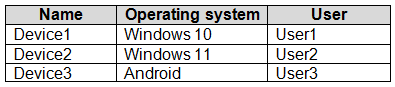
For each of the following statements, select Yes if the statement is true. Otherwise, select No. NOTE: Each correct selection is worth one point.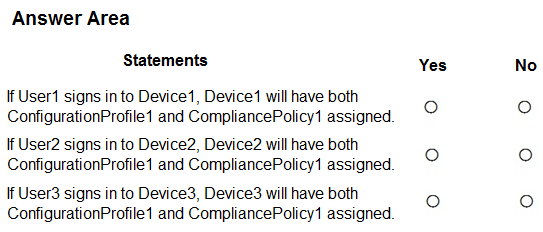
Solution:
Does this meet the goal?
- A. Yes
- B. Not Mastered
Answer: A
NEW QUESTION 14
You have a Microsoft 365 E5 subscription and 100 unmanaged iPad devices.
You need to deploy a specific iOS update to the devices. Users must be prevented from manually installing a more recent version of iOS.
Which two actions should you perform? Each correct answer presents part of the solution. NOTE: Each correct selection is worth one point.
- A. Enroll the devices in Microsoft Intune by using the Intune Company Portal.
- B. Create a compliance policy.
- C. Enroll the devices in Microsoft Intune by using Apple Business Manager.
- D. Create an iOS app provisioning profile.
- E. Create a device configuration profile.
Answer: CE
Explanation:
To deploy a specific iOS update to the unmanaged iPad devices, you need to perform the following actions: Enroll the devices in Microsoft Intune by using Apple Business Manager. Apple Business Manager is a service that allows you to enroll and manage iOS/iPadOS devices in bulk. You can use Apple Business Manager to assign devices to Microsoft Intune and enroll them as supervised devices. Supervised devices are devices that have more management features and restrictions than unsupervised
devices. You can also use Apple Business Manager to create device groups and assign roles and permissions12. Create a device configuration profile. A device configuration profile is a policy that you can create and assign in Microsoft Intune to configure settings on your devices. You can use a device configuration profile to manage software updates for iOS/iPadOS supervised devices. You can choose to deploy the latest update or an older update, specify a schedule for the update installation, and delay the visibility of software updates on the devices34.
The other options are not correct for this scenario because: Enrolling the devices in Microsoft Intune by using the Intune Company Portal is not suitable for unmanaged devices. The Intune Company Portal is an app that users can download and install on their personal or corporate-owned devices to enroll them in Microsoft Intune. However, this method requires user interaction and consent, and does not enroll the devices as supervised devices5. Creating a compliance policy is not necessary for this scenario. A compliance policy is a policy that you can create and assign in Microsoft Intune to evaluate and enforce compliance settings on your devices. You can use a compliance policy to check if the devices meet certain requirements, such as minimum
OS version, encryption, or password settings. However, a compliance policy does not deploy or manage software updates on the devices6. Creating an iOS app provisioning profile is not relevant for this scenario. An iOS app provisioning profile is a file that contains information about the app and its distribution method. You can use an iOS app provisioning profile to deploy custom or line-of-business apps to your iOS/iPadOS devices by using Microsoft Intune. However, an iOS app provisioning profile does not affect the software updates on the devices7.
References: What is Apple Business Manager?, Enroll iOS/iPadOS devices in Intune, Manage iOS/iPadOS software update policies in Intune, Software updates planning guide and scenarios for supervised iOS/iPadOS devices in Microsoft Intune, Enroll your personal device in Intune, Device compliance policies in Microsoft Intune, Add an iOS app provisioning profile with Microsoft Intune
NEW QUESTION 15
You have a Microsoft 365 E5 subscription that contains 100 iOS devices enrolled in Microsoft Intune. You need to ensure that notifications of iOS updates are deferred for 30 days after the updates are released. What should you create?
- A. a device configuration profile based on the Device features template
- B. a device configuration profile based on the Device restrictions template
- C. an update policy for iOS/iPadOS
- D. an iOS app provisioning profile
Answer: C
Explanation:
Manage iOS/iPadOS software update policies in Intune, delay visibility of software updates.
When you use update policies for iOS, you might have need to delay visibility of an iOS software update. Reasons to delay visibility include:
Prevent users from updating the OS manually
To deploy an older update while preventing users from installing a more recent one
To delay visibility, deploy a device restriction template that configures the following settings: Defer software updates = Yes
This doesn't affect any scheduled updates. It represents days before software updates are visible to end users after release.
Delay default visibility of software updates = 1 to 90 90 days is the maximum delay that Apple supports.
Reference: https://docs.microsoft.com/en-us/mem/intune/protect/software-updates-ios
NEW QUESTION 16
You have a Microsoft 365 subscription that contains 100 devices enrolled in Microsoft Intune. You need to review the startup processes and how often each device restarts.
What should you use?
- A. Endpoint analytics
- B. Intune Data Warehouse
- C. Azure Monitor
- D. Device Management
Answer: B
NEW QUESTION 17
......
100% Valid and Newest Version MD-102 Questions & Answers shared by Certshared, Get Full Dumps HERE: https://www.certshared.com/exam/MD-102/ (New 98 Q&As)
