
It is more faster and easier to pass the ISC2 SSCP exam by using Virtual ISC2 System Security Certified Practitioner (SSCP) questuins and answers. Immediate access to the Regenerate SSCP Exam and find the same core area SSCP questions with professionally verified answers, then PASS your exam with a high score now.
ISC2 SSCP Free Dumps Questions Online, Read and Test Now.
NEW QUESTION 1
What is the main characteristic of a multi-homed host?
- A. It is placed between two routers or firewalls.
- B. It allows IP routing.
- C. It has multiple network interfaces, each connected to separate networks.
- D. It operates at multiple layers.
Answer: C
Explanation:
The main characteristic of a multi-homed host is that is has multiple network interfaces, each connected to logically and physically separate networks. IP routing should be disabled to prevent the firewall from routing packets directly from one interface to the other.
Source: FERREL, Robert G, Questions and Answers for the CISSP Exam, domain 2 (derived from the Information Security Management Handbook, 4th Ed., by Tipton & Krause).
NEW QUESTION 2
FTP, TFTP, SNMP, and SMTP are provided at what level of the Open Systems Interconnect (OSI) Reference Model?
- A. Application
- B. Network
- C. Presentation
- D. Transport
Answer: A
Explanation:
The Answer Application. The Layer 7 Application Layer of the Open Systems Interconnect (OSI) Reference Model is a service for applications and Operating Systems data transmission, for example FTP, TFTP, SNMP, and SMTP.
The following answers are incorrect:
Network. The Network layer moves information between hosts that are not physically connected. It deals with routing of information. IP is a protocol that is used in Network Layer. FTP, TFTP, SNMP, and SMTP do not reside at the Layer 3 Network Layer in the OSI Reference Model.
Presentation. The Presentation Layer is concerned with the formatting of data into a standard presentation such as
ASCII. FTP, TFTP, SNMP, and SMTP do not reside at the Layer 6 Presentation Layer in the OSI Reference Model.
Transport. The Transport Layer creates an end-to-end transportation between peer hosts. The transmission can be connectionless and unreliable such as UDP, or connection- oriented and ensure error-free delivery such as TCP. FTP, TFTP, SNMP, and SMTP do not reside at the Layer 4 Transportation Layer in the OSI Reference Model.
The following reference(s) were/was used to create this question: Reference: OSI/ISO. Shon Harris AIO v.3 p. 420-421
ISC2 OIG, 2997 p.412-413
NEW QUESTION 3
What protocol is used to match an IP address to the appropriate hardware address of the packet's destination so it can be sent?
- A. Routing tables
- B. Address resolution protocol (ARP)
- C. Reverse address resolution protocol (RARP)
- D. Internet Control Message Protocol (ICMP)
Answer: B
Explanation:
The Address Resolution Protocol (ARP) is used to match an IP address to an Ethernet address so the packet can be sent to the appropriate node.
Shon Harris in her book says:
MAC and IP addresses must be properly mapped so they can be correctly resolved. This happens through the Address Resolution Protocol (ARP). When the data link layer receives a frame, the network layer has already attached the destination IP address to it, but the data link layer cannot understand the IP address and thus invokes ARP for help.
ARP broadcasts a frame requesting the MAC address that corresponds with the destination IP address. Each computer on the subnet receives this broadcast frame, and all but the computer that has the requested IP address ignore it.
The computer that has the destination IP address responds with its MAC address. Now ARP knows what hardware address corresponds with that specific IP address. The data link layer takes the frame, adds the hardware address to it, and passes it on to the physical layer, which enables the frame to hit the wire and go to the destination computer.
ARP maps the hardware address and associated IP address and stores this mapping in its table for a predefined amount of time. This caching is done so that when another frame destined for the same IP address needs to hit the wire, ARP does not need to broadcast its request again. It just looks in its table for this information.
Man-In-The-Middle attack
Because ARP does not require authentication, an attacker could place bogus entries into the ARP cache of a remote host (gratuitous ARP replies) to carry out attacks, such as a man-in-the-middle attacks. This attack is called ARP poisoning.
The following answers were incorrect:
RARP is used to match an Ethernet address to an IP address.
ICMP is a management protocol whose function is to send message between network devices.
Routing tables are used by routers to choose the appropriate interface to route packets. Reference(s) used for this question:
Harris, Shon (2012-10-25). CISSP All-in-One Exam Guide, 6th Edition, Chapter 6 Telecommunications and Network Security, Pages 580-581 or on the Kindle edition look around Locations 12298-12306. McGraw-Hill. Kindle Edition.
and
Schneiter, Andrew (2013-04-15). Official (ISC)2 Guide to the CISSP CBK , Third Edition: Telecommunications and Network Security, Page 342.
NEW QUESTION 4
In what way can violation clipping levels assist in violation tracking and analysis?
- A. Clipping levels set a baseline for acceptable normal user errors, and violations exceeding that threshold will be recorded for analysis of why the violations occurred.
- B. Clipping levels enable a security administrator to customize the audit trail to record only those violations which are deemed to be security relevant.
- C. Clipping levels enable the security administrator to customize the audit trail to record only actions for users with access to user accounts with a privileged status.
- D. Clipping levels enable a security administrator to view all reductions in security levels which have been made to user accounts which have incurred violations.
Answer: A
Explanation:
Companies can set predefined thresholds for the number of certain types of errors that will be allowed before the activity is considered suspicious. The threshold is a baseline for violation activities that may be normal for a user to commit before alarms are raised. This baseline is referred to as a clipping level.
The following are incorrect answers:
Clipping levels enable a security administrator to customize the audit trail to record only those violations which are deemed to be security relevant. This is not the best answer, you would not record ONLY security relevant violations, all violations would be recorded as well as all actions performed by authorized users which may not trigger a violation. This could
allow you to indentify abnormal activities or fraud after the fact.
Clipping levels enable the security administrator to customize the audit trail to record only actions for users with access to user accounts with a privileged status. It could record all security violations whether the user is a normal user or a privileged user.
Clipping levels enable a security administrator to view all reductions in security levels which have been made to user accounts which have incurred violations. The keyword "ALL" makes this question wrong. It may detect SOME but not all of violations. For example, application level attacks may not be detected.
Reference(s) used for this question:
Harris, Shon (2012-10-18). CISSP All-in-One Exam Guide, 6th Edition (p. 1239). McGraw- Hill. Kindle Edition.
and
TIPTON, Hal, (ISC)2, Introduction to the CISSP Exam presentation.
NEW QUESTION 5
What is used to bind a document to its creation at a particular time?
- A. Network Time Protocol (NTP)
- B. Digital Signature
- C. Digital Timestamp
- D. Certification Authority (CA)
Answer: C
Explanation:
While a digital signature binds a document to the possessor of a particular key, a digital timestamp binds a document to its creation at a particular time.
Trusted timestamping is the process of securely keeping track of the creation and modification time of a document. Security here means that no one ?? not even the owner of the document ?? should be able to change it once it has been recorded provided that the timestamper's integrity is never compromised.
The administrative aspect involves setting up a publicly available, trusted timestamp management infrastructure to collect, process and renew timestamps or to make use of a commercially available time stamping service.
A modern example of using a Digital Timestamp is the case of an industrial research organization that may later need to prove, for patent purposes, that they made a particular discovery on a particular date; since magnetic media can be altered easily, this may be a nontrivial issue. One possible solution is for a researcher to compute and record in a hardcopy laboratory notebook a cryptographic hash of the relevant data file. In the future, should there be a need to prove the version of this file retrieved from a backup tape has not been altered, the hash function could be recomputed and compared with the hash value recorded in that paper notebook.
According to the RFC 3161 standard, a trusted timestamp is a timestamp issued by a trusted third party (TTP) acting as a Time Stamping Authority (TSA). It is used to prove the existence of certain data before a certain point (e.g. contracts, research data, medical records,...) without the possibility that the owner can backdate the timestamps. Multiple TSAs can be used to increase reliability and reduce vulnerability.
The newer ANSI ASC X9.95 Standard for trusted timestamps augments the RFC 3161 standard with data-level security requirements to ensure data integrity against a reliable time source that is provable to any third party. This standard has been applied to authenticating digitally signed data for regulatory compliance, financial transactions, and legal evidence.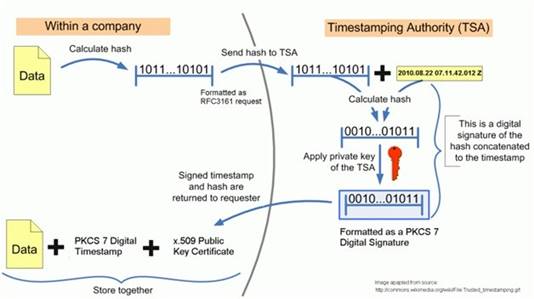
C:\Users\MCS\Desktop\1.jpg Digital TimeStamp
The following are incorrect answers:
Network Time Protocol (NTP) is used to achieve high accuracy time synchronization for computers across a network.
A Certification Authority (CA) is the entity responsible for the issuance of digital certificates. A Digital Signature provides integrity and authentication but does not bind a document to a specific time it was created.
Reference used for this question: http://en.m.wikipedia.org/wiki/File:Trusted_timestamping.gif
and
http://en.wikipedia.org/wiki/Trusted_timestamping
NEW QUESTION 6
Which of the following phases of a system development life-cycle is most concerned with maintaining proper authentication of users and processes to ensure appropriate access control decisions?
- A. Development/acquisition
- B. Implementation
- C. Operation/Maintenance
- D. Initiation
Answer: C
Explanation:
The operation phase of an IT system is concerned with user authentication.
Authentication is the process where a system establishes the validity of a transmission, message, or a means of verifying the eligibility of an individual, process, or machine to carry out a desired action, thereby ensuring that security is not compromised by an untrusted source.
It is essential that adequate authentication be achieved in order to implement security policies and achieve security goals. Additionally, level of trust is always an issue when dealing with cross-domain interactions. The solution is to establish an authentication policy and apply it to cross-domain interactions as required.
Source: STONEBURNER, Gary & al, National Institute of Standards and Technology (NIST), NIST Special Publication 800-27, Engineering Principles for Information Technology Security (A Baseline for Achieving Security), June 2001 (page 15).
NEW QUESTION 7
This baseline sets certain thresholds for specific errors or mistakes allowed and the amount of these occurrences that can take place before it is considered suspicious?
- A. Checkpoint level
- B. Ceiling level
- C. Clipping level
- D. Threshold level
Answer: C
Explanation:
Organizations usually forgive a particular type, number, or pattern of violations, thus permitting a predetermined number of user errors before gathering this data for analysis. An organization attempting to track all violations, without sophisticated statistical computing ability, would be unable to manage the sheer quantity of such data. To make a violation listing effective, a clipping level must be established.
The clipping level establishes a baseline for violation activities that may be normal user errors. Only after this baseline is exceeded is a violation record produced. This solution is particularly effective for small- to medium-sized installations. Organizations with large-scale computing facilities often track all violations and use statistical routines to cull out the minor infractions (e.g., forgetting a password or mistyping it several times).
If the number of violations being tracked becomes unmanageable, the first step in correcting the problems should be to analyze why the condition has occurred. Do users understand how they are to interact with the computer resource? Are the rules too difficult to follow? Violation tracking and analysis can be valuable tools in assisting an organization to develop thorough but useable controls. Once these are in place and records are produced that accurately reflect serious violations, tracking and analysis become the first line of defense. With this procedure, intrusions are discovered before major damage occurs and sometimes early enough to catch the perpetrator. In addition, business protection and preservation are strengthened.
The following answers are incorrect:
All of the other choices presented were simply detractors. The following reference(s) were used for this question:
Handbook of Information Security Management
NEW QUESTION 8
Why does compiled code pose more of a security risk than interpreted code?
- A. Because malicious code can be embedded in compiled code and be difficult to detect.
- B. If the executed compiled code fails, there is a chance it will fail insecurely.
- C. Because compilers are not reliable.
- D. There is no risk difference between interpreted code and compiled code.
Answer: A
Explanation:
From a security standpoint, a compiled program is less desirable than an interpreted one because malicious code can be
resident somewhere in the compiled code, and it is difficult to detect in a very large program.
NEW QUESTION 9
Related to information security, the prevention of the intentional or unintentional unauthorized disclosure of contents is which of the following?
- A. Confidentiality
- B. Integrity
- C. Availability
- D. capability
Answer: A
Explanation:
Confidentiality is the prevention of the intentional or unintentional unauthorized disclosure of contents.
Source: KRUTZ, Ronald L. & VINES, Russel D., The CISSP Prep Guide: Mastering the Ten Domains of Computer Security, 2001, John Wiley & Sons, Page 60.
NEW QUESTION 10
Sensitivity labels are an example of what application control type?
- A. Preventive security controls
- B. Detective security controls
- C. Compensating administrative controls
- D. Preventive accuracy controls
Answer: A
Explanation:
Sensitivity labels are a preventive security application controls, such as are firewalls, reference monitors, traffic padding, encryption, data classification, one-time passwords, contingency planning, separation of development, application and test environments.
The incorrect answers are:
Detective security controls - Intrusion detection systems (IDS), monitoring activities, and audit trails.
Compensating administrative controls - There no such application control. Preventive accuracy controls - data checks, forms, custom screens, validity checks,
contingency planning, and backups. Sources:
KRUTZ, Ronald L. & VINES, Russel D., The CISSP Prep Guide: Mastering the Ten Domains of Computer Security, John Wiley & Sons, 2001, Chapter 7: Applications and Systems Development (page 264).
KRUTZ, Ronald & VINES, Russel, The CISSP Prep Guide: Gold Edition, Wiley Publishing Inc., 2003, Chapter 7: Application Controls, Figure 7.1 (page 360).
NEW QUESTION 11
An access system that grants users only those rights necessary for them to perform their work is operating on which security principle?
- A. Discretionary Access
- B. Least Privilege
- C. Mandatory Access
- D. Separation of Duties
Answer: B
Explanation:
Source: TIPTON, Hal, (ISC)2, Introduction to the CISSP Exam presentation.
NEW QUESTION 12
What protocol is used on the Local Area Network (LAN) to obtain an IP address from it's known MAC address?
- A. Reverse address resolution protocol (RARP)
- B. Address resolution protocol (ARP)
- C. Data link layer
- D. Network address translation (NAT)
Answer: A
Explanation:
The reverse address resolution protocol (RARP) sends out a packet including a MAC address and a request to be informed of the IP address that should be assigned to that MAC.
Diskless workstations do not have a full operating system but have just enough code to know how to boot up and broadcast for an IP address, and they may have a pointer to the server that holds the operating system. The diskless workstation knows its hardware address, so it broadcasts this information so that a listening server can assign it the correct IP address.
As with ARP, Reverse Address Resolution Protocol (RARP) frames go to all systems on the subnet, but only the RARP server responds. Once the RARP server receives this request, it looks in its table to see which IP address matches the broadcast hardware address. The server then sends a message that contains its IP address back to the requesting computer. The system now has an IP address and can function on the network.
The Bootstrap Protocol (BOOTP) was created after RARP to enhance the functionality that RARP provides for diskless workstations. The diskless workstation can receive its IP address, the name server address for future name resolutions, and the default gateway address from the BOOTP server. BOOTP usually provides more functionality to diskless workstations than does RARP.
The evolution of this protocol has unfolded as follows: RARP evolved into BOOTP, which evolved into DHCP.
The following are incorrect answers:
NAT is a tool that is used for masking true IP addresses by employing internal addresses. ARP does the opposite of RARP, it finds the MAC address that maps with an existing IP address.
Data Link layer The Data Link layer is not a protocol; it is represented at layer 2 of the OSI model. In the TCP/IP model, the Data Link and Physical layers are combined into the Network Access layer, which is sometimes called the Link layer or the Network Interface layer.
Reference(s) used for this question:
Harris, Shon (2012-10-25). CISSP All-in-One Exam Guide, 6th Edition, Telecommunications and Network Security, Page 584-585 and also 598. For Kindle users see Kindle Locations 12348-12357. McGraw-Hill.
and
KRUTZ, Ronald L. & VINES, Russel D., The CISSP Prep Guide: Mastering the Ten Domains of Computer Security, John Wiley & Sons, 2001, Chapter 3: Telecommunications and Network Security (page 87).
NEW QUESTION 13
A Wide Area Network (WAN) is basically everything outside of:
- A. a Local Area Network (LAN).
- B. a Campus Area Network (CAN).
- C. a Metropolitan Area Network (MAN).
- D. the Internet.
Answer: A
Explanation:
A WAN is basically everything outside of a LAN.
Source: KRUTZ, Ronald L. & VINES, Russel D., The CISSP Prep Guide: Mastering the Ten Domains of Computer Security, 2001, John Wiley & Sons, Page 99.
NEW QUESTION 14
Which TCSEC level is labeled Controlled Access Protection?
- A. C1
- B. C2
- C. C3
- D. B1
Answer: B
Explanation:
C2 is labeled Controlled Access Protection.
The TCSEC defines four divisions: D, C, B and A where division A has the highest security. Each division represents a significant difference in the trust an individual or organization
can place on the evaluated system. Additionally divisions C, B and A are broken into a series of hierarchical subdivisions called classes: C1, C2, B1, B2, B3 and A1.
Each division and class expands or modifies as indicated the requirements of the immediately prior division or class.
D ?? Minimal protection
Reserved for those systems that have been evaluated but that fail to meet the requirements for a higher division
C ?? Discretionary protection
C1 ?? Discretionary Security Protection Identification and authentication Separation of users and data
Discretionary Access Control (DAC) capable of enforcing access limitations on an individual basis
Required System Documentation and user manuals C2 ?? Controlled Access Protection
More finely grained DAC
Individual accountability through login procedures Audit trails
Object reuse Resource isolation
B ?? Mandatory protection
B1 ?? Labeled Security Protection
Informal statement of the security policy model Data sensitivity labels
Mandatory Access Control (MAC) over selected subjects and objects Label exportation capabilities
All discovered flaws must be removed or otherwise mitigated Design specifications and verification
B2 ?? Structured Protection
Security policy model clearly defined and formally documented DAC and MAC enforcement extended to all subjects and objects
Covert storage channels are analyzed for occurrence and bandwidth Carefully structured into protection-critical and non-protection-critical elements Design and implementation enable more comprehensive testing and review Authentication mechanisms are strengthened
Trusted facility management is provided with administrator and operator segregation Strict configuration management controls are imposed
B3 ?? Security Domains
Satisfies reference monitor requirements
Structured to exclude code not essential to security policy enforcement Significant system engineering directed toward minimizing complexity Security administrator role defined
Audit security-relevant events
Automated imminent intrusion detection, notification, and response Trusted system recovery procedures
Covert timing channels are analyzed for occurrence and bandwidth
An example of such a system is the XTS-300, a precursor to the XTS-400 A ?? Verified protection
A1 ?? Verified Design Functionally identical to B3
Formal design and verification techniques including a formal top-level specification Formal management and distribution procedures
An example of such a system is Honeywell's Secure Communications Processor SCOMP, a precursor to the XTS-400
Beyond A1
System Architecture demonstrates that the requirements of self-protection and completeness for reference monitors have been implemented in the Trusted Computing Base (TCB).
Security Testing automatically generates test-case from the formal top-level specification or formal lower-level specifications.
Formal Specification and Verification is where the TCB is verified down to the source code level, using formal verification methods where feasible.
Trusted Design Environment is where the TCB is designed in a trusted facility with only trusted (cleared) personnel.
The following are incorrect answers: C1 is Discretionary security
C3 does not exists, it is only a detractor
B1 is called Labeled Security Protection.
Reference(s) used for this question:
HARE, Chris, Security management Practices CISSP Open Study Guide, version 1.0, april 1999.
and
AIOv4 Security Architecture and Design (pages 357 - 361) AIOv5 Security Architecture and Design (pages 358 - 362)
NEW QUESTION 15
Which backup method only copies files that have been recently added or changed and also leaves the archive bit unchanged?
- A. Full backup method
- B. Incremental backup method
- C. Fast backup method
- D. Differential backup method
Answer: D
Explanation:
A differential backup is a partial backup that copies a selected file to tape only if the archive bit for that file is turned on, indicating that it has changed since the last full backup. A differential backup leaves the archive bits unchanged on the files it copies.
Source: KRUTZ, Ronald L. & VINES, Russel D., The CISSP Prep Guide: Mastering the Ten Domains of Computer Security, John Wiley & Sons, 2001, Chapter 3: Telecommunications and Network Security (page 69).
Also see: http://e-articles.info/e/a/title/Backup-Types/
Backup software can use or ignore the archive bit in determining which files to back up, and can either turn the archive bit off or leave it unchanged when the backup is complete. How the archive bit is used and manipulated determines what type of backup is done, as follows
Full backup
A full backup, which Microsoft calls a normal backup, backs up every selected file, regardless of the status of the archive bit. When the backup completes, the backup software turns off the archive bit for every file that was backed up. Note that "full" is a misnomer because a full backup backs up only the files you have selected, which may be as little as one directory or even a single file, so in that sense Microsoft's terminology is actually more accurate. Given the choice, full backup is the method to use because all files are on one tape, which makes it much easier to retrieve files from tape when necessary. Relative to partial backups, full backups also increase redundancy because all files are on all tapes. That means that if one tape fails, you may still be able to retrieve a given file from another tape.
Differential backup
A differential backup is a partial backup that copies a selected file to tape only if the archive bit for that file is turned on, indicating that it has changed since the last full backup. A differential backup leaves the archive bits unchanged on the files it copies. Accordingly, any differential backup set contains all files that have changed since the last full backup. A differential backup set run soon after a full backup will contain relatively few files. One run soon before the next full backup is due will contain many files, including those contained on all previous differential backup sets since the last full backup. When you use differential backup, a complete backup set comprises only two tapes or tape sets: the tape that contains the last full backup and the tape that contains the most recent differential backup. Incremental backup
An incremental backup is another form of partial backup. Like differential backups, Incremental Backups copy a selected file to tape only if the archive bit for that file is turned on. Unlike the differential backup, however, the incremental backup clears the archive bits for the files it backs up. An incremental backup set therefore contains only files that have changed since the last full backup or the last incremental backup. If you run an incremental backup daily, files changed on Monday are on the Monday tape, files changed on Tuesday are on the Tuesday tape, and so forth. When you use an incremental backup scheme, a complete backup set comprises the tape that contains the last full backup and all of the tapes that contain every incremental backup done since the last normal backup. The only advantages of incremental backups are that they minimize backup time and keep multiple versions of files that change frequently. The disadvantages are that backed-up files are scattered across multiple tapes, making it difficult to locate any particular file you need to restore, and that there is no redundancy. That is, each file is stored only on one tape.
Full copy backup
A full copy backup (which Microsoft calls a copy backup) is identical to a full backup except for the last step. The full backup finishes by turning off the archive bit on all files that have been backed up. The full copy backup instead leaves the archive bits unchanged. The full copy backup is useful only if you are using a combination of full backups and incremental or differential partial backups. The full copy backup allows you to make a duplicate "full" backup??e.g., for storage offsite, without altering the state of the hard drive you are backing up, which would destroy the integrity of the partial backup rotation.
Some Microsoft backup software provides a bizarre backup method Microsoft calls a daily copy backup. This method ignores the archive bit entirely and instead depends on the date- and timestamp of files to determine which files should be backed up. The problem is, it's quite possible for software to change a file without changing the date- and timestamp, or to change the date- and timestamp without changing the contents of the file. For this reason, we regard the daily copy backup as entirely unreliable and recommend you avoid using it.
NEW QUESTION 16
Which of the following protects a password from eavesdroppers and supports the encryption of communication?
- A. Challenge Handshake Authentication Protocol (CHAP)
- B. Challenge Handshake Identification Protocol (CHIP)
- C. Challenge Handshake Encryption Protocol (CHEP)
- D. Challenge Handshake Substitution Protocol (CHSP)
Answer: A
Explanation:
CHAP: A protocol that uses a three way hanbdshake The server sends the client a challenge which includes a random value(a nonce) to thwart replay attacks. The client responds with the MD5 hash of the nonce and the password.
The authentication is successful if the client's response is the one that the server expected. Reference: Page 450, OIG 2007.
CHAP protects the password from eavesdroppers and supports the encryption of communication.
Reference: KRUTZ, Ronald L. & VINES, Russel D., The CISSP Prep Guide: Mastering the Ten Domains of Computer Security, 2001, John Wiley & Sons, Page 44.
NEW QUESTION 17
Which of the following is an IP address that is private (i.e. reserved for internal networks, and not a valid address to use on the Internet)?
- A. 192.168.42.5
- B. 192.166.42.5
- C. 192.175.42.5
- D. 192.1.42.5
Answer: A
Explanation:
This is a valid Class C reserved address. For Class C, the reserved addresses are 192.168.0.0 - 192.168.255.255.
The private IP address ranges are defined within RFC 1918: RFC 1918 private ip address range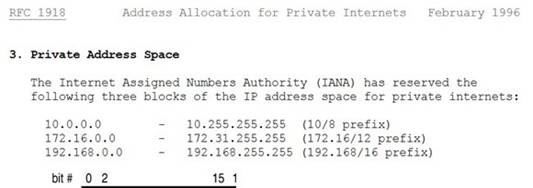
C:\Users\MCS\Desktop\1.jpg
The following answers are incorrect:
192.166.42.5 Is incorrect because it is not a Class C reserved address. 192.175.42.5 Is incorrect because it is not a Class C reserved address.
192.1.42.5 Is incorrect because it is not a Class C reserved address.
NEW QUESTION 18
The computations involved in selecting keys and in enciphering data are complex, and are not practical for manual use. However, using mathematical properties of modular arithmetic and a method known as " ," RSA is quite feasible for computer use.
- A. computing in Galois fields
- B. computing in Gladden fields
- C. computing in Gallipoli fields
- D. computing in Galbraith fields
Answer: A
Explanation:
The computations involved in selecting keys and in enciphering data are complex, and are not practical for manual use. However, using mathematical properties of modular arithmetic and a method known as computing in Galois fields, RSA is quite feasible for computer use.
Source: FITES, Philip E., KRATZ, Martin P., Information Systems Security: A Practitioner's Reference, 1993, Van Nostrand Reinhold, page 44.
NEW QUESTION 19
Which of the following statements pertaining to packet switching is incorrect?
- A. Most data sent today uses digital signals over network employing packet switching.
- B. Messages are divided into packets.
- C. All packets from a message travel through the same route.
- D. Each network node or point examines each packet for routing.
Answer: C
Explanation:
When using packet switching, messages are broken down into packets. Source and destination address are added to each packet so that when passing through a network node, they can be examined and eventually rerouted through different paths as conditions change. All message packets may travel different paths and not arrive in the same order as sent. Packets need to be collected and reassembled into the original message at destination.
Source: TIPTON, Hal, (ISC)2, Introduction to the CISSP Exam presentation.
NEW QUESTION 20
Which type of attack consists of modifying the length and fragmentation offset fields in sequential IP packets?
- A. Teardrop attack
- B. Smurf attack
- C. SYN attack
- D. Buffer overflow attack
Answer: A
Explanation:
A teardrop attack consists of modifying the length and fragmentation offset fields in sequential IP packets so the target system becomes confused and crashes after it receives contradictory instructions on how the fragments are offset on these packets. A SYN attack is when an attacker floods a system with connection requests but does not respond when the target system replies to those requests. A smurf attack is an attack where the attacker spoofs the source IP address in an ICMP ECHO broadcast packet so it seems to have originated at the victim's system, in order to flood it with REPLY packets. A buffer overflow attack occurs when a process receives much more data than expected. Source: KRUTZ, Ronald L. & VINES, Russel D., The CISSP Prep Guide: Mastering the Ten Domains of Computer Security, John Wiley & Sons, 2001, Chapter 3: Telecommunications and Network Security (page 76).
NEW QUESTION 21
What is the greatest danger from DHCP?
- A. An intruder on the network impersonating a DHCP server and thereby misconfiguring the DHCP clients.
- B. Having multiple clients on the same LAN having the same IP address.
- C. Having the wrong router used as the default gateway.
- D. Having the organization's mail server unreachable.
Answer: A
Explanation:
The greatest danger from BootP or DHCP (Dynamic Host Control Protocol) is from an intruder on the network impersonating a DHCP server and thereby misconfiguring the DHCP clients. Other choices are possible consequences of DHCP impersonation.
Source: STREBE, Matthew and PERKINS, Charles, Firewalls 24seven, Sybex 2000, Chapter 4: Sockets and Services from a Security Viewpoint.
NEW QUESTION 22
When you update records in multiple locations or you make a copy of the whole database at a remote location as a way to achieve the proper level of fault-tolerance and redundancy, it is knows as?
- A. Shadowing
- B. Data mirroring
- C. Backup
- D. Archiving
Answer: A
Explanation:
Updating records in multiple locations or copying an entire database to a remote location as a means to ensure the appropriate levels of fault-tolerance and redundancy is known as Database shadowing. Shadowing is the technique in which updates are shadowed in multiple locations. It is like copying the entire database on to a remote location.
Shadow files are an exact live copy of the original active database, allowing you to maintain live duplicates of your production database, which can be brought into production in the event of a hardware failure. They are used for security reasons: should the original database be damaged or incapacitated by hardware problems, the shadow can immediately take over as the primary database. It is therefore important that shadow files do not run on the same server or at least on the same drive as the primary database files.
The following are incorrect answers:
Data mirroring In data storage, disk mirroring is the replication of logical disk volumes onto separate physical hard disks in real time to ensure continuous availability. It is most commonly used in RAID 1. A mirrored volume is a complete logical representation of separate volume copies.
Backups In computing the phrase backup means to copy files to a second medium (a disk or tape) as a precaution in case the first medium fails. One of the cardinal rules in using computers is back up your files regularly. Backups are useful in recovering information or a system in the event of a disaster, else you may be very sorry :-(
Archiving is the storage of data that is not in continual use for historical purposes. It is the process of copying files to a long-term storage medium for backup.
Reference(s) used for this question:
Hernandez CISSP, Steven (2012-12-21). Official (ISC)2 Guide to the CISSP CBK, Third Edition ((ISC)2 Press) (Kindle Locations 27614-27626). Auerbach Publications. Kindle Edition.
http://en.wikipedia.org/wiki/Disk_mirroring http://www.webopedia.com/TERM/A/archive.html http://ibexpert.net/ibe/index.php?n=Doc.DatabaseShadow
NEW QUESTION 23
What ISO/OSI layer do switches primarily operate at?
Do take note that this question makes reference to a plain vanilla switch and not one of the smart switches that is available on the market today.
- A. Physical layer
- B. Network layer
- C. Data link layer
- D. Session layer
Answer: C
Explanation:
Switches primarily operate at the data link layer (layer 2), although intelligent, extremely fast Layer 3 switching techniques are being more frequently used.
Source: KRUTZ, Ronald L. & VINES, Russel D., The CISSP Prep Guide: Mastering the Ten Domains of Computer Security, John Wiley & Sons, 2001, Chapter 3: Telecommunications and Network Security (page 111).
NEW QUESTION 24
......
Recommend!! Get the Full SSCP dumps in VCE and PDF From Dumps-files.com, Welcome to Download: https://www.dumps-files.com/files/SSCP/ (New 1074 Q&As Version)
