
Proper study guides for Leading CompTIA CompTIA Network+ Exam certified begins with CompTIA N10-009 preparation products which designed to deliver the Top Quality N10-009 questions by making you pass the N10-009 test at your first time. Try the free N10-009 demo right now.
Check N10-009 free dumps before getting the full version:
NEW QUESTION 1
An employee reports to a network administrator that internet access is not working. Which of the following should the administrator do FIRST?
- A. Establish a theory of probable cause.
- B. Identify symptoms.
- C. Determine if anything has changed.
- D. Ask the user to restart the computer.
Answer: C
Explanation:
When a user reports that internet access is not working, it is important to first determine if there have been any recent changes to the network or the user's computer that could have caused the issue. This could include changes to the network configuration, the installation of new software or hardware, or other events that could have impacted the user's ability to access the internet. By determining if anything has changed, the administrator can narrow down the possible causes of the issue and focus on addressing the most likely cause.
NEW QUESTION 2
A user reports that a new VoIP phone works properly but the computer that is connected to the phone cannot access any network resources. Which of the following MOST Likely needs to be configured correctly to provide network connectivity to the computer?
- A. Port duplex settings
- B. Port aggregation
- C. ARP settings
- D. VLAN tags
- E. MDIX settings
Answer: D
Explanation:
VLAN (virtual LAN) tags are used to identify packets as belonging to a particular VLAN. VLANs are used to segment a network into logical sub-networks, and each VLAN is assigned a unique VLAN tag. If the VLAN tag is not configured correctly, the computer may not be able to access network resources.
NEW QUESTION 3
A network administrator is reviewing the following metrics from a network management system regarding a switchport. The administrator suspects an issue because users are calling in regards to the switchport's performance: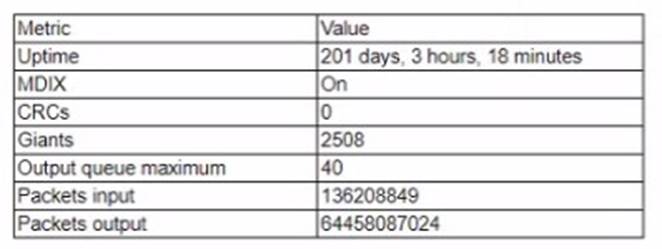
Based on the information in the chart above, which of the following fs the cause of these performance issues?
- A. The connected device is exceeding the configured MTU.
- B. The connected device is sending too many packets
- C. The switchport has been up for too long
- D. The connected device is receiving too many packets.
- E. The switchport does not have enough CRCs
Answer: A
NEW QUESTION 4
Which of the following objectives does an evil twin achieve?
- A. DNS poisoning
- B. Log-in credentials
- C. ARP spoofing
- D. Denial of service
Answer: B
Explanation:
The objective that an evil twin achieves is log-in credentials. An evil twin is a type of rogue access point that mimics a legitimate wireless network by using the same SSID, encryption, and authentication methods. An evil twin can trick unsuspecting users into connecting to it instead of the real network, and then capture their log-in credentials or other sensitive data. An evil twin can also perform man-in-the-middle attacks, redirecting or modifying the user’s traffic. References: CompTIA Network+ N10-008 Certification Study Guide, page 358; The Official CompTIA Network+ Student Guide (Exam N10-008), page 14-1.
NEW QUESTION 5
A network technician needs to ensure outside users are unable to telnet into any of the servers at the datacenter. Which of the following ports should be blocked when checking firewall configuration?
- A. 22
- B. 23
- C. 80
- D. 3389
- E. 8080
Answer: B
Explanation:
Port 23 should be blocked when checking firewall configuration to prevent outside users from telnetting into any of the servers at the datacenter. Port 23 is the default port for Telnet, which is an insecure protocol that allows remote access to servers and network devices. Telnet sends data in clear text, which can be easily intercepted and compromised by attackers. A more secure alternative is SSH, which uses port 22 and encrypts data. References: https://www.cisco.com/c/en/us/support/docs/ip/routing-information-protocol-rip/13788-3.html
NEW QUESTION 6
A network technician is investigating a trouble ticket for a user who does not have network connectivity. All patch cables between the wall jacks and computers in the building were upgraded over the weekend from Cat 5 to Cat 6. The newly installed cable is crimped With a TIA/EIA 568A on one end and a TIA/EIA 568B on the other end. Which of the following should the technician do to most likely fix the issue?
- A. Ensure the switchport has POE enabled.
- B. Crimp the cable as a straight-through cable.
- C. Ensure the switchport has STP enabled.
- D. Crimp the cable as a rollover cable.
Answer: B
Explanation:
Crimping the cable as a straight-through cable is the most likely fix for the issue where users are unable to access any network resources after upgrading from Cat 5 to Cat 6 cables. Crimping is a process of attaching connectors to the ends of cables using a tool called a crimper. A straight-through cable is a type of twisted-pair cable that has the same wiring scheme on both ends, meaning that each pin on one end is connected to the same pin on the other end. A straight-through cable is used to connect devices that operate on different layers of the OSI model, such as a computer and a switch, or a switch and a router. If the newly installed cable is crimped with TIA/EIA 568A on one end and TIA/EIA 568B on the other end, it becomes a crossover cable. A crossover cable is a type of twisted-pair cable that has opposite wiring schemes on both ends, meaning that each pin on one end is connected to a different pin on the other end. A crossover cable is used to connect devices that operate on the same layer of the OSI model, such as two computers or two switches. Using a crossover cable instead of a straight-through cable can cause network communication errors or failures. References: [CompTIA Network+ Certification Exam Objectives], Straight Through vs Crossover Cable: What’s The Difference?
NEW QUESTION 7
A network technician needs to install patch cords from the UTP patch panel to the access switch for a newly occupied set of offices. The patch panel is not labeled for easy jack identification. Which of the following tools provides the easiest way to identify the appropriate patch panel port?
- A. Toner
- B. Laptop
- C. Cable tester
- D. Visual fault locator
Answer: A
Explanation:
A toner is a tool that generates an audible signal that can be traced by a probe. A network technician can use a toner to identify the appropriate patch panel port by connecting the toner to one end of the patch cord and using the probe to scan the patch panel until the signal is detected. A toner is the easiest way to identify the patch panel port when the patch panel is not labeled, as it does not require a laptop, a cable tester, or a visual fault locator.
A toner can also be used to locate breaks or shorts in a cable, or to verify continuity. References:
✑ Using a Toner and Probe - CompTIA Network+ Certification (N10-008): The Total
Course Video
✑ CompTIA Network+ Certification Exam Objectives, page 141
NEW QUESTION 8
A network engineer receives the following when connecting to a switch to configure a port:
Which of the following is the MOST likely cause for the failure?
- A. The network engineer is using the wrong protocol
- B. The network engineer does not have permission to configure the device
- C. SNMP has been secured with an ACL
- D. The switchport the engineer is trying to configure is down
Answer: D
NEW QUESTION 9
After a company installed a new IPS, the network is experiencing speed degradation. A network administrator is troubleshooting the issue and runs a speed test. The results from the different network locations are as follows:
Which of the following is the most likely issue?
- A. Packet loss
- B. Bottlenecking
- C. Channel overlap
- D. Network congestion
Answer: B
Explanation:
The most likely issue is bottlenecking. Bottlenecking occurs when a component or device limits the performance or capacity of the network. In this case, the IPS (intrusion prevention system) may be causing a bottleneck by inspecting and filtering the incoming and outgoing traffic, which reduces the speed and bandwidth available for the network devices12
To confirm this issue, the network administrator can compare the speed test results before and after installing the IPS, and check the IPS configuration and logs for any errors or warnings. The network administrator can also try to bypass the IPS temporarily and run the speed test again to see if there is any improvement3
If the IPS is indeed the cause of the bottleneck, the network administrator can try to optimize the IPS settings, such as adjusting the inspection rules, thresholds, and priorities, to reduce the processing overhead and latency. Alternatively, the network administrator can upgrade the IPS hardware or software, or add more IPS devices to balance the load and increase the throughput45
1: What is Network Congestion? Common Causes and How to Fix Them? -
GeeksforGeeks 2: Network congestion - Wikipedia 3: How to Fix Packet Loss - Lifewire 4: How to Optimize Your IPS Performance - Cisco 5: How to Avoid Network Bottlenecks - TechRepublic
NEW QUESTION 10
A network administrator is working to configure a new device to provide Layer 2 connectivity to various endpoints including several WAPs. Which of the following devices will the administrator MOST likely configure?
- A. WLAN controller
- B. Cable modem
- C. Load balancer
- D. Switch
- E. Hub
Answer: D
Explanation:
A switch is a device that provides Layer 2 connectivity to various endpoints by forwarding frames based on MAC addresses. A switch can also connect to several WAPs (wireless access points) to provide wireless connectivity to wireless devices.
NEW QUESTION 11
An office area contains two PoE-enabled WAPs. After the area was remodeled, new cable uplinks were installed in the ceiling above the fluorescent lights. However, after the WAPs were reconnected, users reported slowness and application errors. An intern reviewed the network and discovered a lot of CRC errors. A network engineer reviewed the intern's work and realized UTP cabling was used. Which of the following is the MOST likely cause of the CRC errors?
- A. Insufficient power at the antennas
- B. PoE and UTP incompatibility
- C. Electromagnetic interference
- D. Wrong cable pinout
Answer: C
Explanation:
"EMI is a problem when cables are installed near electrical devices, such as air conditioners or fluorescent light fixtures. If a network medium is placed close enough to such a device, the signal within the cable might become corrupt. Network media vary in their resistance to the effects of EMI. Standard unshielded twisted-pair (UTP) cable is susceptible to EMI, whereas fiber cable, with its light transmissions, is resistant to EMI. When deciding on a particular medium, consider where it will run and the impact EMI can have on the installation."
NEW QUESTION 12
Which of the following layers of the OSI model receives data from the application layer and converts it into syntax that is readable by other devices on the network?
- A. Layer 1
- B. Layer 3
- C. Layer 6
- D. Layer 7
Answer: C
NEW QUESTION 13
Which of the following is a cost-effective advantage of a split-tunnel VPN?
- A. Web traffic is filtered through a web filter.
- B. More bandwidth is required on the company's internet connection.
- C. Monitoring detects insecure machines on the company's network.
- D. Cloud-based traffic flows outside of the company's network.
Answer: D
Explanation:
A split-tunnel VPN is a configuration where only specific traffic is routed through a VPN, while the remaining data is sent directly over the internet. This can reduce the bandwidth consumption and cost of the company’s internet connection, as cloud-based traffic does not need to pass through the VPN tunnel. A web filter, monitoring, and security are not advantages of a split-tunnel VPN, as they may require all traffic to go through the VPN.
https://www.auvik.com/franklyit/blog/vpn-split-tunneling/
NEW QUESTION 14
An on-call network technician receives an automated email alert stating that a power supply on a firewall has just powered down. Which of the following protocols would best allow for this level of detailed device monitoring?
- A. TFTP
- B. TLS
- C. SSL
- D. SNMP
Answer: D
Explanation:
SNMP stands for Simple Network Management Protocol, and it is a protocol that allows network devices to communicate their status, performance, and configuration information to a central management system. SNMP can be used to monitor and manage various aspects of network devices, such as CPU usage, memory utilization, interface statistics, temperature, voltage, power supply, etc. SNMP can also generate alerts or notifications when certain events or thresholds are reached, such as a power supply failure, a link down, or a high traffic volume. SNMP is widely used for network monitoring and troubleshooting purposes, as it provides a comprehensive and detailed view of the network health and performance.
The other options are not correct because they are not protocols that allow for detailed device monitoring. They are:
✑ TFTP. TFTP stands for Trivial File Transfer Protocol, and it is a protocol that allows for simple and fast file transfer between network devices. TFTP is often used to transfer configuration files, firmware updates, or boot images to network devices, such as routers, switches, or firewalls. TFTP does not provide any monitoring or management capabilities for network devices, nor does it generate any alerts or notifications.
✑ TLS. TLS stands for Transport Layer Security, and it is a protocol that provides encryption and authentication for data transmission over a network. TLS is often used to secure web traffic, email, or other applications that use TCP as the transport protocol. TLS does not provide any monitoring or management capabilities for network devices, nor does it generate any alerts or notifications.
✑ SSL. SSL stands for Secure Sockets Layer, and it is a protocol that provides encryption and authentication for data transmission over a network. SSL is the predecessor of TLS, and it is still used to secure some web traffic, email, or other applications that use TCP as the transport protocol. SSL does not provide any monitoring or management capabilities for network devices, nor does it generate any alerts or notifications.
References1: What is SNMP? - Definition from WhatIs.com2: Network+ (Plus) Certification
| CompTIA IT Certifications3: What is TFTP? - Definition from WhatIs.com4: What is TLS? - Definition from WhatIs.com5: What is SSL? - Definition from WhatIs.com
NEW QUESTION 15
A customer connects a firewall to an ISP router that translates traffic destined for the internet. The customer can connect to the internet but not to the remote site. Which of the following will verify the status of NAT?
- A. tcpdump
- B. nmap
- C. ipconfig
- D. tracert
Answer: A
Explanation:
tcpdump is a command-line tool that can capture and analyze network traffic on a given interface. tcpdump can verify the status of NAT by showing the source and destination IP addresses of the packets before and after they pass through the ISP router that translates traffic destined for the internet. tcpdump can also show the NAT protocol and port numbers used by the router. nmap, ipconfig, and tracert are not suitable tools for verifying the status of NAT, as they do not show the IP address translation process.
References
✑ 1: Network Address Translation – N10-008 CompTIA Network+ : 1.4
✑ 2: CompTIA Network+ N10-008 Certification Study Guide, page 95-96
✑ 3: CompTIA Network+ N10-008 Exam Subnetting Quiz, question 16
✑ 4: CompTIA Network+ N10-008 Certification Practice Test, question 7
NEW QUESTION 16
A network technician wants to deploy a new wireless access point to reduce user latency. Currently, the organization has the following deployed:
Which of the following channels should the new device broadcast on?
- A. Channel 3
- B. Channel 9
- C. Channel 10
- D. Channel 11
Answer: D
Explanation:
The best channel for a new wireless access point is one that does not overlap with the existing channels used by other devices. Overlapping channels can cause interference and degrade the performance of the wireless network. According to the web search results, the 2.4 GHz band has 11 channels in the U.S., but only channels 1, 6, and 11 are non- overlapping. Since the existing devices are using channels 1 and 6, the new device should use channel 11 to avoid adjacent-channel interference12
References1: Why Channels 1, 6 and 11? | MetaGeek 2: How to Choose the Best Wi-Fi Channels for Your Network - Lifewire
NEW QUESTION 17
A company has multiple offices around the world. The computer rooms in some office locations are too warm Dedicated sensors are in each room, but the process of checking each sensor takes a long time. Which of the following options can the company put In place to automate temperature readings with internal resources?
- A. Implement NetFlow.
- B. Hire a programmer to write a script to perform the checks
- C. Utilize ping to measure the response.
- D. Use SNMP with an existing collector server
Answer: D
Explanation:
SNMP (Simple Network Management Protocol) is a protocol that allows network devices to communicate with a management server. By using SNMP, the company can set up an SNMP agent on each sensor, which will report its temperature readings to an existing collector server. This will enable the company to monitor the temperatures of all their sensors in real-time without the need for manual checks. Additionally, SNMP's scalability means that even if the company adds more rooms or sensors, the existing system can be easily expanded to accommodate them.
NEW QUESTION 18
A network engineer is monitoring a fiber uplink to a remote office and notes the uplink has been operating at 100% capacity for a long duration. Which of the following performance metrics is MOST likely to be impacted with sustained link saturation?
- A. Latency
- B. Jitter
- C. Speed
- D. Bandwidth
Answer: A
Explanation:
When a fiber uplink is operating at 100% capacity for an extended period of time, it can cause sustained link saturation. This can impact the network's performance by increasing latency. Latency is the time it takes for a packet to travel from the source to its destination. When there is link saturation, packets may have to wait in a queue before being transmitted, which increases the time it takes for them to reach their destination. As a result, users may experience delays or timeouts when accessing network resources. Other metrics such as jitter, speed, and bandwidth are also important, but they are not as directly impacted by sustained link saturation as latency.
NEW QUESTION 19
Which of the following policies is MOST commonly used for guest captive portals?
- A. AUP
- B. DLP
- C. BYOD
- D. NDA
Answer: A
Explanation:
AUP stands for Acceptable Use Policy, which is a policy that defines the rules and guidelines for using a network or service. A guest captive portal is a web page that requires users to agree to the AUP before accessing the Internet or other network resources. This is a common way to enforce security and legal compliance for guest users. References: https://www.arubanetworks.com/techdocs/Instant_87_WebHelp/Content/instant-ug/captive- portal/captive-portal.htm
NEW QUESTION 20
A network engineer is investigating reports of poor network performance. Upon reviewing a report, the engineer finds that jitter at the office is greater than 10ms on the only WAN connection available. Which of the following would be MOST affected by this statistic?
- A. A VoIP sales call with a customer
- B. An in-office video call with a coworker
- C. Routing table from the ISP
- D. Firewall CPU processing time
Answer: A
Explanation:
A VoIP sales call with a customer would be most affected by jitter greater than 10ms on the WAN connection. Jitter is the variation in delay of packets arriving at the destination. It can cause choppy or distorted audio quality for VoIP applications, especially over WAN links that have limited bandwidth and high latency. The recommended jitter for VoIP is less than 10ms. References: https://www.voip-info.org/voip-jitter/
NEW QUESTION 21
......
P.S. Easily pass N10-009 Exam with 111 Q&As Downloadfreepdf.net Dumps & pdf Version, Welcome to Download the Newest Downloadfreepdf.net N10-009 Dumps: https://www.downloadfreepdf.net/N10-009-pdf-download.html (111 New Questions)
