
we provide Certified Network-Appliance NS0-520 simulations which are the best for clearing NS0-520 test, and to get certified by Network-Appliance NetApp Certified Implementation Engineer - SAN. ONTAP. The NS0-520 Questions & Answers covers all the knowledge points of the real NS0-520 exam. Crack your Network-Appliance NS0-520 Exam with latest dumps, guaranteed!
Check NS0-520 free dumps before getting the full version:
NEW QUESTION 1
Which native GUI switch tool is used to manage Cisco MDS-Series switches and directors?
- A. Operations Manager
- B. Fabric Manager
- C. Web Tools
- D. Data Fabric Manager
Answer: B
NEW QUESTION 2
Exhibit.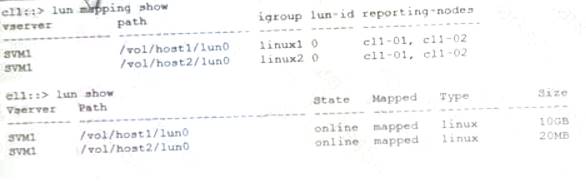
Dining a data mobility test on a 4-node ONTAP 9.3 cluster, the host loses direct access to its LUNs. The LUNs are hosting on node cl1-01 and are being moved to cl1-03 on a different HA pair.
Referring to the exhibit, which corrective step is needed to ensure access while the volume is moved?
- A. Add reporting nodes for cl1-03 and cl1-04.
- B. Create additional LIFs on cl1-01 and cl1-02.
- C. Create a new destination volume on cll-03.
- D. Create new igroups on cl1-03 and cl1-04.
Answer: A
NEW QUESTION 3
A customer is planning to connect a Linux server to a FAS8200 using Brocade FC switches. During the initial configuration, the SVM does not log in to the fabric.
Which two statements are correct in this scenario? (Choose two.)
- A. NPIV has not been enabled on the switches.
- B. The switch port topology is set incorrectly to the E_Port.
- C. ALUA has not been set up on the FAS8200.
- D. Zoning is incorrectly configured between the Linux server and the ONTAP cluster.
Answer: AC
NEW QUESTION 4
Which topology allows for guaranteed maximum network performance for iSCSI?
- A. isolated VLAN network
- B. MetroWAN network
- C. direct connect
- D. WAN network
Answer: C
NEW QUESTION 5
You created a LUN in a new volume on your Netapp ONTAP cluster. You enabled the default snapshot schedule and enabled snapshot autodelete on the volume. In this scenario, in which three situations
does the snapshot autodelete feature automatically delete snapshot copies in the volume? (choose three)
- A. The snapshot reserve space is nearly full
- B. The LUN is nearly full
- C. The overwrite reserve space is full
- D. The volume is nearly full
- E. The aggregate is nearly full
Answer: ACD
Explanation:
Depending on what is selected in the "Trigger" option, Snapshot Autodelete will automatically delete a snapshot when, either the volume space utilized, or the snapshot reserve reaches a threshold capacity
specified below.
Automatic deletion of Snapshot copies from flexible volumes Data ONTAP can automatically delete one or more Snapshot copies on the volume, provided the Data ONTAP Snapshot copy autodeletion
policy is enabled and set to trigger when the overwrite reserve is nearly full on the volume. You can find more information on this link:
https://kb.netapp.com/Advice_and_Troubleshooting/Data_Storage_Software/ONTAP_OS/How_to_use_Snapsh
https://library.netapp.com/ecmdocs/ECMP1217281/html/GUID-98FB8EC4-F3AE-4D25-AF44-E3200AFEB1A
NEW QUESTION 6
You have implemented FabricPool on your AFF ASA ONTAP 9.8 Cluster. An archived database has become very active, and it requires FabricPool adjustments.
Which two steps are required to address this issue? (Choose two)
- A. Use the promote cloud-retrieval-policy
- B. Remove all snapshot copies.
- C. Set the tiering-policy to none
- D. Set the space-guarantee on the volume
Answer: AC
Explanation:
Promoting all data from a FabricPool volume to the performance tier.
You can proactively retrieve all data on a FabricPool volume in the Cloud and promote it to the performance tier.
Use the volume modify command to set tiering-policy to none and cloud-retrieval-policy to promote. You can find more information on this link:
https://docs.netapp.com/ontap-9/index.jsp?topic=%2Fcom.netapp.doc.dot-mgng-stor-tier-fp%2FGUID-45FEF77
NEW QUESTION 7
You have deployed an AFF 400 systems for ISCSI workloads and want to ensure maximum performance to the hosts.
In this scenario, which two steps should be configured? (Choose two)
- A. Enable Jumbo frames on the network switch
- B. Enable Jumbo frames on the LIF
- C. Enable Jumbo frames on the broadcast domain
- D. Enable Jumbo frames on the IPspace
Answer: AC
Explanation:
Changing the Network port settings at the broadcast domain level will change all ports in that broadcast domain sequentially, or one at the time. This will only cause a disruption if the port is a single point of
failure.
Enable jumbo frames (typically MTU of 9000).All devices in the data path, including initiators, targets, and switches, must support jumbo frames. Otherwise, enabling jumbo frames actually reduces network
performance substantially.
You can find more information on this link: https://kb.netapp.com/Advice_and_Troubleshooting/Data_Storage_Software/ONTAP_OS/How_to_enable_jum
NEW QUESTION 8
You upgraded your Linux hosts to SUSE Enterprise Linux 15. In this scenario, which two actions should you perform before you test asymmetric namespace access (ANA)? (Choose two)
- A. Verify if the NVMe service has started
- B. Verify if the LUNs and namespaces are in the same volume.
- C. Verify if the version of Netapp ONTAP software is 9.5 or later
- D. Verify if there is only one LIF in the SVM
Answer: AC
Explanation:
ONTAP 9.5 Introduces ANA
Diagram Description automatically generated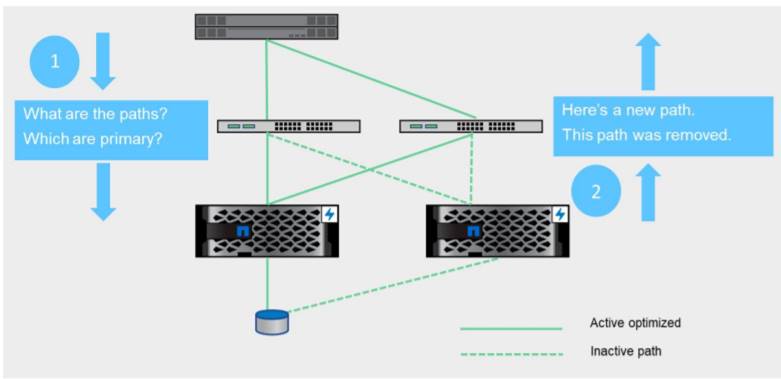
https://www.netapp.com/de/media/10681-tr4684.pdf
NEW QUESTION 9
A customer wants to deploy NVMe/FC along with an existing FC SAN fabric using ONTAP 9.8. In this scenario, which two actions are correct? (choose two)
- A. Use existing zoning on fabric switches
- B. Enable NVMe/FC on the existing FC SVM
- C. Upgrade your FC switches from 16GB to 32GB
- D. Create new zoning on fabric switches
Answer: AB
Explanation:
Because NVMe/FC simply swaps command sets from SCSI to NVMe, it is an easy transition to make.
NVMe/FC uses the same FC transport and therefore the same hardware from the host, through the
switch and all the way to the NVMe/FC target port on the storage array. Thus, NVMe/FC implementations can use existing FC infrastructure, including HBAs, switches, zones, targets, and cabling.
You can find more information on this link: https://www.netapp.com/de/media/10681-tr4684.pdf
NEW QUESTION 10
A customer has an FC host that needs to be attached to the NetApp AFF A700 dual controller storage cluster. To accomplish this task, which three steps should the customer perform? (Choose three.)
- A. Configure the FCP service for the node that has the LUN that is being accessed.
- B. Confirm that the FC HBA driver and firmware is supported according to the Interoperability Matrix Tool (IMT)
- C. Configure portsets to support the availability of multiple paths.
- D. Configure an igroup with the WWPN from the host initiator for LUN access.
- E. Confirm that the switch firmware is supported according to the Interoperability Matrix Tool (IMT).
Answer: CDE
NEW QUESTION 11
A company has 20 ESX hosts. Ten of the hosts are connected using FC, and the rest are connected over iSCSI. The FC host HBA queue depth is set to 32, and the iSCSI LUN queue depth is set to 64. The FC hosts are now experiencing random connectivity issues.
In this scenario, what would be the reason for the disconnects?
- A. The FC host has a lower queue depth.
- B. According to the IMT, unsupported HBA firmware is in use.
- C. All of the hosts are part of the same cluster.
- D. The queue depth is not consistent across the cluster.
Answer: A
NEW QUESTION 12
You create a new iSCSI SVM and secure iSCSI sessions by using both Challenge-Handshake Authentication Protocol (CHAP) and iSCSI Access Control Lists (ACL).
In this scenario, in which two ways are you securing your iSCSI implementation? (Choose two.)
- A. CHAP creates a hash value for the username and shared secret.
- B. iSCSI ACLs are applied to the initiator configuration to provide an IP address of the targets.
- C. CHAP encrypts all iSCSI session I/O.
- D. iSCSI ACLs are applied to the target configuration to provide an IP address of the initiators.
Answer: AD
NEW QUESTION 13
You are planning to install a new AFF All SAN Array A250 system and want to use persistent ports. In this
scenario, what should be identical within the HA pair?
- A. FCP port MTU size
- B. FCP Port
- C. FCP port names
- D. FCP port LIF WWNN-based zoning
Answer: C
Explanation:
Graphical user interface, text, application, email Description automatically generated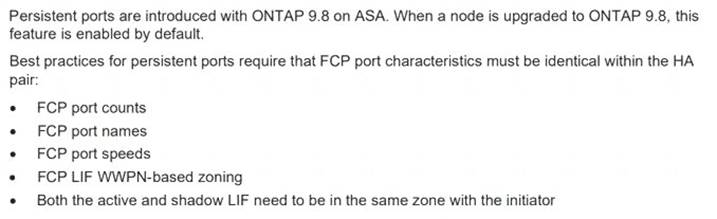
You can find more information on this link: https://www.netapp.com/pdf.html?item=/media/10379-tr4515.pdf&v=20217121554 (11)
NEW QUESTION 14
You have an 8-node AFF A400 ONTAP 9.8 cluster that is serving FC and ISCSI LUNs. You have three SVMs for FC and one SVM for ISCSI, each for separate VMware VSphere clusters. The VMware
clusters are on separate, non-routable, networks. You are asked to set up SnapCenter software for backups of the Virtual machine datastores. What is the minimum management LIF count that is needed to
satisfy this requirement?
- A. four
- B. one
- C. eight
- D. two
Answer: A
Explanation:
You need to configure an SVM management LIF to link it with snapcenter... every SVM will need 1 management LIF minimun and we have 4 SVM
You can find more information on this link:
https://docs.netapp.com/ocsc-44/index.jsp?topic=%2Fcom.netapp.doc.ocsc-isg%2FGUID-5B2FB84B-91E9-430
NEW QUESTION 15
You are about to replace a failed Brocade Fibre Channel switch. Which three steps do you take prior to connecting the switch in the SAN? (Choose three.)
- A. Force the new switch to be the principle switch.
- B. Change the domain ID of the replacement switch to the domain ID of the failed switch.
- C. Clear all zoning configurations on the replacement switch.
- D. Change the core PID format of the replacement switch to the core PID format of the failed switch.
- E. Preload the zoning information from the fabric onto the new switch.
Answer: BCD
NEW QUESTION 16
You have a two node Netapp ONTAP cluster that is hosting FC LUNs for 90 SAN hosts. The hosts are experiencing occasional performance problems and receiving QFULL responses from the cluster
nodes. Which action would solve this issue?
- A. Increase the queue depth on the target ports
- B. Configure additional FC target ports
- C. Increase the queue depth on the initiator ports
- D. Configure additional FC ports on the hosts
Answer: B
Explanation:
Adding more FC initiators on host will not solve this bottle-neck situation, we can try to increase the queue depth but we need the number of hosts and the number of target ports to calculate it correctly.
We need to add more FC target ports on our storage to keep the load balanced and distributed You can find more information on this link
https://docs.netapp.com/ontap-9/index.jsp?topic=%2Fcom.netapp.doc.dot-cm-sanconf%2FGUID-A055B184-08
NEW QUESTION 17
You have a SAN host that is only sending traffic to an ONTAP cluster using active non-optimized paths. In this scenario, over which network type does the node that is hosting the target LUN receive the
traffic?
- A. Fibre Channel network
- B. Cluster network
- C. ISCSI network
- D. Intercluster network
Answer: B
Explanation:
The Cluster Network
This is used for traffic that is going between the nodes themselves, such as system information that is being replicated between the nodes. Also, if incoming client data traffic hits a network port on a different
controller than the one which owns the disks, that traffic will also go over the cluster network.
NEW QUESTION 18
When running diagnostic tests after an initial installation of a NetApp FAS3000 storage system, which command is used to run a comprehensive set of diagnostic tests on the entire system?
- A. all
- B. comprehensive
- C. full
- D. stress
Answer: A
NEW QUESTION 19
......
Recommend!! Get the Full NS0-520 dumps in VCE and PDF From Dumpscollection.com, Welcome to Download: https://www.dumpscollection.net/dumps/NS0-520/ (New 234 Q&As Version)
